

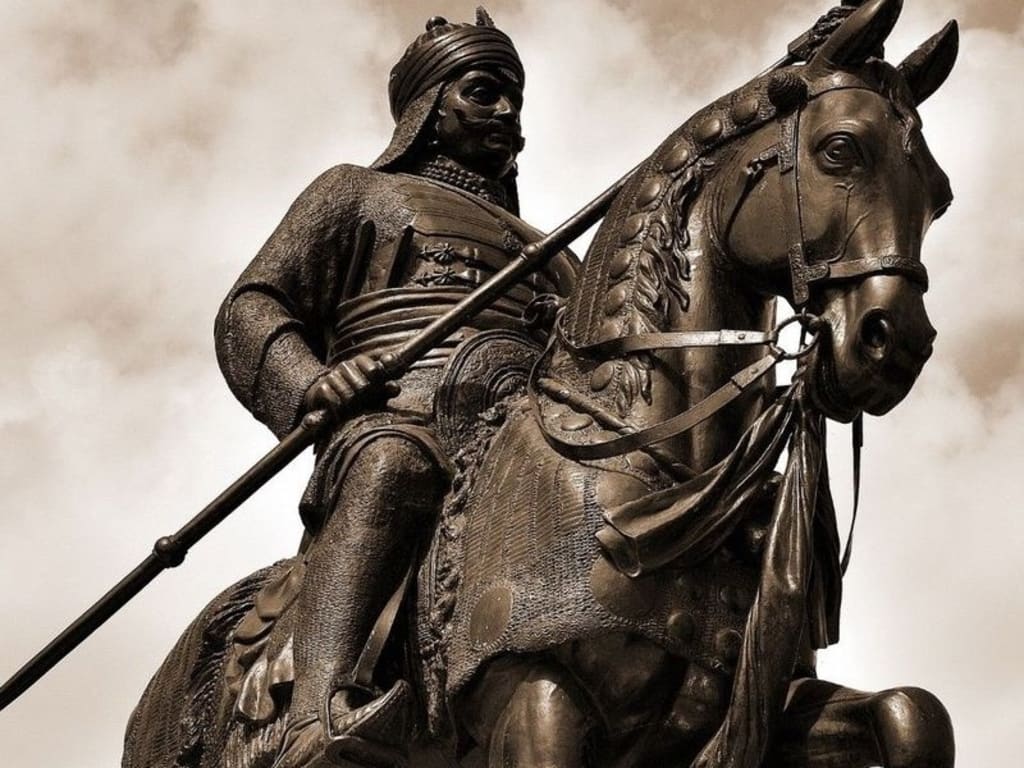
Early Life and Background (1540–1572)
Maharana Pratap was born on May 9, 1540, in Kumbhalgarh, Rajasthan, to Maharana Udai Singh II and Maharani Jaiwanta Bai of the Sisodia Rajput clan. He was the eldest son and heir to the throne of Mewar, a kingdom in present-day Rajasthan. From an early age, Pratap displayed exceptional bravery, leadership, and a deep love for his homeland.
His father, Maharana Udai Singh II, moved the capital from Chittorgarh to Udaipur after repeated Mughal attacks. Despite political pressure, Maharana Pratap vowed to reclaim Chittorgarh and defend Mewar’s independence from Mughal rule.
The Struggle Against the Mughals (1572–1576)
In 1572, after the death of Udai Singh II, Maharana Pratap became the ruler of Mewar. His reign was immediately challenged by Mughal Emperor Akbar, who sought to bring Rajput kingdoms under his control. While many Rajput rulers accepted Akbar’s dominance, Maharana Pratap refused to bow to the Mughals, upholding the spirit of freedom and Rajput honor.
Akbar sent several diplomatic missions urging Pratap to surrender, but he remained steadfast in his resolve. This led to one of the most famous battles in Indian history—the Battle of Haldighati.
The Battle of Haldighati (1576)
The Battle of Haldighati took place on June 18, 1576, between Maharana Pratap’s forces and the Mughal army led by Raja Man Singh, a Rajput general loyal to Akbar.
Maharana Pratap had an army of about 20,000 warriors, while the Mughal forces numbered over 80,000.
The battle was fought in the narrow mountain passes of Haldighati, which Pratap used to his advantage.
Chetak, Maharana Pratap’s loyal horse, played a heroic role, carrying Pratap to safety even after being gravely wounded.
Despite his bravery and guerrilla tactics, Pratap’s army was outnumbered, and he had to retreat. However, the Mughals failed to capture him, and he continued his resistance from the Aravalli Hills, refusing to accept defeat.
Guerrilla Warfare and Resurgence (1576–1597)
Maharana Pratap did not surrender even after losing the Battle of Haldighati. Instead, he adopted guerrilla warfare tactics to harass the Mughal forces and recapture lost territories. With support from his loyal generals and tribal allies, he:
Built secret bases in the dense forests and mountains.
Conducted hit-and-run attacks on Mughal camps.
Created an independent administration and revenue system to sustain his war efforts.
In 1582, he achieved a remarkable victory at the Battle of Dewair, where he regained many forts from the Mughals and established his control over Mewar once again.
Maharana Pratap’s Principles and Governance
Unlike other Rajput rulers who allied with the Mughals, Maharana Pratap remained committed to Rajput pride and sovereignty. He never allowed his kingdom to be annexed and continued to rule with honor, justice, and equality.
He ensured welfare policies for his people, even during wartime.
He formed alliances with local tribes and villagers, who helped in his fight against the Mughals.
He refused to live in palaces and instead lived in the forests with his army, sharing their hardships.
Death and Legacy (1597–Present)
Maharana Pratap passed away on January 19, 1597, at Chavand, due to injuries sustained during his battles. Even on his deathbed, he urged his son, Amar Singh I, to never surrender to the Mughals.
Why is Maharana Pratap Remembered?
He was a symbol of bravery, patriotism, and resistance against foreign rule.
He proved that determination and strategy could challenge even the most powerful empire.
His battle against the Mughals inspired future generations, including India’s freedom fighters.
Even today, Maharana Pratap is honored as a national hero in India. Statues, books, and folk tales continue to celebrate his unbreakable spirit and sacrifice for his motherland.
Conclusion
Maharana Pratap’s life was dedicated to protecting Mewar’s independence and upholding Rajput honor. His courage, resilience, and unyielding love for his land make him one of the greatest warriors in Indian history. His legacy continues to inspire millions, reminding us that freedom is worth any sacrifice.
"Jai Mewar! Jai Maharana Pratap!" 🚩
About the Creator
Keep reading
More stories from Uday Kushwaha and writers in History and other communities.
Indian warrior- Chhatrapati Shivaji Maharaj
Early Life and Childhood (1630–1645) Chhatrapati Shivaji Maharaj was born on February 19, 1630, at Shivneri Fort in present-day Maharashtra. His father, Shahaji Bhonsle, was a respected general serving under the Bijapur Sultanate, while his mother, Jijabai, played a crucial role in shaping his character. She instilled in him the values of bravery, dharma (righteousness), and self-rule (Swarajya). From a young age, Shivaji showed exceptional leadership qualities and was deeply inspired by tales of Ramayana, Mahabharata, and historical warriors.
By Uday Kushwaha12 months ago in History
The Day the Rope Broke
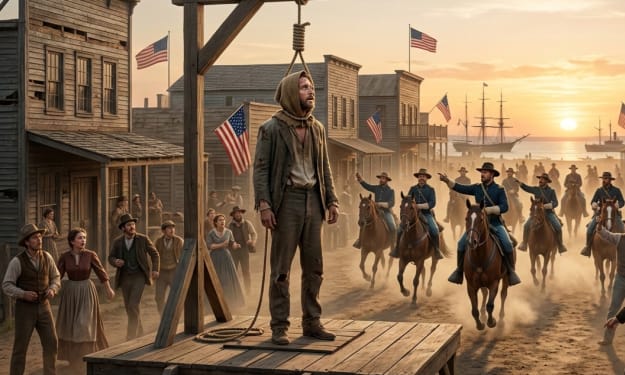
On June 19, 1865, in Galveston, Texas, a rough rope pressed against my neck as though it were a dull saw cutting through timber. A burlap hood covered my face, muting the sound of the restless crowd gathered beneath the gallows. Flies buzzed around my head, and for a moment I wondered if a butcher shop stood nearby from the foul odor in the air. Then I realized the smell came from my own bruised and bloodied body. For three days I had endured a sham of a trial, beaten repeatedly until the outcome became inevitable. I felt no regret. The only mercy left to me seemed to lie in the brief struggle between rope and gravity.
By LUNA EDITH5 days ago in History
A More Human Vocal
When we launched Vocal nearly a decade ago, the world was a very different place. LLMs did not exist, and stories were created one at a time by people sitting down to write, revise, and share something personal. Many of our assumptions about publishing, trust, and participation were built for a world where effort and output were inseparable.
By Justin @ Vocal5 days ago in Resources



Comments
There are no comments for this story
Be the first to respond and start the conversation.