
The love story of Shah Jahan and Mumtaz Mahal is one of the most famous tales of love and devotion in history. Shah Jahan, whose full name was Khurram Shihab-ud-din Muhammad Shah Jahan, was the fifth Mughal emperor of India, ruling from 1628 to 1658.
Mumtaz Mahal, originally named Arjumand Banu Begum, was born into a Persian noble family. She was renowned for her beauty, intelligence, and grace. In 1612, at the age of 19, she married Shah Jahan, who was then known as Prince Khurram. Their marriage was a love match, which was quite unusual for royal marriages of that time.
Mumtaz Mahal quickly became Shah Jahan's favorite wife and an influential figure in his court. She accompanied him on his military campaigns and actively participated in political affairs. Mumtaz Mahal was not only a loving wife but also a trusted advisor to the emperor.
The couple had a deep and passionate bond. Mumtaz Mahal bore Shah Jahan 14 children, and she was constantly by his side, providing support and counsel. Shah Jahan was known to consult her on important matters, and her opinions held great weight in his decision-making.
Tragically, Mumtaz Mahal passed away on June 17, 1631, while giving birth to their 14th child. The loss of Mumtaz Mahal devastated Shah Jahan, and he was said to be inconsolable with grief. He went into a period of mourning, during which he withdrew from public life and immersed himself in the construction of a grand mausoleum in her honor—the Taj Mahal.
The Taj Mahal, with its opulent beauty and grandeur, stands as a testament to Shah Jahan's undying love for Mumtaz Mahal. It is believed that Shah Jahan himself played a significant role in the design and planning of the mausoleum, ensuring that it reflected the depth of his love and the magnificence of his wife.
The Taj Mahal became Mumtaz Mahal's final resting place, and it is considered her eternal abode. Shah Jahan's own tomb was later placed beside hers, as he desired to be reunited with his beloved wife in the afterlife.
The love story of Shah Jahan and Mumtaz Mahal has captured the hearts of people for centuries, and the Taj Mahal stands as a symbol of their eternal love and devotion. It is an enduring legacy that has made their names immortalized in history.
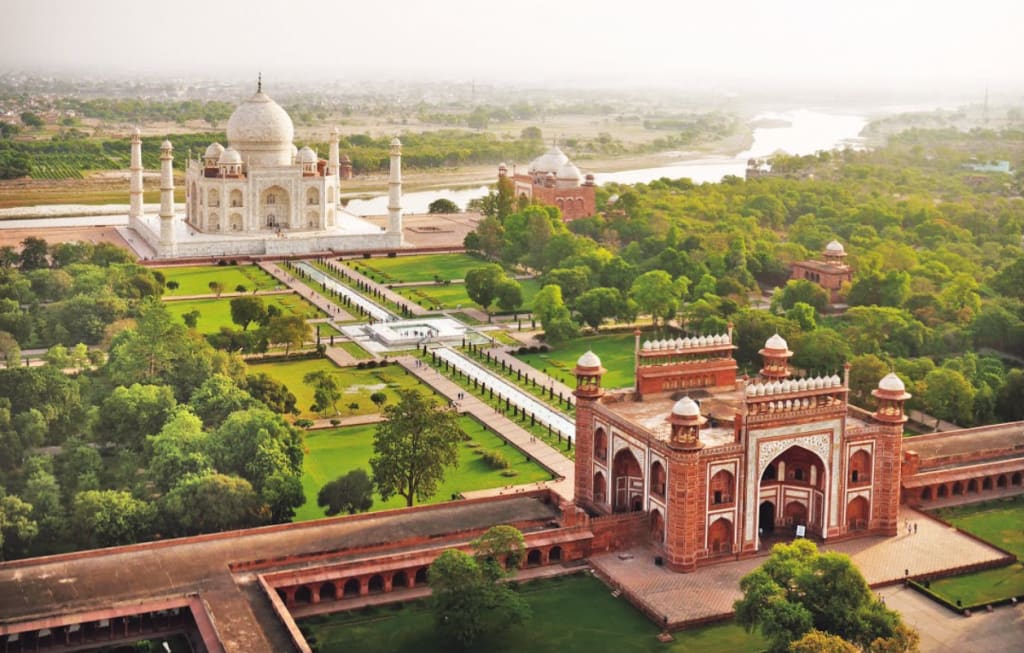
The Taj Mahal is an iconic mausoleum located in Agra, Uttar Pradesh, India. It was commissioned by the Mughal emperor Shah Jahan in memory of his beloved wife, Mumtaz Mahal. The construction of the Taj Mahal began in 1632 and was completed in 1648, employing thousands of artisans, architects, and laborers.
Devastated by the loss, Shah Jahan decided to build an exquisite monument to honor the memory of his beloved wife. The Taj Mahal was constructed on the southern bank of the Yamuna River, in a large garden complex. The mausoleum itself is made of white marble and is surrounded by several other structures, including a mosque, a guesthouse, and formal gardens.
The construction of the Taj Mahal involved the work of skilled architects, calligraphers, craftsmen, and artisans from various regions of the Mughal Empire and beyond. It is considered a masterpiece of Mughal architecture, blending elements of Persian, Islamic, and Indian styles.
The Taj Mahal is renowned for its symmetrical design, exquisite marble inlays, intricate carvings, and delicate detailing. It is particularly famous for its grand dome, which is adorned with a decorative finial and is a prominent feature of the monument's silhouette.
The Taj Mahal stands as a symbol of eternal love and is often described as one of the most beautiful buildings in the world. It has become a UNESCO World Heritage Site and attracts millions of visitors from around the globe, who come to admire its stunning architecture and immerse themselves in its romantic history.
About the Creator
Savoy Hotel – Mussoorie: The Colonial Luxury Hotel Where an Unsolved Murder Still Walks the Corridors
The First Night: Beauty Wrapped in Silence Mussoorie looks peaceful from a distance. Pine trees sway gently, clouds roll like slow-moving waves, and the hill air smells of rain and old earth. But as evening falls, the silence becomes heavier—almost watchful.
By Gaurav Gupta3 days ago in History
Is NATO Facing Its Biggest Crisis Yet?
Is NATO Facing Its Biggest Crisis Yet? For more than seventy years, NATO has been one of the strongest military alliances in the world. Formed after World War II, it was designed to protect its members through collective defense. An attack on one was considered an attack on all. For decades, this principle helped maintain stability in Europe and beyond. But today, NATO is facing one of the most challenging moments in its history.
By Wings of Time 7 days ago in History
Silver Screen Magic with Mae West
American actress and singer Mae West became a popular film actress during the Great Depression. She started entertaining in vaudeville, then performed on Broadway, and finally went to Hollywood. She signed up with Paramount Pictures and made her debut in the 1932 film “Night After Night.” She also starred in musicals, comedies, and crime dramas. The American Film Institute named her one of the best classic Hollywood actresses.
By Rasma Raisters5 days ago in Geeks


Comments
There are no comments for this story
Be the first to respond and start the conversation.