
London's great but ill-fated Alexander Palace
What is the secret of this palace?


On July 10, 1980, the second major fire at London's Alexander Palace was also shrouded in mystery. There is a veil of superstition and appearances. Insurance company executives, firemen, and policemen are still baffled as to what could have happened at Ali Pali to turn it into an inferno for the second time. This palace is also called Ali Pali.
It would be a great Socratic irony or ignorance to say that when Queen Victoria inaugurated it 133 years ago in 1873, only 16 days later, this palace was destroyed by fire. The exact cause of the fire was not known, although it was known to have started in the dome of the palace. At the same time, Alexander Palace was completed, isolated on a hilltop in North London. It seems that disaster was written in his destiny from that time on. Some believe that the ancient footpath was destroyed when part of the castle, the Great Hall, was built on the other side, and it is recorded in the Burroughs Castle Museum's Totton Hume historical documents that the old wooden casket stated that due to a permanent curse, the place where Alexander's palace is located will continue to suffer, i.e., destruction was written in his fate, and his story was as follows:
The construction of the palace required the banishment of an old woman who was believed to be a witch and lived on a hilltop. The woman became so angry that she placed an eternal curse on him, whatever the creature might be, and it appeared that the witch's curse might be true. This palace was built in 1875, and it is well known that in the last hundred years, it has been a financial headache for all who ventured there. It was closed entirely from 1889 to 1898, and a second attempt to reopen after that bankrupted the owners.

London's largest council finally took over the management and maintenance of this public palace. Then, in January 1980, it was sold to Haringey Council for the nominal sum of one pound, with expenses for its decoration. The ill-fated palace was in perfect condition at the time of the new beginning, and then on July 10, 1980, smoke began to billow undetectably from the Great Hall entrance. within minutes, the flames shot up and spread across the roof, which Londoners could see from 11 kilometers away.
On September 25, 1980, under the prying eyes of the Haringey Council, eight psychics were hired to go into altered states of consciousness and try to find an explanation for what caused the fire. due to which a large part of the hall was lost. They established the symmetrical circle between the remains of wrought iron pillars that once supported the arches of the Great Hall. Occultists claimed to have contacted spirits who told them that the four elements—fire, water, air, and earth—were out of balance in the palace. All agreed that the fire had dispelled all the negative vibrations that had arisen there. They all came to the conclusion that all would be well if a new passage was built through the palace, and the balance of the elements would be achieved if seven copper rods were buried on the floor of the new building. Councilor Terry O'Sullivan, who chairs the Haringey Alexander Palace and Parks Committee, said: "These occultists have provided some new insight." "The route of the trail is already under consideration, but the question of the seven copper bars will have to come before the committee."
Whether the public palace was the victim of a curse or caused an imbalance in the elements, it appears that the council must have taken the advice of the occultists very seriously. The English people were very superstitious in the past and believed in magic, tricks, and witchcraft, but despite being so modern, they still believed in supernatural powers.
About the Creator
Umair Amjad Kayani
I am a Professor of English Literature and Language as well as I am a Content Writer and writing is not only my Profession but also my Passion.
Keep reading
More stories from Umair Amjad Kayani and writers in History and other communities.
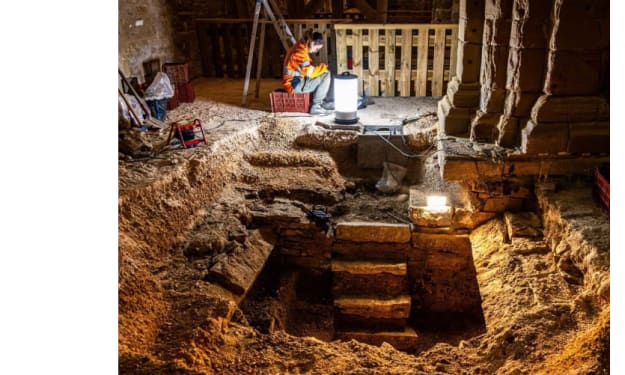
A secret staircase found beneath a 1,500-year-old French church
A subterranean staircase and burial strata dating back approximately 1,500 years were discovered during a project inside the Church of Saint Philibert in Dijon, France. The stairs were discovered by restoration workers inside the church when repairs were being made, and the excavation soon ensued.
By Francis Dami4 days ago in History
Martin Luther King's 'I Have a Dream' Speech: Things People Still Don't Know
Former President Ronald Reagan declared the third Monday in January to be Martin Luther King Jr. Day to celebrate the slain civil rights activist. Had he lived, he would be celebrating his birthday at age 97 on January 15, 2026, but he was assassinated at the young age of 39 on April 4, 1968.
By Margaret Minnicksabout 20 hours ago in History



Comments
There are no comments for this story
Be the first to respond and start the conversation.