
London in Roman Times
All roads led to Londinium

One of the many lessons you can gleam from the study of history is that everything starts out small. Rome became an empire which reshaped the Mediterranean but, for centuries, it was a backwater city with no real importance. As the saying goes, ‘Rome wasn’t built in a day’ and neither, for that matter, was London. Today, London is one of the most prominent and well known cities in the world. It’s an economic and cultural centre, which sees, on average, 30 million visitors each year.
This would come as something of a shock to the Romans who founded ‘Londinium’. They had set it up purely to have a defensible supply route back to continental Europe. Their invasion of Britain in 43 AD wasn’t the first time they’d tried to invade, but it was the attempt which stuck. Rome held the view that any war they waged must be a ‘just’ war in order to retain the support of the gods. But their extensive empire shows that they bent this justification like it owed them money. In this case, they were attacking in’defence’ of British tribal leader Vericus, who had been forced out of his kingdom. As General Plautius’s forces advanced north, they reached the River Thames. In his accounts of his failed invasions of 55 and 54 BC, Julius Caesar had noted that the river had limited places where it could be safely forded. Combined with the fact that the area was too far from the main bases of the local tribes for them to easily defend it, this became the perfect spot for the Romans to set up shop.
So, as often happens, a new settlement sprang up around a river. It started with a bridge for easy crossing of the river. Such a strategically important structure needed engineers to maintain it, and soldiers to defend it, so a small settlement was built around it. This settlement’s importance as a supply line to and from Britain meant that it was maintained and expanded. After four years, the Romans decided to make the settlement permanent and named it ‘Londinium’.
This ‘first’ Londinium lasted a grand total of 13 years before Queen Boudica of the Iceni tribe rose up in rebellion in 60 AD. Her husband, Prasutagus, had been a ‘client ruler’; a local leader who was allowed to keep his position on the understanding that he acknowledged Roman rule, and that his lands would pass into direct Roman control upon his death. However, Prasutagus, as he was dying, decided that he wanted to divide control of his lands between Rome and his wife. The Roman response to this was (according to Roman historian Tacitus), to seize the lands anyway, while having Boudica flogged and her daughters raped. Understandably ‘apocalyptically’ furious about this, Boudica lead the Iceni in rebellion alongside the neighbouring Trinovantes tribe. Camulodunum (Colchester) was destroyed first, before Boudica’s forces descended upon Londinium; destroying the town and slaughtering all of the population who hadn’t fled. Verulamium (St Albans) was also wiped out before Boudica and her forces were finally defeated.
However, Londinium was too important for Roman control of Britain to be left a ruin. So it was rebuilt; this time, built in the typical style of a Roman city. This included the standard grid system layout, as well as many grand buildings for the various officials who lived there. Around 120 AD, a stone fort was built to the north-west of the city to accommodate the many soldiers which would pass through Londinium. The city would continue to expand and add new buildings. A great flourish of building and repair took place in 122AD, when Emperor Hadrian visited. Londinium would continue to expand during Hadrian’s reign, with new additions such as a stone amphitheatre, public baths, temples and many others.
Like a lot of things in life, how much a settlement flourishes comes down to location. Londinium was founded out of strategic necessity as a defendable position which controlled easy crossing of the Thames. But, as already pointed out, its position also made it perfect for trade with the continent. Few things boost a city like trade, and (for most of human history) nothing boosted trade like the easy transport a river could provide. And, where there are goods and raw materials, there will be people who make things out of them. Workshops popped up in Londinium to do just that.
But, lest we forget, this earliest form of London is a world away from the version we know today. And progress over the centuries is never a straight line upwards. With the rises, also come the falls. Under the Romans, Londinium hit its peak with a population of between 45,000 to 60,000 during the second century AD. It would enjoy relatively quiet prosperity over the next few centuries. However, this prosperity depended on the continued presence of the Romans. Unfortunately, Rome’s military presence would begin to decline from the end of the 4th century as political strife required the troops stationed on the Empire’s borders. With the increasing disconnect between Roman Britain and the increasingly fragmented Empire, Londinium’s glory and importance would begin to see a sharp decline.
But that’s a story for another time.
About the Creator
Keep reading
More stories from Joseph Morgan and writers in History and other communities.
Myths About Bullying
Bullying is, regrettably, a reality that many people of all ages still have to deal with. It’s not something that everyone grows out of. But school is a time of our lives where we’re likely to have to deal at least some bullies. It’s a deeply complex issue with a wide variety of different factors, so I’m assuming you won’t have started to read this with any expectation that I will be ‘solving’ bullying over the course of this short blog post. I certainly hope not, as I don’t like my odds of solving an issue that’s been ongoing about as long as humans have been socializing. Reducing the presence and impact of bullying is a challenge which needs to be dealt with gradually over generations.
By Joseph Morganabout a year ago in Education
What Would World War III Look Like Today?
What Would World War III Look Like Today? When people imagine World War III, many still picture massive armies, tanks rolling across borders, and cities reduced to rubble by bombs. While traditional warfare would still play a role, a modern world war would look very different from the conflicts of the 20th century. Advances in technology, global interdependence, and new forms of power have changed how wars are fought—and how they affect the world.
By Wings of Time 7 days ago in History
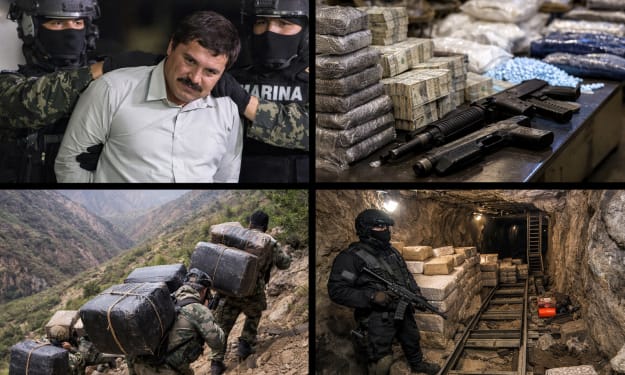
El Chapo
Joaquín “El Chapo” Guzmán and the Sinaloa Cartel Joaquín Archivaldo Guzmán Loera, widely known by his nickname “El Chapo,” is one of the most infamous figures in the history of organized crime. He rose from extreme poverty in rural Mexico to become the leader of the Sinaloa Cartel, an organization that for decades played a central role in international drug trafficking. The story of El Chapo and the Sinaloa Cartel reflects broader issues such as corruption, inequality, weak institutions, and the global demand for illegal drugs.
By jhony aour4 days ago in History



Comments