
Lines in the Sand - Israel’s International Law Violations in Post-Assad Syria
Think-tanks retreat as Israel moves in to exploit the aftermath of the dictator dynasty’s fall.

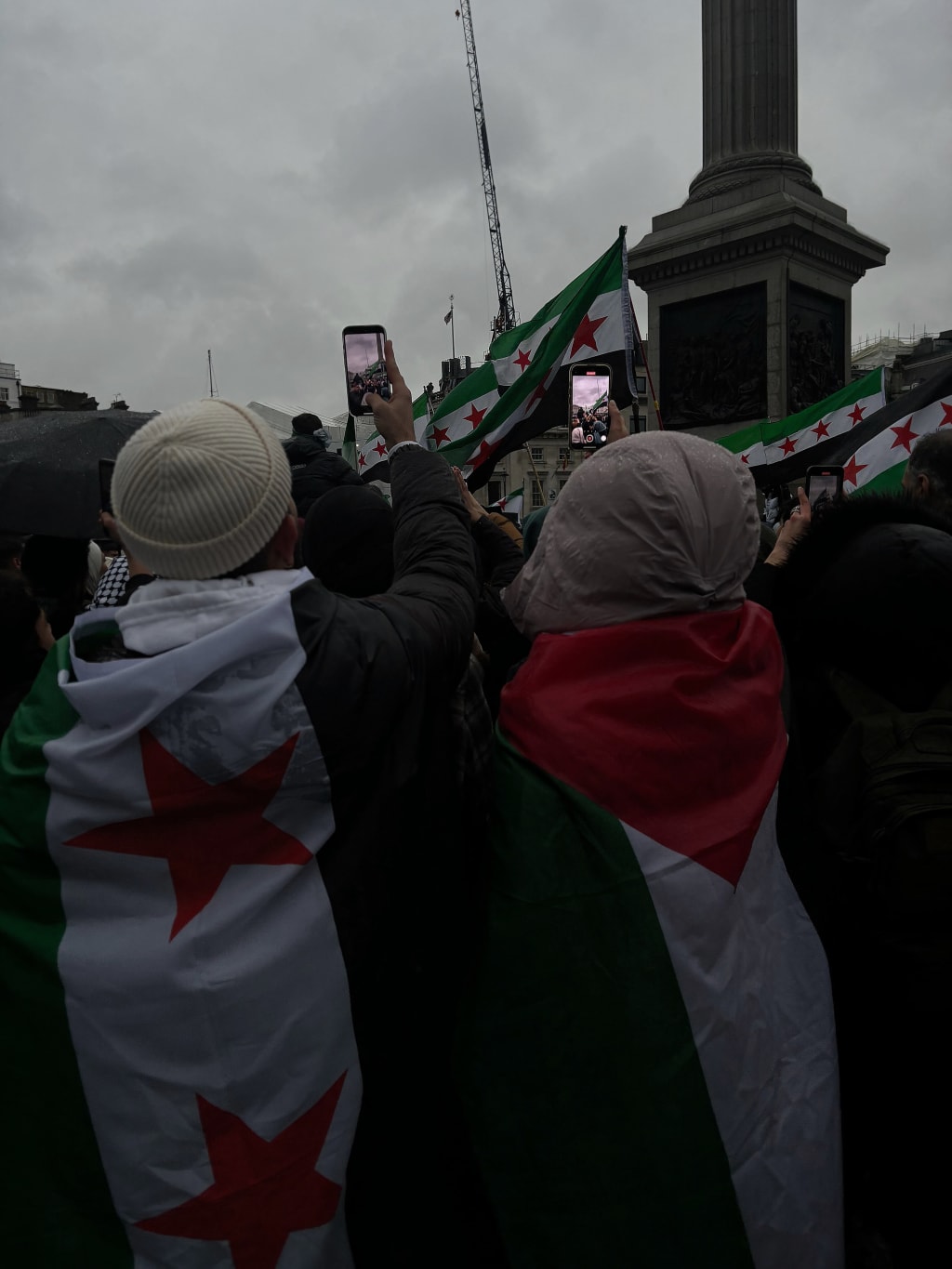
The night the Assad regime finally crumbled was one of the most joyous moments in recent history. Syrians took to the streets, finally able to breathe, to tear down and tear apart the statues of the dictator and his father. The seven million-strong diaspora and their friends around the words did not sleep a wink. Even once it was confirmed that Assad fled the country, and that the PM Ghazi al-Jalali announced he will cooperate with HTS, we could not believe it was over.
Over five decades of dictatorship and 14 years of civil war left one of the cradles of civilisation in ruins. From a pre-war population of 22 million, the Syrian Observatory for Human Rights has recorded the identities of 507,567 souls lost, with further confirmed 110,343 stripped even of their names. Near 50,000 were killed in a notorious network of Assad’s torture prisons, and the full scope of their horrors will continue to emerge for months. Over 8,700 were victims of Russian strikes, the beginning of which marked the end of all optimism for many Syrians. The deaths caused by the International Coalition could not be documented due to extreme secrecy covering their missions.
13 million Syrians were displaced. 6.7 million were forced to flee their homeland.
Eastern Ghouta was one of the most fought over regions of the civil war, and in the early hours of 21 August 2013, Assad’s regime dosed it in sarin. This was Obama’s ‘red line,’ but you can hide a lot of US red lines under Arab blood. On 7 April 2018, a Syrian citizen Tawfiq Diam lost his wife and 4 young children in another chemical attack. In a BBC interview he gave 3 days after the regime fall, he noted: ‘[i]f I'd spoken out before, Bashar al-Assad's forces would have cut off my tongue.’
There is no justification for the terror of Assad. Whoever claims there is does not fight the same fight. And Assad was never an ally to the Palestinian cause in anything but calculated statements.
However, this does not mean that Israel is not Syria’s enemy.
The colony moved immediately into the Golan Heights, a region rich in resources and perched above Syria, captured with in 1967 during the Six Day War regardless of broad international condemnation. While the unanimously adopted UN Security Council Resolution 242 called upon Israel to withdraw, Tel Aviv’s strategic interests in this territory have not waned. In fact, recent developments suggest that Israel is not only securing its hold on the Golan, but seeks to expand settlements in the area at any cost.
Syria is now a territory of three armed groups: the Hayat Tahrir al-Sham (HTS) who chased Assad out, set up in 2011 in affiliation with Al-Qaeda; the Syrian Democratic Forces, a chiefly Kurdish militia instrumental in the fall of ISIS; and Israel. All three are aided by the US.
Syria’s new political reality is incredibly fragile. The HTS is a complex actor, and there are reasons for both optimism and horror.
The front on which they are demonstrably failing is Golan Heights.
Despite widespread condemnation of the initial occupation, Israel has maintained its control over the region, building settlements and reinforcing its military presence. In 1981, it passed the Golan Heights Law, effectively annexing the region, a move that was met with widespread international rejection and declared ‘null and void’ by the United Nations Security Council Resolution 497.
The international community, while largely recognizing the Golan as Syrian territory under international law, has been divided on how to address Israel’s continued presence. The United States, under the Trump administration, notably broke with international consensus in 2019. ‘All Israelis were deeply moved when President Trump made his historic decision,’ Netanyahu noted then. ‘After the Passover holiday I intend to bring to the government a resolution calling for a new community on the Golan Heights named after President Donald J. Trump.’
Following the fall of the Assad dynasty, Israel targeted 61 sites in Syria on the night of 15 December. The aerial campaign raised alarm among international officials about Tel Aviv’s potential long-term occupation of Syrian territory, and its broader agenda of the Syrian buffer zone extending far beyond not only the 1949 Armistice Line, but even past the demilitarised zone established by the UN in 1974 following the Yom Kippur war.
As always, Israel justified the move by reference to its strategic security interest. The apartheid state realised long ago that it does not need to try to hide its colonial ambition anymore. The UN, echoed by, inter alia, Egypt, France, Spain and even Germany, condemned IDF’s operations in the region and called for withdrawal. The Syrian Observatory for Human Rights reported that recent strikes were among the most intense since Israel’s operations began in 2012.
As Netanyahu endorsed a plan to double the population of the Golan Heights, the international condemnation is mounting. Turkey called it an effort to expand Israeli borders and a serious threat to Syria’s stability.
Germany emphasized that under international law, the Golan Heights belong to Syria. In the context of this territory, under article 42 of the 1907 Hague Regulations, Israel became an occupying power in 1967, placing it ‘under the authority of the hostile army.’ The continued settlement and military presence in the area are therefore subject to the rules governing the conduct of occupying powers.
This determination in turn triggers the Fourth Geneva Convention (1949), which addresses protections of civilians within war and occupation. Article 49 thereof instructs that ‘[t]he Occupying Power shall not deport or transfer parts of its own civilian population into the territory it occupies.’ This provision builds upon an earlier framework established by the 1933 Montevideo Convention, which prohibits an occupying power from making changes to the status quo of the territory beyond military necessity.
Israel’s settlement agenda in the Golan Heights stands in clear violation, and its impact would also contradict Article 55, prohibiting the occupation from exploiting the resources of the occupied territory. This is especially despicable given Syria’s resource shortage, including food and water with 3 million people severely food insecure.
The UN condemned Israel’s imperialist ambition in the region for decades, including the above mentioned Resolutions 242 in 1967 and 497 in 1981. In the latter, ‘[t]he Security Council… [reaffirms] that the Israeli decision to impose its laws, jurisdiction and administration in the Syrian Golan Heights is null and void and has no international legal effect.’
The 2012 UN General Assembly Resolution 67/19, granting Palestine non-member observer status at the UN, reaffirms the sovereignty of territories occupied by Israel, including the Golan Heights. In 2016, UN SC Resolution 2334 focusing on Israeli settlements in the West Bank and East Jerusalem, occupied Palestinian land, reiterates Israel’s continued disregard for international law, as addressed in great detail by the ICJ in 2004 in its advisory opinion on the Israeli barrier construction in the West Bank.
All credibility of Israel’s appeal to the right to self-defence under Article 51 of the UN Charter is rotting in the mass graves in Gaza. Under Article 2(4) of the same foundational document, the use of force to acquire territory is prohibited.
Occupation does not bestow sovereignty over the occupied territory; therefore, an occupier cannot invoke self-defense to justify the annexation of that territory. Israel's actions in the Golan Heights, particularly the settlement and military occupation, are in violation of this fundamental prohibition against the acquisition of territory by force.
Just as with the occupation of Palestinian territory starting in 1948, the international legal order has consistently called upon Israel to end its terror campaign. With the most recent chapter of its violence, by now engulfing Gaza, the West Bank, Lebanon, Syria, Yemen and Iraq, it is high time for the heads of states that continue to materially aid it to act. Unsuccessful in its attempt to crush Lebanon, and in its final stages of destruction of Gaza, Israel yet again proves it seeks nothing but total domination of the region.
Post-Assad Syria is a source of great opportunity for its people, and the millions now hoping to call it their hope again. It will face enormous internal challenges, as well as external pressures. Many are already becoming apparent. The true depth of depravity of the fallen regime of the Syrian refugee Bashar Al-Assad will also continue to emerge. On the evening of 7 December, thousands of Syrians, later followed by humanitarian aid organisations, swarmed the Sednaya prison in the mountains north of the capital. The search for their loved ones brings the most harrowing findings. Mazen al-Hamada became a symbol of the heart-break. The prominent pro-democracy activist who alerted the world to incomprehensible violence that he and other detainees experienced at the hands of the regime did not survive to celebrate the government’s fall. He was tortured to death in the ‘Human Slaughterhouse’ nicknamed facility.
Syria needs peace, and time to grieve and rebuilt a civilian-led state. What it is getting instead is 800 bombs from US-backed colony on its increasingly unstable western border.
Marija Carter LLM MSc
About the Creator
Marija Carter
International Law
Keep reading
More stories from writers in History and other communities.
De-Globalization or Re-Globalization? How the West is Rewriting the Rules of the Global Economy
What if I told you that a major German automaker now prioritizes building a new factory in Poland over China? Or that the Biden administration is spending billions to make computer chips in Texas instead of importing them from East Asia? This isn't a hypothetical future—it's today's economic reality.
By Hossam Gamal3 days ago in History
King Arthur – The Once and Future King
In the mist-covered hills of ancient Britain, when the land was divided by warring kings and haunted by uncertainty, a prophecy was whispered across the kingdoms: a child would be born who would unite the realm and bring peace. That child was Arthur. Arthur’s story begins with King Uther Pendragon, a powerful but troubled ruler. Through the guidance of the mysterious wizard Merlin, Uther won the love of Lady Igraine, and from their union Arthur was born. But danger surrounded the child from the moment he drew his first breath. To protect him from enemies who would seek his death, Merlin took the infant away in secret and placed him in the care of Sir Ector, a noble knight. Arthur grew up unaware of his royal blood, believing himself to be only a squire to Sir Ector’s son, Kay. Years passed, and Britain fell into chaos after King Uther’s death. Without a clear heir, rival lords fought bitterly for control. Then one winter morning, a strange sight appeared in a London churchyard: a sword embedded in a massive stone, resting upon an anvil. Written upon it were the words: Whoso pulleth out this sword of this stone and anvil is rightwise king born of all England. Many knights tried to pull the sword free. They strained, sweated, and cursed—but none could move it. The sword remained firm, as if the stone itself refused their claim. One day, young Arthur accompanied his brother Kay to a tournament. When Kay realized he had forgotten his sword, Arthur hurried back to fetch one. Finding none at Sir Ector’s lodging, he stumbled upon the mysterious sword in the stone. Without knowing its significance, he grasped the hilt and pulled. To his surprise, it slid out effortlessly. When the truth was revealed, the great lords demanded he repeat the act. Again and again, Arthur drew the sword while others failed. At last, they bowed to him. A boy who had believed himself ordinary was crowned king. Arthur’s early reign was not easy. Many kings refused to accept him. Battles raged across the countryside, and Arthur proved himself not only worthy but courageous. With the guidance of Merlin and the loyalty of brave knights, he slowly united the fractured land. Among his greatest achievements was the creation of the Round Table at Camelot. Unlike ordinary tables, where the head seat showed rank and power, the Round Table symbolized equality. Knights sat side by side, bound by a code of honor, courage, and justice. They pledged to protect the weak, speak truth, and uphold righteousness. The knights of the Round Table became legendary. Sir Lancelot, the bravest of them all; Sir Gawain, noble and steadfast; Sir Percival, pure of heart; and many others whose names would echo through centuries. Together they undertook quests that tested their strength and virtue. One of the most sacred quests was the search for the Holy Grail—the cup said to have been used at the Last Supper and believed to hold divine power. Only the purest knight could find it. Many tried; few succeeded. The quest revealed both the greatness and the flaws of Arthur’s fellowship. Arthur himself was not without human weakness. Though he was a noble king, his life was shadowed by tragedy. He married Queen Guinevere, whose beauty and grace were admired throughout the kingdom. Yet her heart grew close to Sir Lancelot. Their forbidden love would one day shatter Camelot’s unity. Meanwhile, in the shadows, Arthur’s half-sister Morgan le Fay plotted against him. Skilled in magic and consumed by jealousy, she sought to undermine his reign. Through cunning and dark enchantments, she worked to weaken him whenever she could. As years passed, Camelot shone as a beacon of hope. Under Arthur’s rule, justice flourished. The poor were protected, and law replaced chaos. Songs were sung of golden halls, brave knights, and a king who believed that might should serve right. But no kingdom, however glorious, is free from fate. The betrayal of Lancelot and Guinevere tore the Round Table apart. When their secret was revealed, Arthur was forced to confront his closest friend. Torn between his duty as king and his love for his knight, Arthur chose justice. Lancelot fled, and civil war erupted among the knights. Brotherhood turned into bitterness. Amid this turmoil, Mordred rose. In some tales, Mordred was Arthur’s illegitimate son, born of deception and hidden from him. In others, he was merely a traitorous nephew. But in every version, he became the instrument of Arthur’s downfall. While Arthur fought abroad, Mordred seized the throne and attempted to claim Guinevere as his queen. Arthur returned to Britain, heart heavy but determined to reclaim his kingdom. The final battle took place at Camlann, beneath a sky darkened by storm clouds. The clash was fierce and devastating. Knights who had once feasted together now fought to the death. One by one, they fell until only Arthur and Mordred remained. In a final, desperate charge, Arthur struck Mordred with his spear. But even as Mordred fell, he dealt Arthur a mortal wound. Bleeding and weakened, Arthur knew his time was ending. He asked his loyal knight, Sir Bedivere, to return his sword—Excalibur—to the Lady of the Lake. Reluctantly, Bedivere cast the sword into the water. From the lake, a mysterious hand rose, caught the blade, and drew it beneath the surface. Soon after, a barge appeared upon the water, carrying mystical queens dressed in black. They bore Arthur away to the Isle of Avalon, where he would be healed—or so the legends say. Though Arthur was gone, the hope he represented endured. The people believed he was not truly dead, but sleeping, waiting for the moment Britain would need him again. Thus he became known as the “Once and Future King.” King Arthur’s story is not merely one of swords and battles. It is a tale of ideals—of striving for justice in a flawed world, of unity among differences, and of the fragile nature of greatness. Camelot stands in memory as a symbol of what humanity can achieve when guided by honor and courage. Even today, centuries later, the legend lives on. In books, songs, and whispered stories, Arthur rides again across the green hills of imagination. His sword gleams in the light of hope, and the Round Table remains a symbol of equality and fellowship. For legends never truly die. They wait—like a king in Avalon—until the world remembers them once more.
By The best writer a day ago in History
The Blue Ridge Stalker
Tom had left the Ford down the way, its spark plugs finally exhausted and no mechanics for a dozen miles back through the foothills to Strossburg. No matter, he had worn his boots—almost as if he planned for this to happen. The puzzle he sought to solve emanated from the woods clinging to the slopes above; the valley behind held no mysteries.
By Stephen A. Roddewig3 days ago in Fiction



Comments
There are no comments for this story
Be the first to respond and start the conversation.