Latest Stories
Most recently published stories in History.
The Unseen Planet In Our Solar System
For millennia, humans were aware of only five planets: Mercury, Venus, Mars, Jupiter, and Saturn, observable with basic telescopes or the naked eye under favorable conditions. In the late 18th century, Sir William Herschel, a renowned astronomer, discovered a new planet—a frosty blue one initially mistaken for a star—later recognized as Uranus. It orbits the Sun 19 times farther than Earth and takes 84 years to complete one revolution. Herschel also detected double stars and nebulae. In the mid-1800s, astronomers detected anomalies in Uranus' orbit, leading to the discovery of Neptune in 1846. Despite theories about another planet between Mercury and the Sun, known as Vulcan, corroborated by the peculiar behavior of Mercury's orbit, no concrete evidence surfaced. Einstein's theory of general relativity later explained Mercury's orbit irregularity, suggesting space-time curvature by massive celestial bodies like planets alters orbits. While the Vulcan theory persisted, Einstein's explanation gained traction, and tests during solar eclipses aimed to validate his theory. Additionally, hypotheses about an undiscovered Planet 9 or Planet X beyond Neptune, affecting objects in the Kuiper Belt, emerged. The Nibiru myth, claiming a doomsday scenario in 2012, proved baseless, as calculations disproved its existence. Moreover, the 2011 Comet Elenin briefly misconstrued as Nibiru, dissipated harmlessly. These astronomical mysteries continue to intrigue, shaping our understanding of the solar system's complexities.
By Cudjoe Justice2 years ago in History
"Weaving Identities: Exploring the Tapestry of Cultural Heritage"
Our cultural legacy gives us a feeling of identity and a link to our past, which makes us feel like we belong. We will examine the complex web of cultural legacy in this investigation, piecing together the historical, traditional, and customary elements that make up the rich tapestry of many global communities. We hope to shed light on the distinct identities that comprise our global community by learning more about the histories, significance, and cultural practices of the many objects, historical locations, and historical practices we come across on this voyage. Come along with us as we explore cultural heritage in depth and celebrate the diversity and beauty that make the world a better place.
By Isabel Martinez2 years ago in History
Life on a Slave Ship
In the year 1694, the British slave ship "The Hannibal" embarked on a perilous voyage across the vast Atlantic Ocean, carrying 692 enslaved individuals who had been acquired from African slave owners. These unfortunate souls were destined for the New World, where they would be subjected to brutal labor under oppressive conditions. The journey was marked by tragedy as scores of slaves succumbed to dysentery, some chose deliberate starvation, and others sought escape through desperate acts like jumping overboard. The loss of human lives during the voyage was not merely a tragedy but also a financial setback for the British, who intended to sell the slaves upon reaching the Americas. In response, some slaves faced beatings and forceful restraint.
By Darren Humphery2 years ago in History
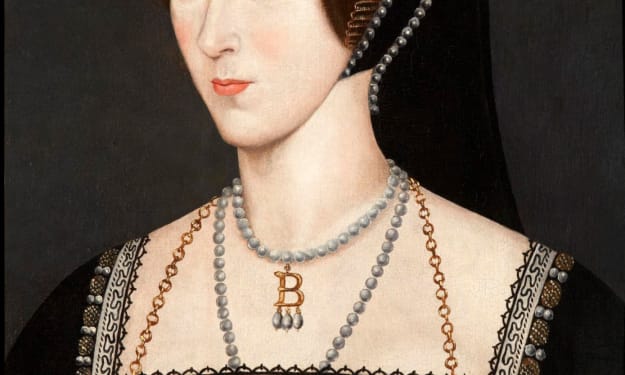
Anne Boleyn: A Tale of Triumph and Tragedy in Tudor England
Anne Boleyn: A Tale of Triumph and Tragedy in Tudor England Anne Boleyn, the second wife of King Henry VIII and mother to Queen Elizabeth I, remains an enigmatic figure in history, with her life marked by an extraordinary rise to power and a swift, tragic fall. This article delves into the captivating narrative of Anne Boleyn, exploring the dynamics of her ascent, characterized by ambition and political maneuvering, and the abrupt descent that unfolded against a backdrop of accusations, betrayal, and the ever-shifting currents of Tudor politics.
By Yaseen Pahad2 years ago in History
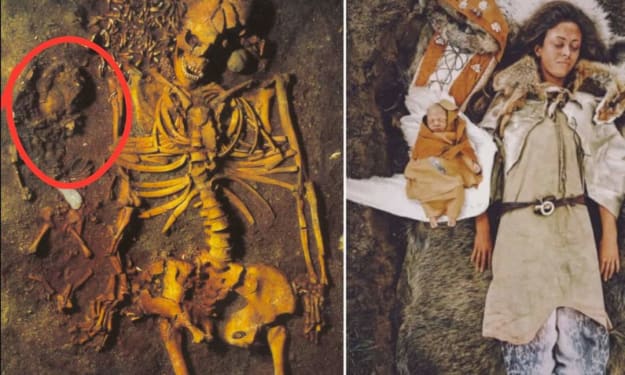
The discovery of the burial site in Vedbæk
History is a treasure trove filled with captivating stories waiting to be discovered and shared. In the small coastal town of Vedbæk, Denmark, an extraordinary burial site dating back to 4000 BC was unearthed, revealing a fascinating glimpse into the lives of our ancient ancestors. This remarkable archaeological find has shed light on ancient burial rituals, social structures, and the customs of the people who once inhabited this land. Join us on a journey back in time as we delve into the captivating tale of this burial site and explore the mysteries it holds, unlocking the secrets of a distant past and connecting us to our shared human heritage.
By Archeology Stories2 years ago in History
Black Holes: The Silent Sagas of Cosmic Mysteries and Quiet Fades
In the vast expanse of the cosmos, where the fabric of space-time weaves a tapestry of wonders, few entities hold the power to captivate our imaginations like black holes. These cosmic enigmas are not just anomalies; they are celestial storytellers, weaving tales of extreme forces and mysterious dimensions. Today, let's embark on a cosmic journey, going back to the basics, to unravel the narrative of black holes – how they form, how they live, and how they eventually bid farewell to the cosmic stage.
By Tallal Jafri2 years ago in History
Perhaps The Enigmatical History Of The Cerne Abbas Giant Will Be Solved
The Cerne Abbas Giant is a massive chalk figure of a butt-naked man with a bat and a powerful erection that stands in the hills of Dorset, England. Its origins have been a centuries-long controversy, but a recent study suggests it may finally hold the key.
By Francis Dami2 years ago in History
Ikenna Ike- Let’s talk about NFL fans’ passion.
The National Football League (NFL) stands as a cultural behemoth, with its immense popularity extending far beyond the confines of the playing field. Central to the league's success is the extraordinary passion exhibited by its fans. In this exploration, we will dissect the roots of fan passion in the NFL, examining how the league cultivated and nurtured this fervor, transforming a game into a cultural phenomenon that resonates with millions.
By Ikenna Ike2 years ago in History