Latest Stories
Most recently published stories in History.
Embracing African Culture Anywhere You Are: A Comprehensive Guide to Cultural Appreciation
Africa, a continent rich in diversity, is home to a multitude of vibrant cultures, each with its unique traditions, languages, and art forms. As the world becomes more interconnected, the appreciation and celebration of African culture are no longer confined to geographical boundaries. This article aims to provide a comprehensive guide on how individuals can practice and appreciate African culture, irrespective of their location.
By Chinedu Charles Okonkwo2 years ago in History
"Embracing the Spirit of Renewal:
As February unfolds, a vibrant tapestry of red lanterns, dragon dances, and joyous festivities blankets many parts of the world. The occasion? Chinese New Year, also known as the Spring Festival, a time-honored celebration that marks the beginning of the lunar new year. Steeped in rich cultural traditions and symbolizing renewal, this annual spectacle encapsulates the spirit of unity, family, and the anticipation of auspicious beginnings.
By Shequan Ebanks2 years ago in History
"Unveiling the Truth About Valentine's Day:
As February unfolds its embrace, hearts and roses take center stage in the celebration of love. Valentine's Day, a day synonymous with romantic gestures and sweet declarations, has etched its place in the cultural calendar as a time to celebrate love and affection. However, beyond the glittering surface of cards and chocolates lies a rich tapestry of history, myths, and diverse cultural interpretations that reveal the nuanced truth about Valentine's Day.
By Shequan Ebanks2 years ago in History
"Unveiling the Astonishing:
In a world filled with wonders and mysteries, there are stories that go beyond the ordinary, leaving us in awe of the incredible feats and remarkable occurrences that defy expectations. Join us on a journey into the extraordinary, as we unravel tales that are bound to amaze and captivate your imagination.
By Shequan Ebanks2 years ago in History
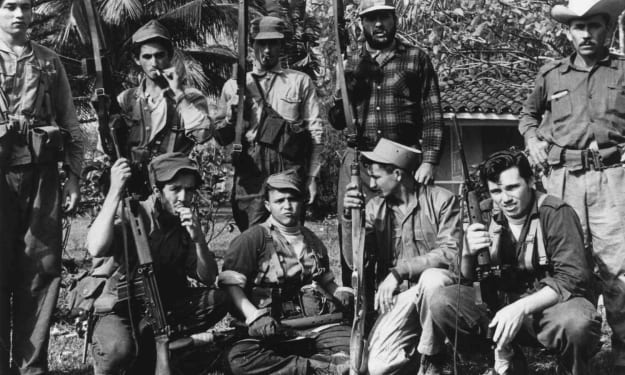
The Bay of Pigs Invasion and its Aftermath, April 1961–October 1962
A left-wing revolution in Cuba had ended in 1959 with the ouster of President Fulgencio Batista and the establishment of a new government under Premier Fidel Castro. The Castro regime quickly severed the country’s formerly strong ties with the United States by expropriating U.S. economic assets in Cuba and developing close links with the Soviet Union.
By Shazee Tahir2 years ago in History
U.S. Involvement in the Vietnam War: the Gulf of Tonkin and Escalation, 1964
In early August 1964, two U.S. destroyers stationed in the Gulf of Tonkin in Vietnam radioed that they had been fired upon by North Vietnamese forces. In response to these reported incidents, President Lyndon B. Johnson requested permission from the U.S. Congress to increase the U.S. military presence in Indochina. On August 7, 1964, Congress passed the Gulf of Tonkin Resolution, authorizing President Johnson to take any measures he believed were necessary to retaliate and to promote the maintenance of international peace and security in southeast Asia. This resolution became the legal basis for the Johnson and Nixon Administrations prosecution of the Vietnam War.
By Shazee Tahir2 years ago in History
Soviet Invasion of Czechoslovakia, 1968
On August 20, 1968, the Soviet Union led Warsaw Pact troops in an invasion of Czechoslovakia to crack down on reformist trends in Prague. Although the Soviet Union’s action successfully halted the pace of reform in Czechoslovakia, it had unintended consequences for the unity of the communist bloc.
By Shazee Tahir2 years ago in History
Love's Bittersweet Symphony
In the small town of Willowbrook, where the sunsets painted the sky in hues of pink and orange, lived a young couple named Emma and James. Their love story began like a melody, soft and sweet, echoing through the corridors of their hearts. Little did they know that fate had composed a symphony of sorrow for them, each note carrying the weight of a tragic tale.
By Samina Shaikh2 years ago in History
1961–1968: The Presidencies of John F. Kennedy and Lyndon B. Johnson
President John F. Kennedy assumed office on January 20, 1961, following an eight-year career in the Senate. The first Catholic president, Kennedy was also the second youngest to ever serve in the office. In his inaugural address, Kennedy proclaimed “Let every nation know, whether it wishes us well or ill, that we shall pay any price, bear any burden, meet any hardship, support any friend, oppose any foe, in order to assure the survival and the success of liberty.” Kennedy came into the presidency determined to reenergize the foreign policy establishment. To that end, he assembled a team of young White House and National Security Council advisers—the so-called “best and the brightest”—which included McGeorge Bundy, Walt Rostow, Ted Sorensen and Arthur Schlesinger, Jr.
By Shazee Tahir2 years ago in History
"Dinosaur Egg Salt:
In the culinary world, amidst the vast array of salts available, one particular variety stands out for its unparalleled rarity and distinctive crafting process – the Dinosaur Egg Salt, also known as a synthip walk. Found in the hands of only a few families on a small island in the Philippines, this salt has earned its place as one of the rarest in the world.
By Shequan Ebanks2 years ago in History
Celebration of Cultural Heritage: The Ram Lallaa's Temple and Scottish Indian Diaspora
In a profound display of cultural pride and religious devotion, the Indian community in Scotland is celebrating the construction of the Ram Lallas Temple in Ayodhya, a project that resonates with Hindus around the globe. Mr Neil Lal, the Chairman and President of the Indian Council of Scotland and the United Kingdom, has expressed immense joy over this development, which marks a significant moment in preserving Hindu traditions and strengthening the Indian identity abroad.
By John Samantha Brown2 years ago in History