
Konark Sun Temple - A Time Machine?
Mystery & Architectural Engineering
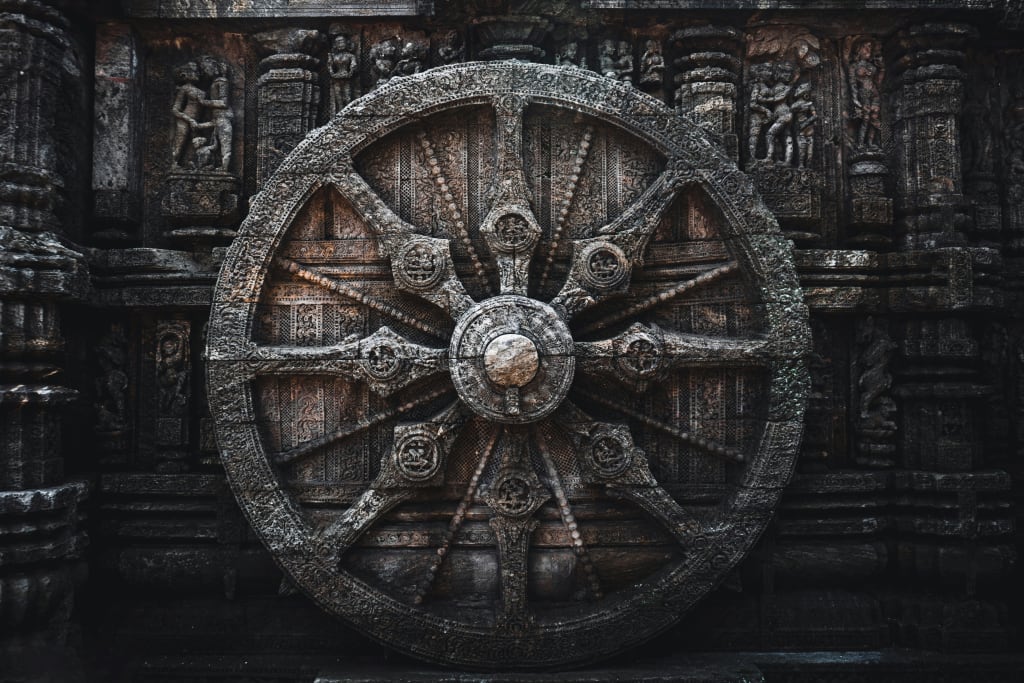
The Sun—the giant ball of fire. What does it signify? Not just today, but thousands of years ago. Sun is a symbol of something significant—Day, life and time.
yes, time itself.
Thousands of years ago, one of the most brilliant discoveries of humankind has been the sundial, a natural clock that told the time of the day. No wonder ancient civilizations believed that time was something under the control of the Sun God.
Now, here are some interesting facts about the Konark Sun Temple that we are talking about.
The Konark Sun Temple in Odisha was built in the 13th century by King Narasimhadeva I of the Eastern Ganga Dynasty. The temple was dedicated to Surya, the Sun God, designed as a massive stone chariot with 12 intricately carved wheels and 7 horses—a remarkable structure that is still a sight to behold. One could only imagine what could have been achieved in its full glory.
The 12 wheels are another marvel of architecture—each of them functions as a sundial, capable of telling time accurately up to seconds, even today.
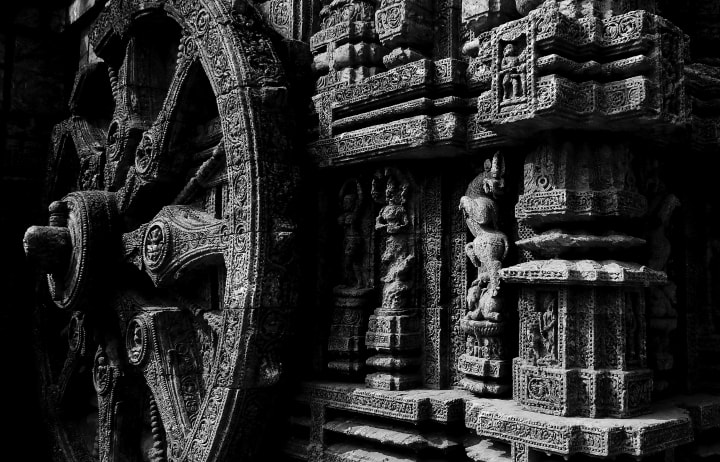
Historical records suggest that the temple had a massive floating idol of Surya, suspended in mid-air using a heavy and strong magnet fixed in the ceiling.
Things get even more interesting—after the completion of the temple, two people mysteriously disappeared. One was a 12-year-old boy named Dharma, the son of the temple’s chief architect, Bishu Maharana. A haunting tale of sacrifice
According to legends, Bishu Maharana, the chief architect of the Konark Sun Temple, and his workers were struggling to install the temple’s crown/ceiling (kalash)—the part of the temple that was supposed to hold the gigantic magnet. For some strange reason, the piece refused to stay in place.
Under immense pressure, Dharma, his 12-year-old son, entered the incomplete temple one night, hoping to help his father. However, he was never seen again. Strangely, after that night, the temple’s crown was in place, the magnet was secured, and the temple was soon completed.
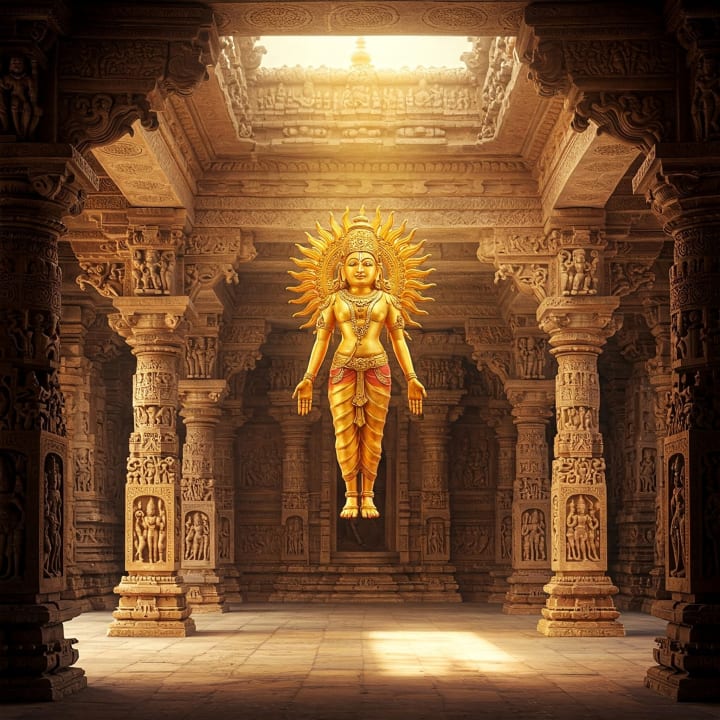
Legends speak of a haunting tale of sacrifice, where Dharma’s disappearance led to the successful completion of the temple. Another person who mysteriously vanished from historical records after the temple’s completion was King Narasimhadeva I himself, giving rise to various mysteries and conspiracy theories.
There is little to no knowledge of his later years or death. Some legends suggest that he was divinely punished for making the temple too powerful. In some versions, it is said that the Sun God, Surya, cursed the king, leading to his mysterious disappearance. The lack of historical records fuels further speculation.
The temple didn’t remain active for many years after it’s completion, but in 1568 CE, it suffered a devastating attack led by the Muslim invader Kalapahad, which marked the beginning of its downfall. Puja (worship) in the temple stopped after this event.
However, the gigantic magnet was said to have remained active for at least another century. It allegedly affected the navigation systems of passing ships in the Bay of Bengal, located about 5 km away from the temple, causing sailors' compasses to malfunction.
During this time, Portuguese sailors, who frequently traveled along the eastern coast of India, are said to have removed the magnetic stone from the temple top and thrown it into the ocean. This removal weakened the temple’s structure, eventually leading to its gradual collapse.
By this point, the temple doors had already been closed forever, and the structure was buried under the sands of time for centuries until British archaeologists rediscovered it in the 19th century and attempted restoration.
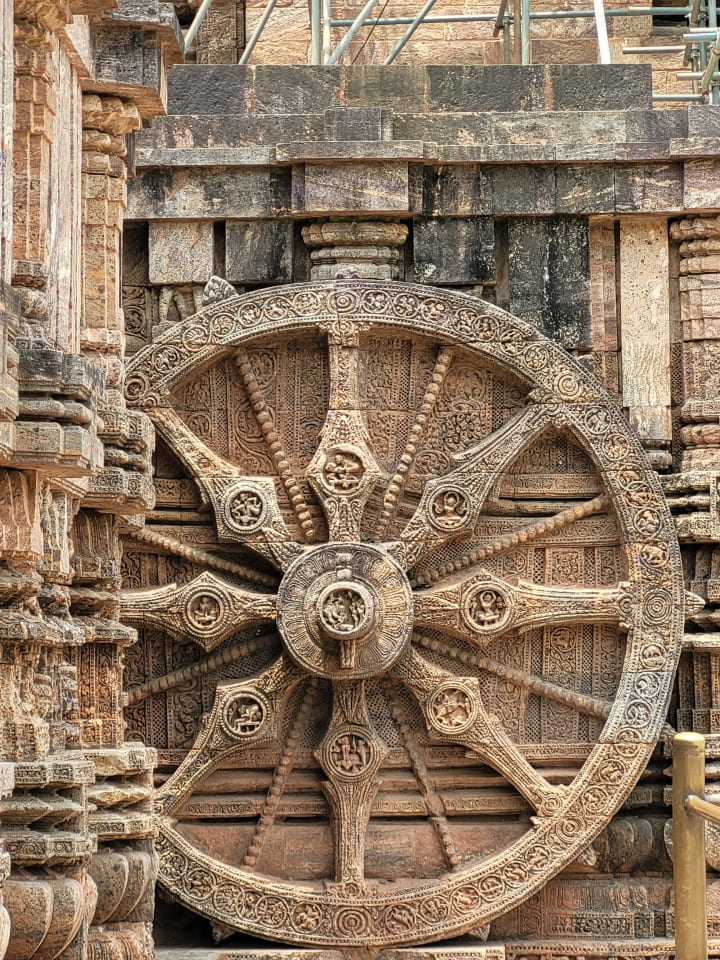
The inner sanctum of the temple remains permanently sealed, officially due to structural weakness. No one has seen its interiors in modern times, leading to countless theories and mysteries.
It is intriguing to imagine whether something resembling a time machine could be hidden in plain sight. But is it just a thought? A conspiracy theory at best?
And as much as it is intriguing to imagine a story where King Narasimhadeva and 12-year-old Dharma were both lost in a time loop, the wheels of time—represented by the sundials—spinning forward at an unimaginable speed, with the magnetic stone overhead generating a field so strong that they were transported to another era, never to return—remains a fascinating thought.
But is such a story scientifically possible? According to modern physics, the answer is no, and here’s why.
The Science Behind the Myth
Einstein’s Theory of Relativity suggests that time slows down in strong gravitational fields (gravitational time dilation) or when moving at speeds close to the speed of light (relativistic time dilation).
According to his famous equation, E = mc², energy and mass are interchangeable. A super-strong magnetic field carries energy, which in extreme cases could curve spacetime, similar to a gravitational field. This could, in theory, cause small amounts of time dilation.
But could the temple’s ceiling have generated a magnetic field strong enough for this effect? Most likely not.
Even if the possibility of the Konark Sun Temple being a time machine does not exist, there could be another reason for how these legends of time travel emerged. Strong electromagnetic fields can alter human perception of time—which might explain why stories of mystical time shifts are linked to the temple.
While electromagnetic fields do not warp spacetime like gravity, they can affect biological and neurological functions in ways that might create an illusion of time distortion:
1. Interaction with Brain Waves and Consciousness
Studies suggest that strong electromagnetic fields (EMFs) can influence human brain activity, particularly in regions responsible for time perception.
High EMFs have been found to cause:
Altered states of consciousness (like deep meditation or hallucinations).
Changes in circadian rhythms, affecting how people perceive time passing.
Slowed or accelerated perception of time, similar to how people in high-stress or dream-like states experience time differently.
2. Magnetic Anomalies and Temporal Illusions
If Konark’s legendary magnetic stone generated a powerful EMF, it could have affected visitors’ neurological processes, making them feel as if time was moving slower or faster.
Similar effects have been observed in areas with strong geomagnetic activity, where people report strange sensations, disorientation, or time slips.
However, like much of this article, this could also be wishful thinking. There is no concrete proof of Dharma’s sacrifice, Narasimhadeva’s curse, or even the levitating Surya idol.
There is no verified evidence that a magnetic stone existed or that Portuguese sailors removed it.
What we do have today are the ruins of a once-majestic temple—with no idol, no roof, no magnet, broken wheels, and a few scattered horses. Just enough to prove that a grand temple once stood there.
And the rest? Just the ramblings of my mind.
So, this is your favorite conspiracy theorist signing off—until next time.
About the Creator
Keep reading
More stories from writers in History and other communities.
Martin Luther King Jr.: A Black Day in America
On April 4, 1968, the world lost one of its most powerful voices for justice and equality. Martin Luther King Jr., the man whose words had ignited hope in millions, was assassinated on the balcony of the Lorraine Motel in Memphis, Tennessee. That day is remembered as a black day in American history—not only for the loss of a great leader but for the reflection it forced the nation to confront about its values, its divisions, and the long road still ahead for civil rights. Martin Luther King Jr. had spent his life advocating for nonviolent resistance, inspired by the teachings of Mahatma Gandhi. From the Montgomery Bus Boycott in 1955 to the historic March on Washington in 1963, where he delivered his iconic “I Have a Dream” speech, King’s words and actions challenged a society deeply entrenched in racial segregation and discrimination. He had become a symbol of hope, a figure who reminded Americans that justice was not a privilege but a right. By 1968, King was focused on addressing broader issues beyond racial inequality. He had shifted his attention to economic justice, poverty, and the Vietnam War, recognizing that systemic oppression was not limited to race alone. In Memphis, he stood with striking sanitation workers demanding better wages and safer working conditions. He knew that the struggle for dignity and fairness extended to every corner of society. But tensions in the country were high. America was a nation divided. Cities were already experiencing unrest, the war in Vietnam was escalating, and extremist groups actively opposed the civil rights movement. King had received countless death threats, yet he remained steadfast, continuing his mission with courage that inspired millions. His presence in Memphis was meant to support the marginalized, but it would tragically mark the final chapter of his life. On that fateful evening, King stepped onto the balcony of his room at the Lorraine Motel. The sun was beginning to set, casting a warm glow over the streets of Memphis. It was a moment of calm, yet danger lurked unseen. A single gunshot rang out, piercing the air and the hearts of those who had looked to him for guidance. King collapsed, fatally wounded, and chaos erupted. News of his assassination spread like wildfire, leaving communities across America in shock and grief. Television networks interrupted regular programming; newspapers ran bold headlines; the streets filled with sorrow, anger, and disbelief. People who had never met him personally felt the sting of loss as if a father, a teacher, or a friend had been taken from them. For many, the dream that King had spoken of—the dream of equality, justice, and brotherhood—suddenly seemed fragile and distant. The immediate aftermath of King’s death was a period of turmoil. Cities erupted in riots, not out of mindless violence, but as an expression of pent-up frustration and despair. Washington D.C., Chicago, Baltimore, and dozens of other cities experienced burning buildings, looting, and clashes with law enforcement. The country mourned, yet it also faced an urgent question: how could a society that claimed freedom and equality fail so tragically to protect one of its most peaceful advocates? Despite the violence, Martin Luther King Jr.’s legacy endured and even grew stronger in the face of tragedy. His death forced Americans to confront the reality that the fight for civil rights was far from over. Congress passed the Civil Rights Act of 1968, also known as the Fair Housing Act, just days after his assassination, banning discrimination in housing—a testament to the momentum King had built. His dream did not die with him; it lived on in the countless people who continued to march, protest, and speak out against injustice. King’s life and death also revealed the fragility of human progress. The black day of April 4th was a stark reminder that the struggle for justice often comes with immense sacrifice. It highlighted the courage required to challenge deeply rooted systems of oppression and the persistent resistance faced by those who seek to change society for the better. Yet, even in mourning, his death inspired a renewed commitment among civil rights activists, politicians, and ordinary citizens to carry his vision forward. In the years following his assassination, memorials and tributes honored King’s life. Streets were renamed, schools dedicated, and eventually, the Martin Luther King Jr. National Memorial was built in Washington, D.C. On every January 15th, his birthday is commemorated as a national holiday, not merely to remember his death, but to celebrate his contributions and the enduring principles he fought for: equality, justice, and nonviolence. But the black day of April 4th also serves as a cautionary tale. It reminds the world that progress is never guaranteed, and the cost of complacency is high. King’s death symbolized the very real dangers that come with standing up for truth and justice in a divided society. It forced Americans to reflect on their own values and actions, and on the work still required to turn King’s dream into a reality. Martin Luther King Jr. once said, “The arc of the moral universe is long, but it bends toward justice.” His assassination did not halt that arc; it strengthened the resolve of those determined to see it through. Today, when people around the world remember that black day in America, they do not remember only the sorrow—they remember the courage, the vision, and the unyielding spirit of a man who believed in a better world and gave everything to achieve it. King’s life and untimely death continue to inspire generations to question injustice, fight inequality, and act with compassion. Though April 4, 1968, was a day of darkness, it ultimately illuminated the path forward, reminding humanity that even in tragedy, hope, courage, and change are possible. The legacy of Martin Luther King Jr. is a testament to the power of one person to awaken a nation, to challenge hatred with love, and to transform despair into a movement for justice. The black day in America is remembered not merely as a day of loss, but as a turning point—a day when the dream was tested, yet proved resilient, enduring in the hearts of those who dare to believe in equality, peace, and freedom for all.
By The best writer 2 days ago in History
The Eternal Triangle: The Story of the Egyptian Pyramids
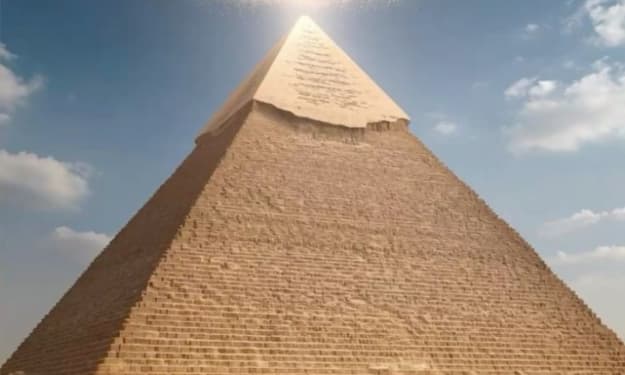
In the golden heat of the Egyptian desert, where the Nile River flows like a ribbon of life through endless sand, stand the greatest monuments of ancient human ambition—the pyramids. For over four thousand years, these towering structures have watched the rise and fall of empires, the march of armies, and the endless turning of time. They are not merely piles of stone; they are symbols of power, faith, and mystery. The story of the pyramids begins in the Old Kingdom of Egypt, around 2600 BCE, during a time when pharaohs ruled as living gods. The Egyptians believed that their king was not just a ruler but a divine being, chosen by the gods to maintain order in the world. When a pharaoh died, it was not seen as an end but as a journey into the afterlife. To ensure that their king would live forever among the gods, the Egyptians built massive tombs—structures that would protect the body and provide everything needed for eternal life. Before pyramids, royal tombs were simple rectangular structures called mastabas, made of mudbrick. But everything changed with Pharaoh Djoser. His architect, a brilliant man named Imhotep, had a daring idea. Instead of building a flat mastaba, he stacked smaller mastabas on top of one another, creating a stepped pyramid. Around 2630 BCE, the Step Pyramid of Saqqara rose toward the sky—the first large stone structure in history. It was a revolutionary achievement, marking the beginning of pyramid construction. As time passed, Egyptian builders sought perfection. They experimented with smoother sides and greater heights. Pharaoh Sneferu, father of the famous Khufu, was determined to create the perfect pyramid. His first attempt, the Meidum Pyramid, partially collapsed. His second attempt, the Bent Pyramid at Dahshur, changed angle midway because of structural concerns, giving it a strange shape. Finally, Sneferu succeeded with the Red Pyramid—the first true smooth-sided pyramid. Through trial and error, Egyptian engineers mastered the art of building monuments that could stand for eternity. Then came the age of greatness—the construction of the Great Pyramid of Giza. Around 2580 BCE, Pharaoh Khufu ordered the building of a pyramid that would surpass all others. On the west bank of the Nile, near modern Cairo, thousands of workers gathered. Contrary to old myths, these were not slaves chained in misery but skilled laborers, farmers who worked during the Nile’s flooding season when their fields were underwater. Stone blocks, some weighing up to 2.5 tons, were quarried and transported across the desert. Historians still debate exactly how they were lifted into place. Some believe ramps were built; others suggest clever systems of levers and sledges. Whatever the method, the achievement remains astonishing. Over 2.3 million blocks were arranged with incredible precision, forming a pyramid originally 146 meters tall. Its sides aligned almost perfectly with the four cardinal directions—north, south, east, and west—showing a deep understanding of astronomy. Inside the Great Pyramid were hidden chambers. The King’s Chamber held a granite sarcophagus, meant to house Khufu’s mummified body. Narrow shafts pointed toward specific stars, perhaps guiding the king’s spirit to the heavens. The pyramid was once covered in smooth white limestone that reflected the sunlight, making it shine brilliantly like a beacon. Near Khufu’s pyramid stood two others—built for his son Khafre and his grandson Menkaure. Together, they formed the famous Pyramids of Giza. Guarding them was the Great Sphinx, a colossal statue with the body of a lion and the face of a pharaoh, likely Khafre. The Sphinx symbolized strength and wisdom, silently protecting the royal tombs. But why did the Egyptians build such enormous structures? The answer lies in their beliefs. The afterlife was central to Egyptian religion. They believed that the soul had different parts—the ka, the ba, and the akh—that needed the body to survive. This is why mummification was so important. Organs were carefully removed, the body dried with natron salt, and wrapped in linen. Treasures, food, statues, and inscriptions were placed inside the tomb to serve the king in the next world. However, pyramid-building did not last forever. After the Old Kingdom, Egypt faced economic troubles and political instability. Later pharaohs built smaller pyramids or chose hidden tombs in the Valley of the Kings, like that of Tutankhamun. The era of giant pyramids faded, but their legacy remained. For centuries, the pyramids stood largely undisturbed. Ancient travelers marveled at them. Greek historian Herodotus visited in the 5th century BCE and wrote stories—some accurate, others exaggerated—about their construction. Over time, sand covered parts of the structures. Treasure hunters and grave robbers broke into tombs, stealing valuables. In modern times, archaeologists have studied the pyramids with scientific methods. Excavations revealed workers’ villages, tools, and even bakeries that fed thousands of laborers. These discoveries changed our understanding, proving that pyramid builders were respected members of society, not enslaved masses. The pyramids have also inspired countless myths. Some claim aliens helped build them, unable to believe that ancient humans could achieve such precision. But evidence shows the Egyptians possessed remarkable engineering knowledge. They understood mathematics, geometry, and organization. The pyramids are a testament to human capability—not extraterrestrial intervention. Today, the Great Pyramid is the only surviving wonder of the Seven Wonders of the Ancient World. Earthquakes have shaken it, stones have been removed, and its shining limestone casing is mostly gone, yet it still stands proudly against the desert sky. Tourists from around the world visit Giza, walking in the footsteps of ancient kings. As the sun sets over the Sahara, the pyramids glow in shades of gold and red. They remind us of a civilization that believed in eternity. Though the pharaohs are long gone, their monuments endure, whispering stories of ambition, faith, and the desire to conquer death itself. The Egyptian pyramids are more than tombs. They are bridges between earth and sky, between life and afterlife. They show what humans can achieve when driven by belief and unity. Thousands of years later, they still challenge our imagination and inspire awe. And perhaps that is their greatest mystery—not how they were built, but why they continue to captivate us. In their silent strength, the pyramids tell a simple truth: time may pass, empires may fall, but the dreams carved in stone can last forever.
By The best writer about 11 hours ago in History



Comments
There are no comments for this story
Be the first to respond and start the conversation.