

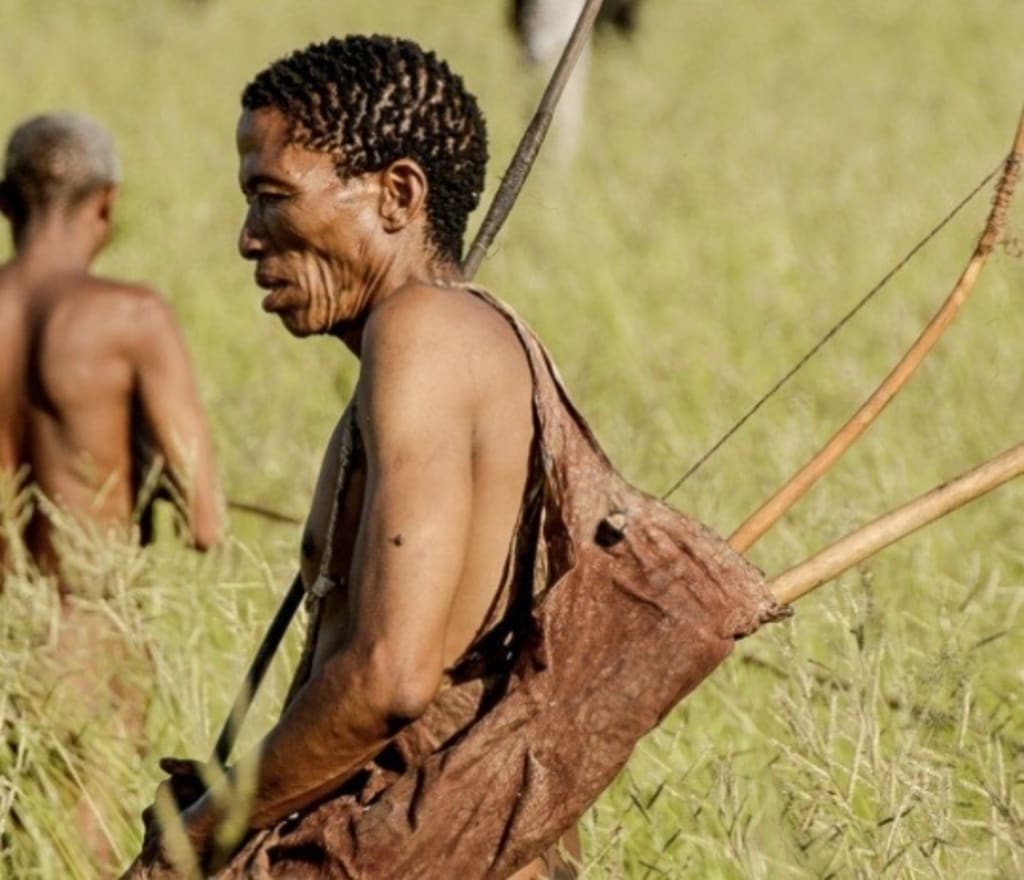
Khoisan tribe, known as the first people of Africa. They originated in South Africa about 140,000 years ago, and migrated north throughout Africa and into Europe around the Mediterranean Sea. They are Hunter/gatherers, known for being expert trackers and for living off the land in very hostile climates like the Kalahari desert of Botswana and the Namibian desert of Namibia.

The San are also known as bushmen. They became internationally known because of the movie The gods must be crazy. They don’t have personal possessions, they only have things that they need to hunt or survive on a daily basis. One of the unusual things about them is the fat storage in their buttocks. When they have a kill, they gorge on the meat, mostly because they have no way to keep it from rotting, or to transport large amounts of food around. Or possessions in general. Everything they have belong to the entire clan.If they don’t get a kill, or find any roots to gather, their bodies survive on the fat stored in their buttocks and their buttocks shrink until they are just flaps of loose skin, until the next gorging.
The San have a distinctive yellow skin, and a click language.22,000 years ago they were the largest population group on earth, but their numbers are dwindling. They can be found in Namibia, South Africa, Botswana and Zimbabwe. They are still Hunter/gatherers, but their lifestyle is changing to pastoralist ( farming, livestock herding) as the governments of the various countries the live in are forcing them into rural villages. The are living in extreme poverty.

The San are known for their cave paintings all over Southern Africa. On a recent trip to South Africa, I visited the last remaining San settlement in South Africa, and the story behind them being there is tragic. They were living in Angola when war broke out between South Africa and Angola and their allie Cuba. South Africa hired the bushmen to be their trackers for the South African armed forces, but South Africa lost that war and withdrew from Angola, and warned the bushmen that if they stayed in Angola they would face reprisal for their participation in the war on the side of South Africa. All the San population of Angola relocated to Namibia ( South West Africa at that time). But a few years later South West Africa, which was attempting to break away from South Africa in their own independence struggle, succeeded in gaining their independence and became Namibia. The Namibian government immediately expelled the San people who had relocated there at the invitation of the South African government, who then had no choice but to move to South Africa, but South Africa was run by the white Afrikaner colonial people who invented Apartheid, (government sanctioned racism) and the San were not welcome there. So they were a displaced people with nowhere to go. In 1994 South Africa had a change of government and in an historic election Nelson Mandela of the ANC party became president, and apartheid was abolished. Mandela granted the San people a large sum of money as compensation for their service to South Africa and for their current residence situation which they used to buy a large tract of land where they could safely live and practice their Hunter/gatherer lifestyle. One of the reasons they picked the land they chose was the ancient petroglyphs found on the rocks located on it, carved thousands of years before by their San ancestors. There was a visitor center on the settlement that catered to interested visitors and tourists, and the history and lifestyle of the San people was explained and shown. One interesting thing the San had to do was buy Sable antelope from other National game parks in the country to stock their own land so that young San boys could hunt them in their traditional way so that the young boys could learn and have a rite of passage into manhood. The San way of life is secured in South Africa.
About the Creator
Guy lynn
born and raised in Southern Rhodesia, a British colony in Southern CentralAfrica.I lived in South Africa during the 1970’s, on the south coast,Natal .Emigrated to the U.S.A. In 1980, specifically The San Francisco Bay Area, California.


Comments (1)
This is a fascinating and informative piece about the Khoisan people. It's truly heartbreaking to learn about their displacement and the challenges they've faced throughout history. The contrast between their ancient, nomadic lifestyle and their forced integration into modern society is stark. It's inspiring to see how they've managed to preserve their cultural heritage and traditions, even in the face of adversity. The story of their resettlement in South Africa is a testament to their resilience and the power of community. It's heartwarming to know that they have a safe haven where they can continue to live their traditional way of life.