

Khalid ibn al-Walid: The Sword of Allah – A Military Genius and Islamic Legend
Introduction
Khalid ibn al-Walid (592–642 CE), known as Sayf Allah al-Maslul (The Drawn Sword of God), stands as one of the greatest military commanders in history. His life was a remarkable journey—from a fierce enemy of Islam to its most formidable champion. With an unbroken record of victories, his strategic brilliance, battlefield courage, and unwavering faith cemented his legacy as a legendary warrior and leader. This essay explores his early life, conversion to Islam, military campaigns, leadership, and enduring legacy.
Early Life and Opposition to Islam
Khalid was born into the Banu Makhzum, a powerful clan of the Quraysh tribe in Mecca. His father, al-Walid ibn al-Mughira, was a wealthy and influential leader, ensuring Khalid received elite training in warfare. From a young age, he mastered horseback riding, archery, and battlefield tactics, earning a reputation as a fierce warrior.
In the early days of Islam, Khalid was a staunch opponent of the Prophet Muhammad (pbuh). As part of the Meccan elite, he saw Islam as a threat to their traditions and power. His military prowess first became evident at the Battle of Uhud (625 CE), where his cavalry charge turned the tide against the Muslims, nearly leading to their defeat. Despite this victory, Khalid began to admire the discipline and faith of the Muslims, planting the seeds for his eventual conversion.
Conversion to Islam and Early Military Leadership
By 628 CE, Khalid embraced Islam, traveling to Medina with Amr ibn al-As, another future Islamic leader. The Prophet Muhammad (pbuh) welcomed him warmly, saying:
"Praise be to Allah who guided you! I always knew you were intelligent, and I hoped you would use your wisdom for Islam."
Khalid’s first major test as a Muslim commander came at the Battle of Mu’tah (629 CE), where a small Muslim force faced the mighty Byzantine Empire. After three Muslim leaders were martyred, Khalid took command. Despite overwhelming odds, he executed a tactical retreat, preserving the Muslim army. Impressed, the Prophet (pbuh) gave him the title "Sayf Allah" (Sword of Allah)—a name that would define his legacy.
Key Battles Under Prophet Muhammad (pbuh)
1. Conquest of Mecca (630 CE)
When the Muslims returned to Mecca, Khalid led one of the army divisions. Though the conquest was largely peaceful, his forces encountered minor resistance, which he swiftly neutralized. This victory marked the end of pagan dominance in Mecca.
2. Battle of Hunayn
Following Mecca’s fall, the tribes of Hawazin and Thaqif launched a surprise attack. Initially, the Muslim army faltered, but Khalid’s leadership helped them regroup and secure victory.
3. Suppression of Rebellious Tribes
Khalid was frequently sent to subdue tribes resisting Islamic rule. His campaigns combined military force with diplomacy, ensuring stability across Arabia.
The Ridda Wars: Khalid’s Greatest Challenge
After the Prophet’s death (632 CE), many Arab tribes renounced Islam, believing the Muslim state would collapse. Caliph Abu Bakr declared the Ridda Wars (Apostasy Wars) and appointed Khalid as his top general.
1. Defeat of Tulayha
Tulayha, a self-proclaimed prophet, led a powerful rebellion. Khalid defeated him at the Battle of Buzakha, crushing his movement.
2. Battle of Yamama – Crushing Musaylima the Liar
The most brutal battle was against Musaylima, another false prophet. At Yamama, Khalid faced a massive rebel force. Despite heavy losses, his tactical genius led to a decisive victory, ensuring Islam’s survival in Arabia.
3. Unification of Arabia
Khalid’s rapid campaigns subdued rebellions across the peninsula, reuniting Arabia under Islamic rule. His success paved the way for the Muslim conquests beyond Arabia.
Conquest of Persia and Syria: Khalid’s Military Mastery
1. Invasion of Persia (Iraq Campaign – 633 CE)
Under Caliph Abu Bakr’s orders, Khalid invaded the Sassanid Empire. His lightning-fast tactics led to victories at:
Battle of Chains – First major Muslim victory over Persia.
Battle of Walaja – A double envelopment tactic, annihilating the Persian army.
Conquest of Hira – A key Persian stronghold fell to Khalid.
His campaigns in Iraq laid the foundation for Islam’s expansion into Persia.
2. Syrian Campaign – The Daring Desert March
When Muslim forces in Syria struggled against the Byzantines, Khalid was ordered to reinforce them. In a legendary maneuver, he led 5,000 troops across the Syrian Desert, arriving undetected behind enemy lines.
Key Battles in Syria:
Battle of Ajnadayn (634 CE) – Khalid crushed a larger Byzantine force, securing Palestine.
Battle of Fahl (635 CE) – Another decisive victory, opening Jordan to Muslim rule.
Battle of Yarmouk (636 CE) – Khalid’s Greatest Triumph
Facing a Byzantine army five times larger, Khalid used superior tactics, feigned retreats, and night attacks to secure a decisive victory.
This battle marked the end of Byzantine rule in Syria and paved the way for Islamic expansion into the Levant.
Dismissal by Caliph Umar and Khalid’s Humility
Despite his unmatched success, Caliph Umar ibn al-Khattab dismissed Khalid from command, fearing people would attribute victories to him rather than Allah. Khalid, known for his fierce pride, accepted the decision without protest, continuing to serve as a soldier.
This act of humility demonstrated his true devotion—not to personal glory, but to Islam.
Death and Last Words
Khalid died in 642 CE in Homs, Syria, not in battle but from illness. On his deathbed, he lamented:
"I have fought in a hundred battles, yet here I die on my bed like a camel. May the eyes of cowards never find rest!"
His words reflected a warrior’s spirit—one who longed for martyrdom but accepted Allah’s decree.
Legacy: The Indomitable Sword of Allah
Khalid ibn al-Walid’s legacy is unmatched:
Never lost a battle in over 100 engagements.
Master of speed, deception, and psychological warfare.
Unified Arabia, conquered Persia and Syria, and shaped Islamic history.
A model of faith, humility, and loyalty.
Unlike conquerors like Alexander or Napoleon, Khalid fought not for empire, but for Islam. His life proves that true greatness lies in submission to divine will.
Conclusion
Khalid ibn al-Walid remains a timeless symbol of military genius, unshakable faith, and selfless service. From Uhud to Yarmouk, his sword was drawn only in Allah’s cause. Even in dismissal, he showed unmatched humility. His legacy endures—not just as a conqueror, but as the Sword of Allah, forever drawn in
About the Creator
Hafsa
"I'm a curious and driven individual with a passion for learning, creativity, and personal growth. I enjoy solving problems, exploring new ideas, and working collaboratively to make a positive impact in everything I do.
Nanchang: A Modern Symbol of China’s Naval Power
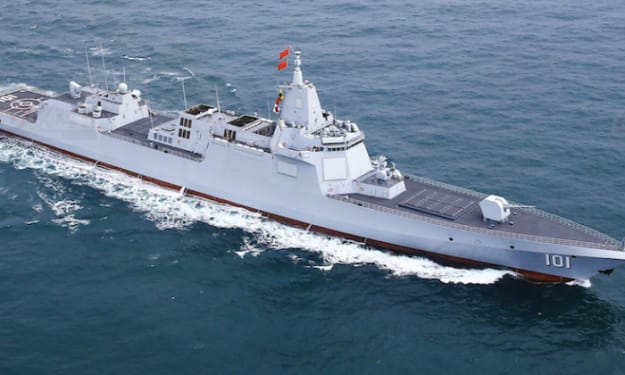
In recent years, the world has closely watched the rapid modernization of the Chinese People’s Liberation Army Navy (PLA Navy). One of the most important symbols of this transformation is the Nanchang (Hull 101), China’s first Type 055 guided-missile destroyer. Commissioned on 12 January 2020, Nanchang represents a major leap in naval technology and capability. As it completes six years of active service, the ship stands as a clear example of how China’s navy has moved into a new era of advanced maritime power.
By sehzeen fatima4 days ago in History
Where the Pulse Ends
© 2026 Sai Marie Johnson The humidity in the city didn’t just hang; it leaned. It was a thick, stagnant soup of diesel exhaust, ozone, and the metallic tang of blood that drifted from the "Compliance Zones." Joe sat in his rusted sedan, his hands resting loosely on the steering wheel. He wasn't gripping it. He wasn't angry. Anger was a chemical spike, a biological inefficiency. Joe was simply... focused.
By Sai Marie Johnsonabout 11 hours ago in History



Comments
There are no comments for this story
Be the first to respond and start the conversation.