
Kambala : The Sport
.100 meter in 8.36 seconds!! New record


Kambala, also known as Kambla or Kambula, is an annual traditional buffalo race that takes place in the coastal districts of Dakshina Kannada and Udupi in the state of Karnataka, India, as well as in the Kasaragod district of Kerala. This event has a significant cultural and historical significance in the Tulu Nadu region.
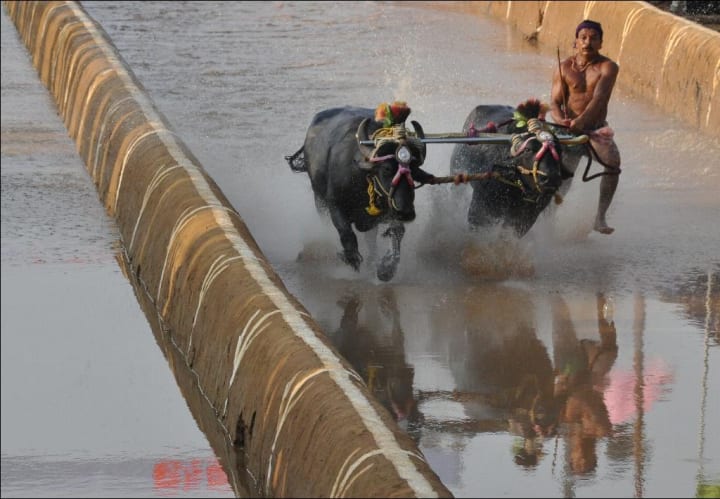
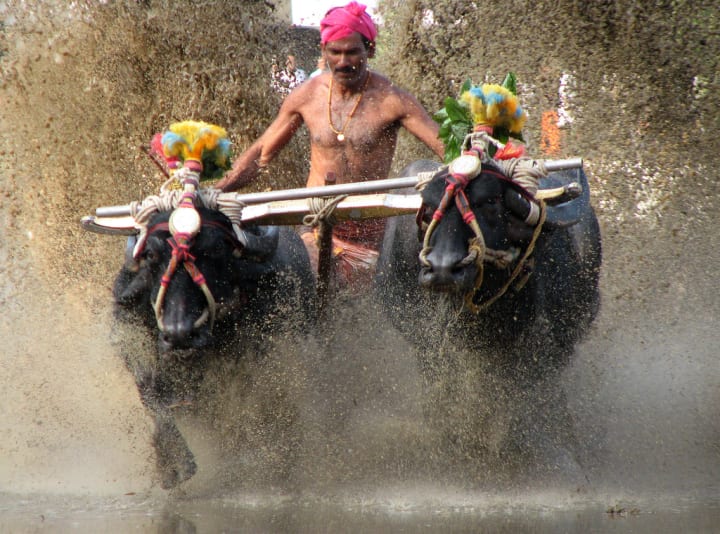
Kambala usually involves pairs of buffaloes driven by a handler, and they race through water-filled paddy fields. The buffaloes are made to run in a slushy track, which is created by flooding the fields. The race is not only a test of speed and endurance for the buffaloes but also a celebration of local culture and tradition.

Traditionally, Kambala was sponsored and organized by local Tuluva landlords and households. It was a way for these landowners to showcase the strength and vitality of their buffaloes. Over time, Kambala has evolved into a larger community event with cultural performances, traditional rituals, and festive celebrations accompanying the races.
Kambala has gained both local and international attention due to its unique nature and the connection it holds with the heritage of the Tulu Nadu region. However, it's worth noting that Kambala has also faced some controversies and debates regarding animal welfare and the treatment of the racing buffaloes. In recent years, there have been discussions about implementing regulations to ensure the well-being of the animals during these races.
Kambala season spans from November to March and that there are several Kambala races held during this period. The involvement of Kambala samithis or Kambala associations in organizing these events highlights the community-driven nature of this traditional practice.

The fact that over 45 races are held annually in various locations across coastal Karnataka, including smaller and more remote villages, underscores the widespread popularity and participation in Kambala. It's evident that Kambala holds a special place in the hearts of the people in these regions and continues to be an important cultural event that brings communities together to celebrate their heritage and traditions.
It's fascinating to learn about the evolution of Kambala from its traditional non-competitive form to the more modern competitive races.The description of the Kambala racetrack as a slushy paddy field and the image of farmers whip-lashing the buffaloes during the race give a vivid sense of the environment and dynamics of the event.
The inclusion of ritualistic aspects in some villages, where the race is seen as a way to express gratitude for the protection of buffaloes from diseases, further highlights the deep cultural significance of Kambala in these communities.
The transition from historical rewards like coconuts and bananas to more contemporary rewards such as gold and silver coins underscores the changing nature of the event and its growing popularity.
It's interesting to see how the event is not only a buffalo race but also deeply intertwined with local religious and social practices.The description of the pre-Kambala rituals involving the Koraga communities, including their dances, songs, and offerings, highlights the spiritual and communal nature of the event. The use of Panchamakara (five "M"s) elements in their rituals (Alcohol, Meat, Fish, Gesture, Sexual) reflects their beliefs and practices that are likely influenced by local traditions.
The significance of daiva Nīcha, their special spirit, and the offerings made to it provide insight into the spiritual context of these rituals. Additionally, the concept of kandēl addyē, the pot pudding, and its role in these ceremonies gives us a glimpse into the specific customs and practices that make Kambala a complex and multifaceted cultural event
The issue of animal welfare and cruelty has been a significant point of contention surrounding Kambala. As you mentioned, critics have raised concerns about the treatment of the racing buffaloes, which are driven by whips during the races. This practice has sparked debates and led to legal action in an attempt to address the welfare of the animals involved.
Animal-rights activist Maneka Gandhi's concerns and the advice from government officials about being gentle with the buffaloes rather than using whips reflect the tension between tradition and ethical treatment.
The Supreme Court of India's ban on Kambala in 2014, alongside the ban on Jallikattu, was a response to concerns raised by animal welfare organizations and activists. However, with public sentiment and requests for reconsideration, there were efforts to re-legalize Kambala and address the concerns while preserving the cultural aspect of the event.
The Prevention of Cruelty to Animals (Karnataka Amendment) Ordinance, 2017, played a role in re-legalizing Kambala in Karnataka. The subsequent legal amendments and the involvement of high-ranking officials like then-President Pranab Mukherjee and President Ram Nath Kovind showcase the complex process of finding a balance between cultural practices and animal welfare.
The issue of animal welfare in cultural events is a sensitive and complex matter that involves finding solutions that respect both tradition and ethical considerations. It's a topic that requires ongoing dialogue and cooperation between various stakeholders.

As an Native of Tulunadu, who have been following Kambala since ages and been a fan of these traditions hope that such ancient events continue to uphold rich culture of Tulunadu. Please share your comments below.
Please support me guys, to bring rich content about land of Tulunadu and its traditions.
About the Creator
Rohan
I am young and enthusiastic writer, prefer to get more encouragement from fellow audience and colleagues. Please do support guys.. Thanks in advance.. Thanks for all the love & encouragement .. cheers
Yajuj and Majuj (Gog and Magog) and the Concept of the “Barrier” That Holds Them Back
The story of Yajuj and Majuj—known in English as Gog and Magog—occupies a powerful place in Islamic eschatology. These mysterious tribes are mentioned in the Qur’an and Hadith as forces of chaos who will emerge near the end of times. Central to their narrative is the construction of a massive barrier built by the righteous ruler Dhul-Qarnayn, a wall designed to restrain their corruption until a divinely appointed time. This article explores who Yajuj and Majuj are, the meaning of the barrier, and how the concept has been understood historically and symbolically.
By Irshad Abbasi 5 days ago in History



Comments
There are no comments for this story
Be the first to respond and start the conversation.