

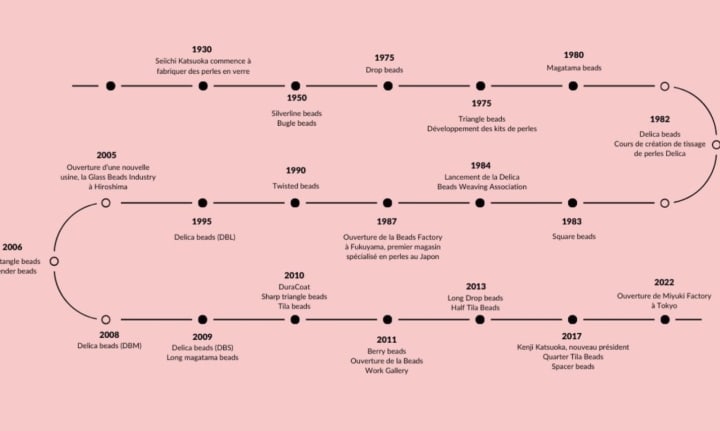
The story of Miyuki beads begins in Japan, in the mid-30s, in the town of Fukuyama in Hiroshima province. Seiichi Katsuoka, great-grandfather of the company's current president, was so fascinated by the color and brilliance of glass beads that he decided to start making them.
In 1949, Seiichi Katsuoka launched his own factory, supported by family and friends. But in the aftermath of the Second World War, materials for making glass beads were scarce, and the cooperative produced only a dozen transparent and opaque colors. Made from high-quality glass, rocailles beads were renowned for their uniformity and brilliance. Local artisans quickly adopted these beads for their jewelry and beadwork projects, as they offered unparalleled precision and beauty.
In the early '50s, Hiroshi Katsuoka, son of the founder and grandfather of the company's current president, took over the reins of the company. At the time, the silverline (silver-plated) technique was used in Europe and the United States, but did not exist in Japan. Eager to learn how to produce this brilliance, Hiroshi Katsuoka devoted his time to researching, studying in specialized books and visiting the laboratories of glass manufacturers. By dint of perseverance, he found a silverline method, which today is unique to Miyuki. The fame of Miyuki pearls quickly spread to the world of fashion and jewelry.
Over the years, Miyuki has continued to innovate. The company has developed new production techniques to improve the quality and consistency of its pearls. It also expanded its product range to include a variety of incomparable sizes, shapes and colors.
Hmm, sounds like the kind of company who would invent miracle beads.
In 1974, Masayoshi Katsuoka, father of the firm's current president, created the Miyuki brand. He also invented Miyuki Delica, beads created exclusively for loom or needle weaving. They quickly became popular for their cylindrical shape and perfect uniformity.
Bead-weaving techniques such as peyote, brick stitch and square stitch became particularly popular, as they enabled intricate, detailed patterns to be created with Miyuki beads.
As of 2017, Kenji Katsuoka is the firm's new president.
And if you're wondering what Miyuki means, it's simply the name of the town where the company's offices are based.
How are Miyuki beads made?
Do you know how your favorite little seed beads are made?
1 - First, the raw materials (silicon oxide, sodium carbonate and calcium carbonate) are mixed with the colorants. Then they are placed in a furnace at 1400°C to melt the glass.
2 - The molten glass is then placed in a slightly cooler crucible. Craftsmen blow the glass through a hole in the bottom of the crucible, using a compressed-air device. The holes in the crucibles are shaped, creating differently shaped beads.
3 - The long glass tubes are cut into small pieces using a special cutting machine.
4 - The cut pieces are then mixed with carbon powder and heated to 700°C to transform the glass pieces into round beads.
5 - The beads are then rinsed to remove the carbon powder. They are then polished. Washed beads are not clear. Transparency is achieved by smoothing the surface.
6 - Different pearl varieties are created using different effects: silverline, dyeing, glazing, rainbow and luster coating, etc.
7 - The pearls are again washed and dried.
8 - Finally, the finished products are packaged and ready for export to various countries.
Miyuki pearls are available in a wide variety of sizes, shapes and colors. Find out more about the durability of Miyuki colors, as well as the shapes and sizes available, in our technical data sheet.
Researching miracle beads on the web, I found this.
Miracle beads" are a contemporary term for Japanese beads with a layered, luminous quality achieved through multiple coatings of lacquer, creating an illusion of depth and a glowing effect, distinct from ancient beads like magatama or traditional rosary beads. The history of Japanese beads is more accurately a story of ancient magatama, the spread of Buddhist prayer beads (mala), and the development of their world-renowned seed and craft beads from the Meiji era through post-WWII Japan, which saw the growth of major bead industries like Miyuki, TOHO, and Matsuno due to their commitment to quality and innovation.
Genuine Japanese "miracle beads" were first made in 1949, when the Miyuki company was founded. Along with other Japanese bead makers that started around the same time, the company helped create a new era of high-quality, innovative glass beads.
Miracle Beads
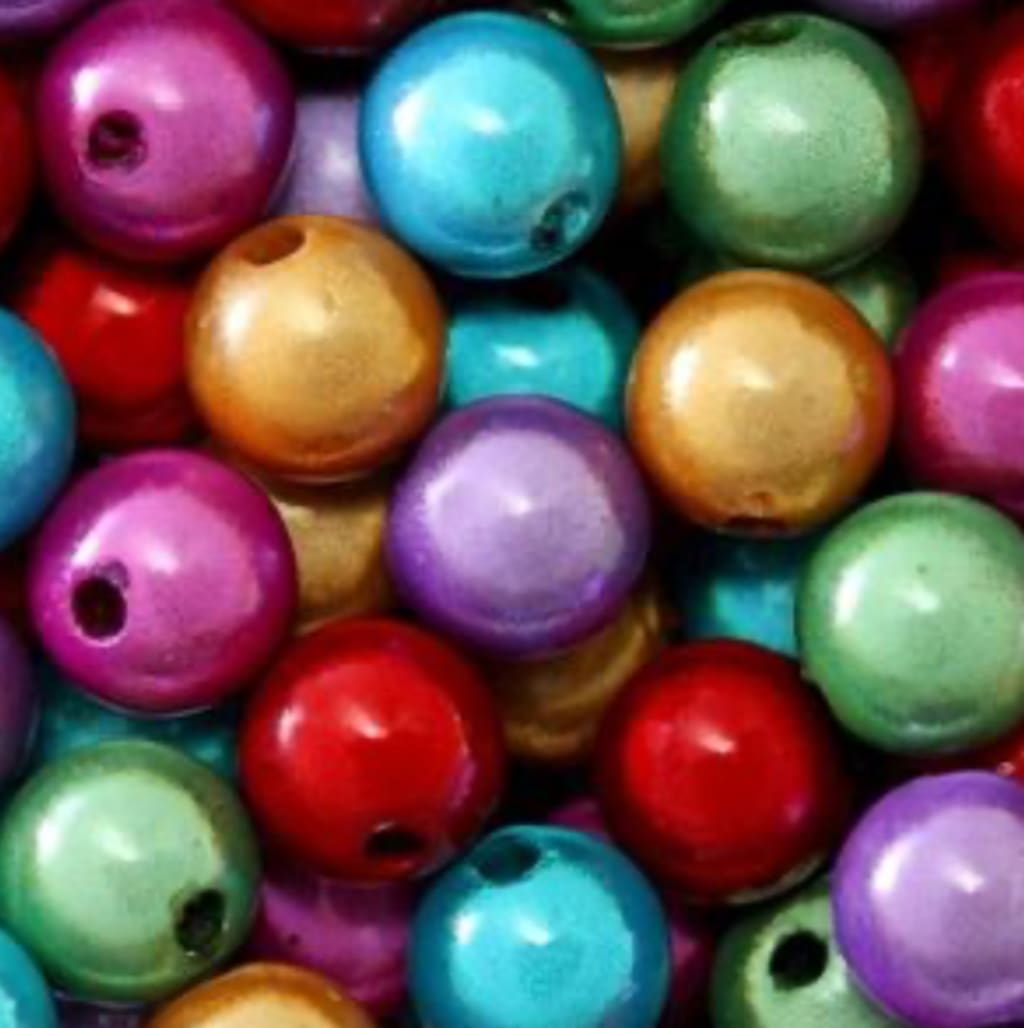
Miracle Beads have A Lucite Core with a silver mirror-plated finish. They are coated with several layers of colored lacquer. When viewed in the light, they appear to have a bead within the bead. The light passes through the lacquer, which reflects the mirror core back through the layers. This results in an Illusion of Depth, hence the “Miraculous” effect. Miracle beads come in 3 different qualities. The best grade of Miracle bead comes from Japan. Miracle bead knock offs are also made in Taiwan and Mainland China.
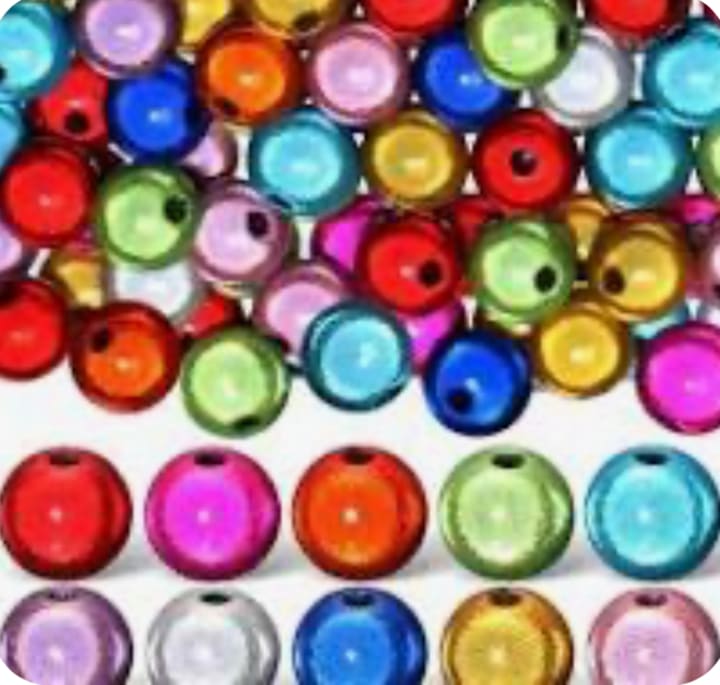
Miracle beads are super-intriguing because they seem to glow in natural light. They also have the optical illusion of having a bead within a bead. Hence the names for these beads.
These beads are a form of plastic beads. They are normally very bright and made from some form of fiberglass material. The bead is sprayed repeatedly with a reflective material and finished with an outer clear coating. It is these layers that create the tantalizing illusion of a bead within a bead. It is also what makes the tantalizing illusion of a bead within a bead. It is also what makes the beads seem to glow in natural light.
These genuine Miracle Beads were made in Japan with superior paints and UV inhibitors, using a special technique of clear lacquer overlay that gives off a magical glow to appear 3D. The optical illusion showing a bead within bead.
The fiberglass used in the beads are of the kind known as glass-reinforced plastic (GRP) which is pretty much inert. And in the case of Miracle Beads used in the jewelry making industry, the beads are encapsulated with layers and layers of protective reflective coatings and clear outer coatings. This is what also gives them the magical, luminous illusion of double glowing beads.
Glass fiber (or spelt as glass fibre) however is the one that has raised the health awareness towards that substance around the world. This unfortunately has now become commonly know as "fiberglass" (a generic trademark), which is really glass wool and was is/was used as insulation material.
Due to the identical terming and the overlap of use of glass in some form, the fiberglass in the Miracle beads and the fiberglass in insulation often causes some unnecessary but justifiable concerns.
The material use to produce Miracle beads can in fact, be correctly viewed as some form of plastic.
Originally these beads came from Japan but these days, they are produced in many countries. But the cheaper knock offs are not as good quality as the original Japanese made beads. The miraculous glow is more muted and lacks the vibrancy of the original. However it is not unusual that they are still often called "Japanese Miracle Beads", so buyer beware.
Magic beads are not expensive. They come in a huge assortment of colors (singular and multi) and in many sizes.
It is not known who first invented Japanese miracle beads, though the technology was pioneered by Japanese bead manufacturers. The creation of these beads relies on a special coating process, which was likely a collaboration of research and manufacturing techniques rather than the invention of a single individual. But like I have pointed out earlier, all point to Miyuki as the creator.
How Japanese miracle beads are made
A bead is made from a lightweight acrylic or Lucite plastic core.
A mirror-plated silver finish is applied over the core.
Several layers of colored lacquer are then coated over the finish.
The final product creates a "bead within a bead" illusion, as light passes through the lacquer layers and reflects off the mirror-plated finish.
Known companies
Japanese companies like Matsuwaka Glass and Pearl Works and TOHO BEADS have played a significant role in the country's beadmaking history. Miyuki, another prominent Japanese seed bead manufacturer, has innovated numerous new beads over the years, though it's unclear whether they were directly involved with the miracle bead creation. I have reached out to the Miyuki company President to see if he would comment on this article, and establish once and for all that his company created the miracle bead. As soon as I hear from him, I’ll report back.
About the Creator
Guy lynn
born and raised in Southern Rhodesia, a British colony in Southern CentralAfrica.I lived in South Africa during the 1970’s, on the south coast,Natal .Emigrated to the U.S.A. In 1980, specifically The San Francisco Bay Area, California.
A More Human Vocal
When we launched Vocal nearly a decade ago, the world was a very different place. LLMs did not exist, and stories were created one at a time by people sitting down to write, revise, and share something personal. Many of our assumptions about publishing, trust, and participation were built for a world where effort and output were inseparable.
By Justin @ Vocalabout 5 hours ago in Resources



Comments
There are no comments for this story
Be the first to respond and start the conversation.