
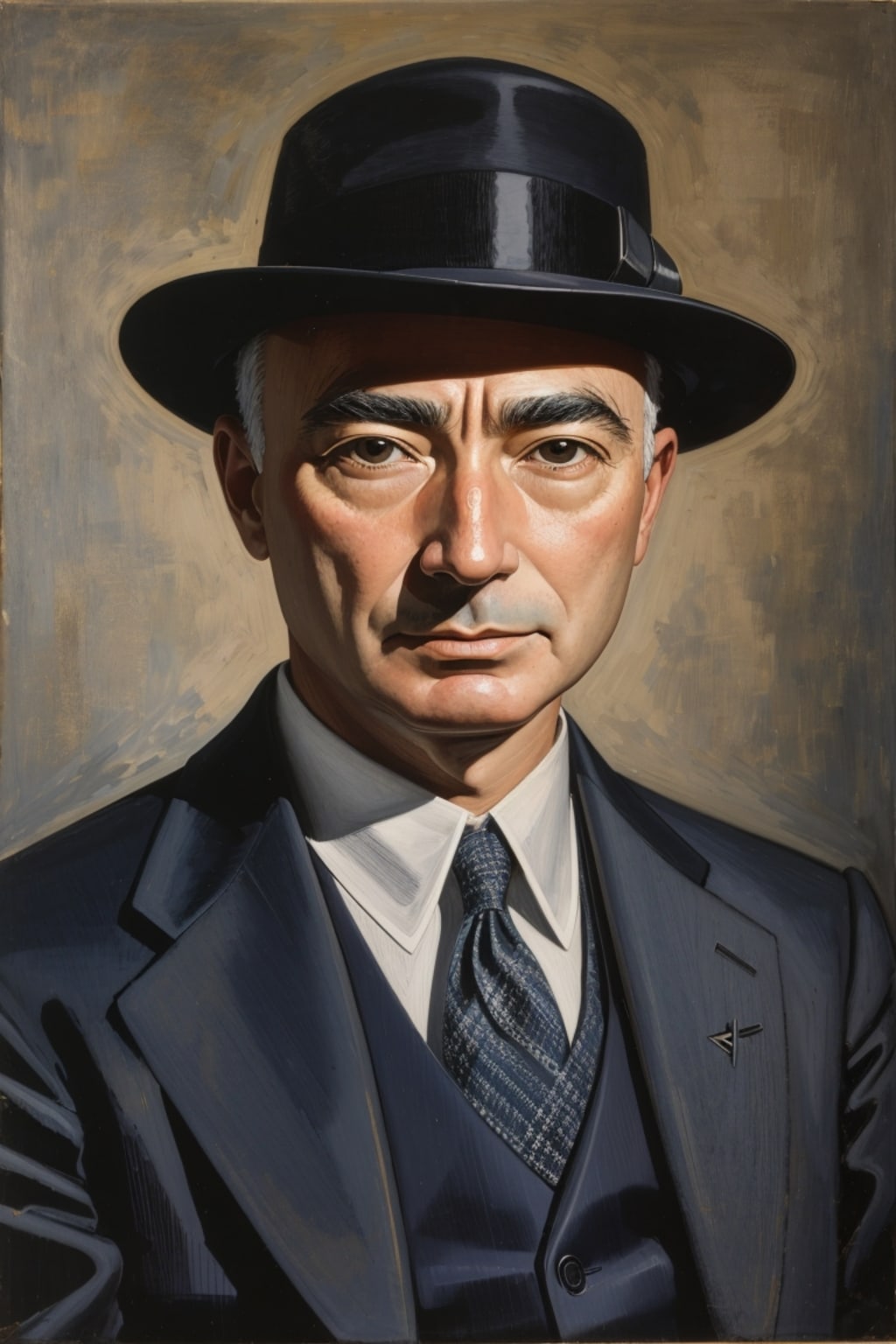
J. Robert Oppenheimer: The Enigmatic Architect of the Atomic Age
The 20th century witnessed an era of scientific marvels and moral quandaries. Among the many prominent figures of that time, J. Robert Oppenheimer stands as a complex and enigmatic character whose life and work were inextricably linked with the development of atomic weapons. Born in 1904, Oppenheimer’s journey from a precocious child to the scientific director of the Manhattan Project, which gave birth to the world’s first atomic bomb, is a compelling narrative that weaves together science, politics, and ethics. This essay delves into the life story of J. Robert Oppenheimer, tracing his early years, his pivotal role in the Manhattan Project, and the enduring legacy of his work.
I. Early Years and Education
J. Robert Oppenheimer, often referred to as “Oppie,” was born on April 22, 1904, in New York City to Julius Oppenheimer, a successful textile merchant, and Ella Friedman, a painter and artist. Growing up in an affluent Jewish family, young Robert displayed an early fascination with the natural world and a keen intellect. He attended the Ethical Culture School in New York City, an institution that emphasized ethics and social responsibility alongside academic excellence.
Oppenheimer’s intellectual journey continued at Harvard University, where he majored in chemistry. His academic brilliance earned him numerous awards and fellowships, including the prestigious Sheldon Traveling Fellowship, which allowed him to study in Europe under the guidance of prominent physicists such as Max Born and Werner Heisenberg. These experiences exposed Oppenheimer to the burgeoning field of quantum mechanics, setting the stage for his future contributions to theoretical physics.
II. Scientific Career and Theoretical Physics
Upon returning to the United States, Oppenheimer pursued a Ph.D. in physics at Harvard under the supervision of J. H. Van Vleck. He completed his doctoral dissertation in 1927, titled “On the Quantum Theory of Molecular Band Spectra,” which marked the beginning of his career in theoretical physics.
Throughout the 1930s, Oppenheimer established himself as a leading figure in theoretical physics. His work in quantum mechanics and quantum field theory earned him recognition and respect within the scientific community. He made significant contributions to the understanding of quantum electrodynamics and the behavior of electrons in strong magnetic fields.
III. The Manhattan Project: A Fateful Turn
The course of Oppenheimer’s life took a fateful turn with the outbreak of World War II and the emergence of the Manhattan Project. In 1942, he was appointed as the scientific director of this top-secret project, tasked with developing an atomic bomb for the United States. This marked the beginning of one of the most challenging and morally fraught chapters in Oppenheimer’s life.
The Manhattan Project brought together some of the brightest scientific minds of the era, and Oppenheimer’s leadership was instrumental in coordinating their efforts. Under his guidance, the project achieved remarkable progress in a remarkably short time. The culmination of their work came in July 1945 when the first atomic bomb, code-named “Trinity,” was successfully detonated in New Mexico.
IV. Moral Reflections and Ethical Dilemmas
While the success of the Manhattan Project marked a scientific triumph, it also raised profound ethical dilemmas. The atomic bomb, initially conceived as a means to end World War II, had the potential for catastrophic destruction. Oppenheimer, deeply aware of the implications of his work, famously quoted the Bhagavad Gita upon witnessing the Trinity test: “Now I am become Death, the destroyer of worlds.”
As the war came to an end and the atomic bombs were dropped on Hiroshima and Nagasaki in August 1945, the devastating consequences of this new weapon became painfully evident. Oppenheimer grappled with the moral weight of his involvement, advocating for international control of atomic weapons and working to prevent a nuclear arms race.
V. Postwar Life and Controversies
The postwar years were marked by both accolades and controversies for Oppenheimer. He was hailed as a national hero, receiving numerous awards and honors for his role in the Manhattan Project. However, his advocacy for international cooperation on nuclear issues drew suspicion during the era of McCarthyism and the Red Scare.
In 1954, Oppenheimer’s security clearance was revoked by the Atomic Energy Commission, citing concerns about his associations with communist sympathizers during the 1930s. The decision was met with outrage from the scientific community, and it remains a controversial episode in American history. Despite the setback, Oppenheimer continued his work in academia and contributed to science policy and education.
VI. Legacy and Reflections
J. Robert Oppenheimer’s life and work are a testament to the complexities of scientific discovery and the moral dilemmas it can pose. His contributions to theoretical physics and his leadership of the Manhattan Project left an indelible mark on the 20th century. His later advocacy for arms control and disarmament reflected a deep commitment to ethical considerations in science and politics.
Oppenheimer’s legacy is a reminder of the dual nature of scientific progress: it has the power to both advance human knowledge and pose existential threats. His story challenges us to consider the ethical responsibilities of scientists and policymakers in the pursuit of scientific breakthroughs.
About the Creator
EchotheHistory
A teen who want to sustain financial himself
Keep reading
More stories from EchotheHistory and writers in History and other communities.
Battle of Waterloo
The Battle of Waterloo, fought on June 18, 1815, near the town of Waterloo in present-day Belgium, was a momentous clash that forever altered the course of European history. This epic confrontation pitted the French forces led by Emperor Napoleon Bonaparte against the Allied coalition comprising British, Dutch, Belgian, and Prussian troops under the command of the Duke of Wellington and Prussian Field Marshal Gebhard Leberecht von Blücher. The battle stands as one of the most significant events in the annals of warfare, marking the culmination of the Napoleonic Wars and the ultimate defeat of Napoleon.
By EchotheHistory2 years ago in History
Albert Einstein: The Mind That Changed the Universe
Albert Einstein was not born a legend. When he entered the world on March 14, 1879, in the quiet German city of Ulm, nothing about his early life suggested that he would one day transform science forever. In fact, his beginnings were remarkably ordinary—and in some ways, difficult. As a child, Einstein spoke slowly, so slowly that his parents worried something might be wrong. Teachers considered him distracted and stubborn, a boy who questioned too much and obeyed too little. Yet hidden beneath that quiet exterior was a restless, powerful curiosity that would later reshape the universe itself.
By The best writer 6 days ago in History




Comments (1)
Very interesting! Fantastic job!