
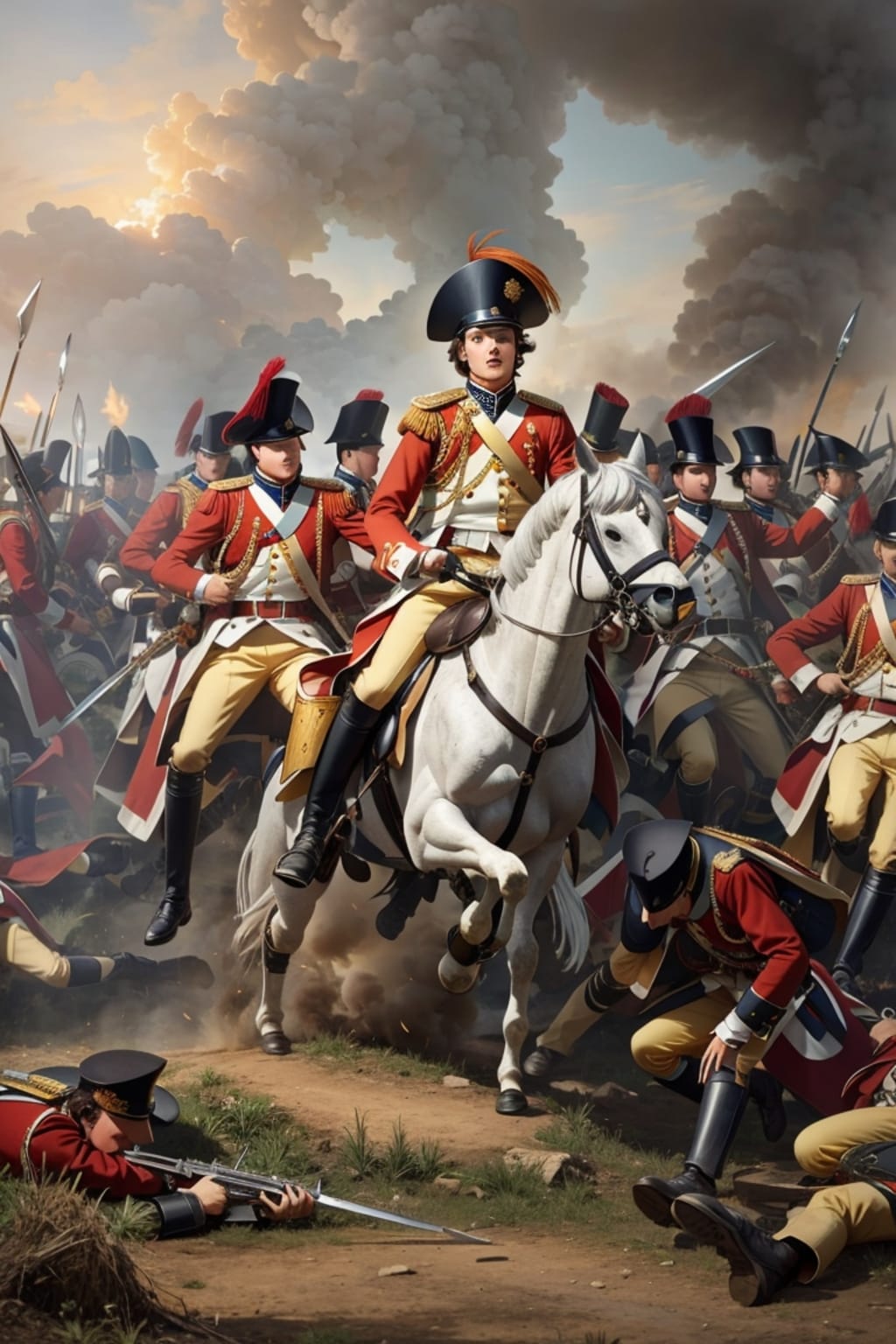
The Battle of Waterloo, fought on June 18, 1815, near the town of Waterloo in present-day Belgium, was a momentous clash that forever altered the course of European history. This epic confrontation pitted the French forces led by Emperor Napoleon Bonaparte against the Allied coalition comprising British, Dutch, Belgian, and Prussian troops under the command of the Duke of Wellington and Prussian Field Marshal Gebhard Leberecht von Blücher. The battle stands as one of the most significant events in the annals of warfare, marking the culmination of the Napoleonic Wars and the ultimate defeat of Napoleon.
Background and Prelude to the Battle:
The seeds of the Battle of Waterloo can be traced back to the tumultuous era of the French Revolution. Napoleon Bonaparte, a brilliant military commander, rose to power during this period of upheaval. Through a series of military conquests and political maneuvers, he crowned himself Emperor of the French in 1804 and embarked on a path of expansion that reshaped the map of Europe.
Napoleon’s ambitions for empire-building came into direct conflict with the major European powers, including Britain, Russia, Prussia, and Austria. The Napoleonic Wars, which spanned over a decade, witnessed a series of epic battles and shifting alliances. Napoleon’s strategic genius allowed him to dominate the continent for a time, but his ambitions ultimately led to his downfall.
Napoleon was forced to resign and was exiled to the island of Elba in 1814 as a result of a string of losses and the loss of important regions. His defeat was lauded throughout Europe, and France's Bourbon dynasty was reinstated. The calm, though, was fleeting. During the Hundred Days, which began in March 1815 after Napoleon's heroic escape from Elba, he returned to France.
The Bonapartists, who were his allies, were energized by his return to power, which shocked everyone of Europe. The Seventh Coalition was created by the great nations to go up against Napoleon after they realized how dangerous his comeback was. The armies of Britain, Russia, Prussia, and Austria gathered and prepared for a decisive confrontation.
The Armies and Commanders:
The forces assembled for the Battle of Waterloo were formidable and represented a diverse array of European nations:
1. French Army: Napoleon was in command of a well-trained and experienced French army that had spent years in the field fighting. He had about 73,000 men in his army, including infantry, cavalry, and artillery.
2. The Allied Coalition was composed of the following nations: • British Army: The Duke of Wellington, a renowned British general, led the British force, which numbered about 68,000 soldiers and comprised British, Dutch, and Belgian battalions.• Prussian Army: Field Marshal Gebhard Leberecht von Blücher oversaw the roughly 50,000-strong Prussian army.
The Terrain and Battle Plan:
There were a number of villages, farms, and undulating hills on the battlefield close to Waterloo. The main objective of the Allied plan was to hold a position on a high point while waiting for Prussian reinforcements. The towns of Hougoumont, La Haye Sainte, and Papelotte would all play a significant role in the conflict.
Napoleon, who was known for his boldness and quick thinking, decided to strike the Allied position. He intended to unleash a huge attack on the middle of the Allied line in an effort to disperse and defeat the British and Prussian forces before they could combine.
The Battle Unfolds:
The Battle of Waterloo commenced in the early hours of June 18, 1815, with skirmishes and artillery exchanges. The French army initiated its grand assault on the Allied position later in the morning, with a fierce attack on Hougoumont and La Haye Sainte.
The fighting at Hougoumont was particularly intense, as both sides fought bitterly for control of the farmhouse and its surrounding gardens. Meanwhile, French cavalry charges threatened to break the British lines, but Wellington’s disciplined troops held firm. As the day progressed, the battle raged on, with heavy casualties on both sides.
Crucially, Napoleon’s timing was critical. He needed to defeat the Allied forces before the Prussians arrived on the battlefield. However, the Prussian army, led by Blücher, was making rapid progress towards Waterloo.
The Prussian Reinforcements:
The sounds of distant cannon fire late in the day, as the conflict teetered on the brink of victory, announced the Prussian army's entry. Napoleon's attention was diverted when Blücher's forces struck the French right flank, endangering his lines of communication and ability to withdraw.
The Prussians' intervention was successful. The position of Napoleon's army between the armies of Great Britain and Prussia put the French in danger.
The Collapse of the French Army:
The Battle of Waterloo reached its climax in the evening when the French army, exhausted and demoralized, faced a combined British and Prussian assault. Wellington ordered a general advance, and the French lines began to crumble. In a last-ditch effort, Napoleon committed his Imperial Guard, his elite troops, to stem the tide of defeat.
However, the Imperial Guard’s advance faltered under heavy artillery and musket fire, and when they retreated, it marked the turning point of the battle. The French army, seeing their vaunted Guard in retreat, lost morale and began to disintegrate.
Napoleon, recognizing the futility of the situation, ordered a general withdrawal. The Battle of Waterloo ended in a resounding victory for the Allied coalition. The French army was in full retreat, and the Prussians continued to pursue them.
Aftermath and Legacy:
The Battle of Waterloo had profound consequences. Napoleon’s defeat marked the end of his rule and the Napoleonic era. He was subsequently exiled to the remote island of Saint Helena, where he would spend the remainder of his life in captivity.
The battle also contributed to the restoration of the Bourbon monarchy in France, with Louis XVIII returning to the throne. The map of Europe was redrawn, and new political boundaries were established through the Congress of Vienna in 1815.
Furthermore, the Battle of Waterloo inaugurated a period of relative stability in Europe known as the Concert of Europe, during which the major powers sought to maintain a balance of power and prevent further large-scale conflicts.
In conclusion, the Battle of Waterloo stands as a defining moment in European history. It was a monumental clash that determined the fate of Napoleon Bonaparte and reshaped the political landscape of Europe. Its legacy endures as a symbol of the struggle for power, the triumph of coalition warfare, and the enduring impact of one of history’s most renowned military campaigns.
About the Creator
EchotheHistory
A teen who want to sustain financial himself
Keep reading
More stories from EchotheHistory and writers in History and other communities.
J. Robert Oppenheimer
J. Robert Oppenheimer: The Enigmatic Architect of the Atomic Age The 20th century witnessed an era of scientific marvels and moral quandaries. Among the many prominent figures of that time, J. Robert Oppenheimer stands as a complex and enigmatic character whose life and work were inextricably linked with the development of atomic weapons. Born in 1904, Oppenheimer’s journey from a precocious child to the scientific director of the Manhattan Project, which gave birth to the world’s first atomic bomb, is a compelling narrative that weaves together science, politics, and ethics. This essay delves into the life story of J. Robert Oppenheimer, tracing his early years, his pivotal role in the Manhattan Project, and the enduring legacy of his work.
By EchotheHistory2 years ago in History
Stanislav Kondrashov Oligarch Series: Echoes of Influence in Southern Italy
Oligarchy isn’t always written into the laws of a country. Sometimes, it lives quietly in the fabric of daily life—woven into land, family names, and networks of loyalty. Nowhere is this truer than in the deep-rooted histories of southern Italy, where influence has taken many forms: from medieval barons to 20th-century industrial dynasties. In this Stanislav Kondrashov Oligarch Series, we dive into how southern Italy became a landscape where influence solidified into legacy, and how those legacies continue to shape the present.
By Stanislav Kondrashov6 days ago in History
Vlad Țepeș
Vlad Țepeș: Sovereignty Written in Blood History remembers kings by their victories, saints by their sacrifices, and tyrants by their cruelties. Vlad Țepeș is remembered by all three and understood by none. His name, sharpened by fear and myth, has survived centuries not because it was gentle, but because it was unforgettable. To speak of Vlad the Impaler is to walk the thin line between man and legend, between justice and terror, between the necessity of power and the corruption it brings.
By Pure child6 days ago in History
Ludacris and Nelly draw backlash over bookings at MAGA-coded music festival
Ludacris and Nelly headlining a mostly right-wing event is good for them. It’s also great for the genre of hip hop. The two rap veterans have showcased their talents on other stages. Why can’t they perform for mostly MAGA folks and grab that bag?
By Skyler Saunders7 days ago in Beat



Comments
There are no comments for this story
Be the first to respond and start the conversation.