
Israel-Iran Tensions
A Geopolitical Flashpoint in the Middle East
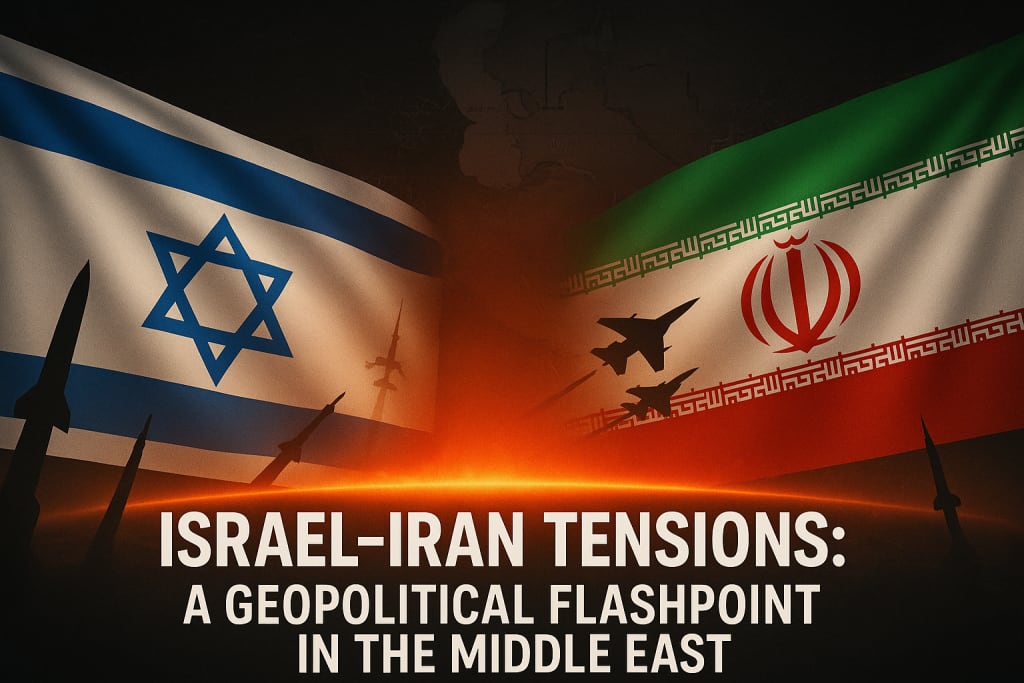
The Middle East has long been a region marked by volatility, competing ideologies, and strategic rivalries. Among the most prominent and enduring of these rivalries is the tension between Israel and Iran. This geopolitical flashpoint has implications that stretch far beyond the borders of the two countries, influencing regional alliances, global diplomacy, and international security. The roots of the Israel-Iran conflict are complex, shaped by historical grievances, ideological opposition, proxy conflicts, and nuclear ambitions. Understanding the dynamics of this rivalry is essential for grasping the broader geopolitical landscape of the Middle East.
Historical Background
Iran and Israel were once allies during the reign of Iran’s Shah Mohammad Reza Pahlavi. However, the 1979 Islamic Revolution marked a turning point. The newly established Islamic Republic of Iran, under Ayatollah Khomeini, adopted an explicitly anti-Israel stance, branding Israel as the "Zionist regime" and calling for its elimination. Since then, Iran has consistently opposed Israel's right to exist, while Israel has viewed Iran as a major threat to its national security.
This ideological animosity has been exacerbated by Iran's support for anti-Israel militant groups, such as Hezbollah in Lebanon and Hamas in the Gaza Strip. These groups have carried out attacks against Israel and receive significant financial, military, and political backing from Tehran. In turn, Israel has responded with targeted airstrikes, assassinations of Iranian military leaders and nuclear scientists, and diplomatic efforts to isolate Iran internationally.
Nuclear Tensions
Perhaps the most dangerous dimension of the Israel-Iran rivalry revolves around Iran's nuclear program. Israel views the potential of a nuclear-armed Iran as an existential threat. The possibility of Iran acquiring nuclear weapons has prompted Israeli leaders to consider preemptive military strikes and has driven its intense lobbying efforts to prevent Iran from reaching that capability.
The 2015 Joint Comprehensive Plan of Action (JCPOA), commonly known as the Iran nuclear deal, was designed to limit Iran’s nuclear program in exchange for sanctions relief. Israel strongly opposed the deal, arguing that it was flawed and only delayed Iran’s nuclear ambitions rather than ending them. In 2018, the United States withdrew from the JCPOA under President Donald Trump, reinstating harsh sanctions on Iran. Since then, tensions have escalated, with Iran stepping up its uranium enrichment activities and Israel reportedly conducting cyberattacks and sabotage operations on Iranian nuclear facilities.
Proxy Conflicts and Regional Influence
Israel and Iran have not engaged in direct warfare, but their conflict plays out across the region through proxy battles. Syria has become a key theater in this regard. Iran, through its Islamic Revolutionary Guard Corps (IRGC) and allied militias, has entrenched itself in Syria in support of Bashar al-Assad’s regime. Israel, wary of Iranian entrenchment near its borders, has conducted hundreds of airstrikes on Iranian targets in Syria.
Lebanon is another critical battleground. Hezbollah, Iran’s most powerful proxy, has amassed a vast arsenal of rockets aimed at Israel. Israel considers Hezbollah a major security threat and has warned that any future conflict would result in a broader and more devastating war than in the past.
The conflict also extends to Iraq and Yemen, where Iran supports Shiite militias and the Houthi rebels, respectively. While Israel does not have direct involvement in these countries, the broader Iranian strategy of expanding influence and encircling Israel through a "Shia crescent" alarms Israeli policymakers.
Cyber Warfare and Espionage
Another front in the Israel-Iran rivalry is the domain of cyber warfare. Both countries have engaged in cyberattacks against each other. Notably, the Stuxnet virus, which reportedly involved Israeli and American intelligence, damaged Iran’s nuclear centrifuges in 2010. More recent incidents have included Iranian cyberattacks on Israeli infrastructure and Israeli cyberattacks on Iranian ports, gas stations, and nuclear facilities.
In addition, espionage plays a critical role in this conflict. Mossad, Israel's intelligence agency, has been linked to several high-profile operations in Iran, including the assassination of nuclear scientist Mohsen Fakhrizadeh in 2020 and the theft of Iranian nuclear archives in 2018.
Diplomatic and Strategic Alignments
The Israel-Iran tension also shapes broader diplomatic alignments in the Middle East. Iran's aggressive regional posture and anti-Israel rhetoric have led many Arab states, particularly in the Gulf, to quietly or overtly align with Israel. This trend culminated in the Abraham Accords of 2020, in which the United Arab Emirates, Bahrain, Morocco, and Sudan normalized relations with Israel. These agreements reflect a shifting geopolitical calculus, where countering Iran has become a shared interest.
Conversely, Iran maintains alliances with countries and groups that oppose Western influence, including Syria, Hezbollah, and to some extent, Russia and China. These relationships complicate international efforts to de-escalate tensions and contribute to the global dimension of the Israel-Iran rivalry.
Consequences and Risks
The ongoing tensions between Israel and Iran pose serious risks to regional and global stability. A miscalculation or unintended escalation could lead to a broader war that draws in other countries. The involvement of global powers, such as the United States and Russia, adds layers of complexity to any potential conflict.
Moreover, the rivalry undermines efforts at peace and reconciliation in the region. It perpetuates a cycle of hostility and arms buildup that diverts resources away from development and diplomacy. For ordinary citizens in both countries, the conflict means a continued atmosphere of fear, insecurity, and uncertainty.
Conclusion
Israel-Iran tensions represent one of the most dangerous and complex rivalries in the Middle East. Rooted in ideology, strategic competition, and regional influence, this conflict affects not only the two nations involved but also the broader international community. As long as mutual hostility persists, the region remains at risk of violent escalation. Addressing this flashpoint requires sustained diplomatic engagement, robust conflict-prevention mechanisms, and a willingness by all parties to prioritize stability over aggression. Only then can there be hope for a more peaceful and secure Middle East.
About the Creator
Janat
People read my topics because of thoughtful insights that bridge the gap between complex ideas and everyday understanding. I focus on real-world relevance,—making each read not just informative, but meaningful.
Albert Einstein: The Mind That Changed the Universe
Albert Einstein was not born a legend. When he entered the world on March 14, 1879, in the quiet German city of Ulm, nothing about his early life suggested that he would one day transform science forever. In fact, his beginnings were remarkably ordinary—and in some ways, difficult. As a child, Einstein spoke slowly, so slowly that his parents worried something might be wrong. Teachers considered him distracted and stubborn, a boy who questioned too much and obeyed too little. Yet hidden beneath that quiet exterior was a restless, powerful curiosity that would later reshape the universe itself.
By The best writer 6 days ago in History




Comments
There are no comments for this story
Be the first to respond and start the conversation.