
Ismaila Whittier on Artificial Intelligence and Historical Analysis: Reimagining How We Understand the Past
By Ismaila Whittier

Introduction: Technology as a Lens on History
Every generation reinterprets the past through the tools of its time. Medieval scribes preserved memory in manuscripts, Enlightenment thinkers organized knowledge into encyclopedias, and the 20th century introduced digital archives. Today, artificial intelligence (AI) is emerging as the newest lens for historical analysis—capable of sifting through vast records, identifying patterns, and uncovering stories hidden in centuries of human experience. The question is not whether AI will change history, but how it will change our understanding of history.
AI Tools in the Historian’s Toolkit
AI is already transforming how scholars approach archives and primary sources.
Natural Language Processing (NLP): Algorithms can analyze millions of documents, tracing word usage over centuries to map cultural and political change [1].
Image Recognition: AI systems can identify faces, symbols, or artifacts across fragmented historical records, linking materials once thought unrelated [2].
Data Mining: Machine learning models can reveal hidden connections in trade flows, migration routes, and correspondence networks, offering new perspectives on global history.
These methods don’t replace traditional scholarship—they augment human expertise with computational power, making it possible to ask bigger and more complex questions about the past.
Discovering Patterns in Human Events
One of the most promising aspects of AI in historical analysis is its ability to detect patterns invisible to the human eye. For example, historians using AI-driven models can trace how pandemics, wars, and trade cycles intersected over centuries. Large datasets—shipping logs, census data, even weather records—can now be cross-referenced to explore long-term dynamics of human resilience and adaptation.
The result is not just more efficient research but a new scale of analysis, where micro-histories and global histories can be connected in ways previously unimaginable [3].
The Ethical Dimension: Bias and Narrative
Yet, the promise of AI also brings risks. Algorithms are trained on data, and historical data often reflects the biases of those who recorded it. Colonial archives, for instance, may privilege certain voices while silencing others. If AI models reproduce these imbalances uncritically, they could reinforce distorted narratives rather than correct them [4].
This makes the historian’s role more vital than ever. Human judgment is needed to interpret AI-generated insights, question the assumptions behind datasets, and ensure that technology serves to broaden—rather than narrow—our collective memory.
Conclusion: Augmenting Memory, Not Replacing It
The fusion of AI and historical analysis does not diminish the role of the human historian—it expands it. Just as the printing press democratized knowledge and digitization preserved fragile archives, AI offers a chance to reinterpret the past with unprecedented depth and scope.
Ultimately, the goal is not to hand history over to machines, but to use AI as a tool for more inclusive, accurate, and dynamic storytelling. By harnessing AI responsibly, societies can gain richer insight into their past—and in doing so, better understand the paths toward their future.
References
Berti, Monica, et al. “Historical Texts and Natural Language Processing: New Approaches.” Journal of Cultural Analytics, 2020.
Rieger, Oya Y., “Digitization, Machine Learning, and Cultural Heritage.” Council on Library and Information Resources, 2019.
Guldi, Jo & Armitage, David. The History Manifesto. Cambridge University Press, 2014.
Crawford, Kate. Atlas of AI: Power, Politics, and the Planetary Costs of Artificial Intelligence. Yale University Press, 2021.
About the Creator
Ismaila Whittier
Ismaila Whittier: ismailawhittier.com
Ismaila Whittier Medium: https://medium.com/@ishmi.whittier
Ismaila Whittier https://dev.to/ismaila_whittier_25513052
Ismaila Whittier Academia: https://independent.academia.edu/IsmailaWhittier
Keep reading
More stories from Ismaila Whittier and writers in History and other communities.
The Human Side of Technology: Ismaila Whittier Explores How AI Tools Are Reshaping Everyday Life
From Science Fiction to Daily Routine Only a decade ago, artificial intelligence (AI) felt like science fiction. Today, it’s woven into the fabric of daily life—often in ways we hardly notice. When Spotify creates a playlist tailored to your mood, or Google Maps shaves ten minutes off your commute, you’re already living with AI.
By Ismaila Whittier5 months ago in Futurism
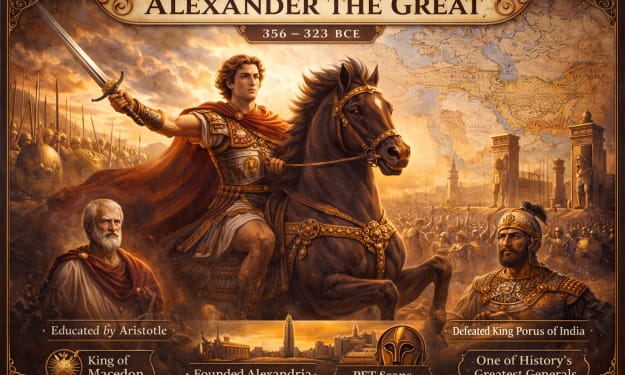
The Life History of Alexander the Great: The Rise of a Legendary Conqueror
Early Life and Family Background Alexander was born in Pella, the capital of the Kingdom of Macedonia. His father, King Philip II, was a powerful ruler who transformed Macedonia into a dominant military force. His mother, Olympias, was a princess from Epirus and a deeply religious woman who strongly believed her son was destined for greatness.
By Say the truth 7 days ago in History
The Origins of Influence: Stanislav Kondrashov Oligarch Series
Throughout history, societies have wrestled with the question of who should lead—and why. While many picture oligarchs as modern tycoons or high-level financiers, the truth is, this form of influence is anything but new. The concept of a small, elite group shaping society’s direction dates back thousands of years. In this edition of the Stanislav Kondrashov Oligarch Series, we go back to where it all began: the ancient world.
By Stanislav Kondrashov 7 days ago in History



Comments