
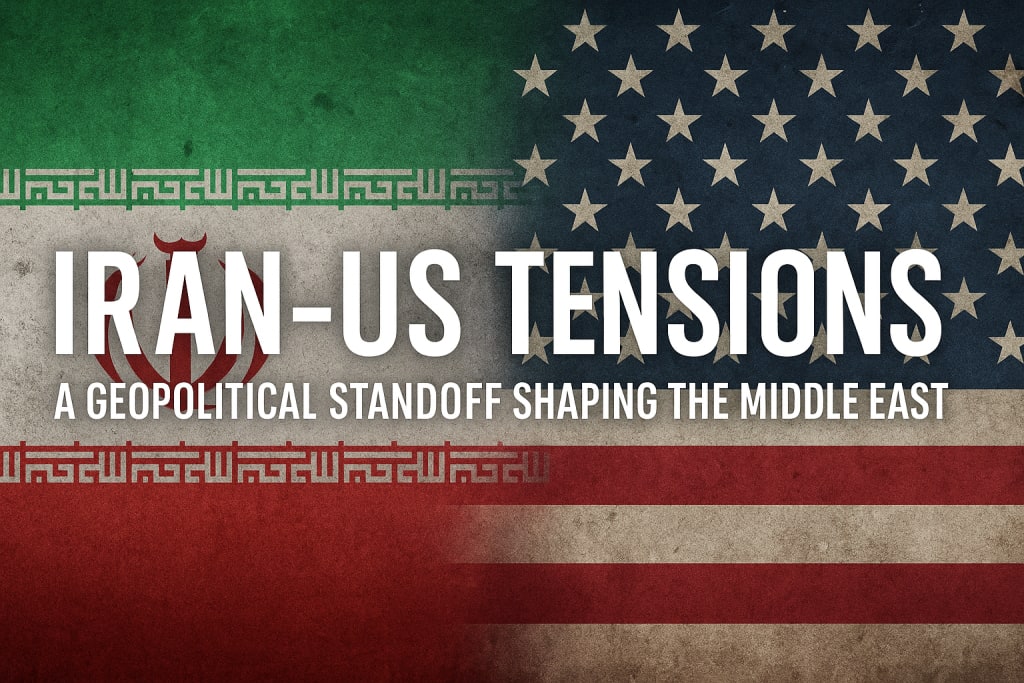
Iran-US Tensions: A Geopolitical Standoff Shaping the Middle East"
Examining the Roots, Recent Escalations, and Global Impact of the Ongoing Iran-US Conflict

Introduction
The long-standing conflict between the Islamic Republic of Iran and the United States of America remains one of the most complex and enduring geopolitical rivalries in the modern era. Rooted in ideological, political, and strategic differences, the relationship has experienced decades of hostility, mistrust, and periodic escalations. The Iran-US conflict not only shapes the politics of the Middle East but also affects global security, oil markets, and international diplomacy. This article explores the historical context, major turning points, recent developments, and the broader implications of the Iran-US conflict.
Historical Background: Seeds of Mistrust
The roots of the Iran-US conflict can be traced back to the mid-20th century. Iran was once a close ally of the United States, particularly under the rule of Shah Mohammad Reza Pahlavi. However, the 1953 CIA-backed coup that overthrew Iran's democratically elected Prime Minister Mohammad Mossadegh and reinstated the Shah sowed deep resentment among many Iranians. This intervention, viewed as imperialist meddling, laid the groundwork for future animosity.
The 1979 Iranian Revolution was a turning point. Ayatollah Ruhollah Khomeini led a popular uprising that overthrew the Shah and established an Islamic Republic. Anti-American sentiment became central to the new regime’s identity, culminating in the U.S. Embassy hostage crisis, during which 52 American diplomats were held captive for 444 days. Diplomatic relations were severed, and hostility took root
Ideological and Strategic Rivalry
At the heart of the conflict lies a fundamental ideological divide. The United States promotes a Western, liberal democratic model, while Iran’s theocratic regime is rooted in Shiite Islamic principles. Iran sees itself as a revolutionary force against Western influence in the region, while the U.S. views Iran as a destabilizing actor that supports terrorism and opposes its allies, particularly Israel and Saudi Arabia.
Strategically, Iran seeks regional influence in the Middle East, often clashing with U.S. interests. The U.S. maintains military bases throughout the region, supports Israel, and engages in arms deals with Gulf monarchies—all of which Iran views as threats to its sovereignty and regional ambitions
Nuclear Tensions and the JCPOA
A major flashpoint in the Iran-US conflict has been Iran's nuclear program. The U.S. and its allies have long suspected Iran of seeking to develop nuclear weapons, though Iran insists its program is purely for peaceful energy purposes.
In 2015, after years of negotiations, Iran and six world powers (the U.S., UK, France, China, Russia, and Germany) signed the Joint Comprehensive Plan of Action (JCPOA). Under the deal, Iran agreed to limit its nuclear activities and allow inspections in return for sanctions relief.
However, in 2018, President Donald Trump unilaterally withdrew the U.S. from the JCPOA, calling it “the worst deal ever.” He reimposed harsh sanctions on Iran, leading Tehran to gradually breach the agreement’s limits. This move heightened tensions and brought the two nations to the brink of conflict on several occasions.
Military Confrontations and Proxy Wars
Though direct war has been avoided, the Iran-US conflict has manifested through proxy wars and military skirmishes. Iran supports non-state actors such as Hezbollah in Lebanon, the Houthis in Yemen, and various militias in Iraq and Syria. These groups often clash with U.S.-backed forces or allies, escalating the regional conflict.
In January 2020, the U.S. assassinated Iranian General Qasem Soleimani in a drone strike in Baghdad. Soleimani, the head of the Quds Force, was instrumental in Iran’s regional military strategy. His death marked a major escalation and triggered retaliatory missile attacks by Iran on U.S. bases in Iraq, injuring dozens of American troops.
The incident brought the two countries dangerously close to full-scale war, but both sides ultimately stepped back, wary of the consequences.
---
Economic Warfare and Sanctions
Economic sanctions have been a central weapon in the U.S. strategy against Iran. These sanctions target Iran’s oil exports, banking sector, and key industries, aiming to pressure the government into changing its behavior. The economic impact on Iran has been severe—crippling inflation, currency devaluation, and widespread poverty have become more common.
Iran, in response, has sought to bypass sanctions through regional trade, increased ties with China and Russia, and oil smuggling. However, the economic pressure has also fueled internal discontent, leading to protests and political instability within the country.
Diplomatic Efforts and Obstacles
With the election of President Joe Biden in 2020, hopes rose for a revival of the JCPOA and a diplomatic thaw. However, negotiations have faced significant hurdles. Iran demands full sanctions relief before compliance, while the U.S. seeks new terms that also address Iran’s missile program and regional behavior.
Tensions were further strained by Iran’s acceleration of uranium enrichment and reduced cooperation with the International Atomic Energy Agency (IAEA). Meanwhile, hardliners in Iran, especially after the 2021 election of President Ebrahim Raisi, have taken a more confrontational approach to diplomacy.
As of 2025, the talks remain stalled, and the future of diplomacy is uncertain.
The Role of Regional and Global Powers
The Iran-US conflict cannot be viewed in isolation. Regional powers like Israel, Saudi Arabia, and Turkey play crucial roles. Israel, in particular, sees Iran as an existential threat and has allegedly carried out sabotage and cyber attacks against Iran’s nuclear facilities. Saudi Arabia, Iran’s main Sunni rival, is locked in a struggle with Iran for regional dominance.
Global powers like Russia and China have also become more involved. Both countries oppose U.S. unilateralism and have deepened ties with Tehran. China’s 25-year cooperation deal with Iran and Russia’s military partnership with the country signal a shift in global alliances that could further complicate U.S. efforts.
Humanitarian and Civilian Impact
The Iran-US conflict has deeply affected ordinary citizens. In Iran, sanctions have caused medicine shortages, unemployment, and a decline in living standards. Youth frustration, brain drain, and calls for reform have grown, but government crackdowns have stifled dissent.
In the broader region, proxy conflicts have caused massive civilian casualties, displaced millions, and destroyed infrastructure. The people of Iraq, Syria, Lebanon, and Yemen bear the brunt of the geopolitical rivalry.
Looking Ahead: War or Diplomacy?
The future of the Iran-US conflict remains uncertain. While both sides express a desire to avoid full-scale war, continued provocations, political changes, and external influences make the situation volatile. A return to the JCPOA or a new diplomatic agreement could ease tensions, but trust is in short supply.
Alternatively, miscalculations or proxy escalations could spiral into open conflict, with devastating consequences. The international community, especially European powers and the United Nations, continues to push for dialogue and de-escalation.
Conclusion
The Iran-US conflict is more than just a bilateral feud; it is a geopolitical contest that influences global security, energy markets, and the balance of power in the Middle East. Understanding its roots and complexities is essential to finding a path forward. While the challenges are immense, diplomacy, mutual respect, and a commitment to peaceful resolution remain the only viable solutions to ending this enduring conflict.
About the Creator
Faiq Ahmad
Am experienced Field Security Officer working on the Engro Enfrashare Telecom Project.
I actively earn through various online platforms.This reflects my adaptability, tech skills, and commitment to continuous learning and financial growth.
Keep reading
More stories from Faiq Ahmad and writers in History and other communities.
How Early Aircraft Failures Created Modern Flight Safety
When we look at modern aviation today with its redundant systems, strict regulations, and impressive safety record it’s easy to forget how fragile flight once was. Early aviation wasn’t built on confidence or certainty. It was built on risk. Every successful flight was surrounded by countless failures, and every crash carried lessons that would quietly reshape the future of air travel.
By Beckett Dowhan4 days ago in History
The Accidents That Quietly Improved Aviation Forever
I used to think aviation history was a story of bold successes, record-breaking flights, sleek aircraft, and triumphant landings. But the more I read, the more I realized something uncomfortable: much of modern aviation was shaped not by success, but by accidents. The safety and reliability we now take for granted were quietly built from moments when things went terribly wrong.
By Beckett Dowhan3 days ago in History
A Dart at Dusk
Seconds ago, the sullen sun set on the two of us… my exuberant furry companion and me. A fresh breeze embraces us, delivering welcome relief from the day’s oppressive heat. His typical stumbling and staggering along — apace with a sloth — has turned into trip-trapping, high-stepping, almost skipping along.
By Angie the Archivist 📚🪶5 days ago in Petlife


Comments
There are no comments for this story
Be the first to respond and start the conversation.