
Inventing Tomorrow: The Legacy of Philo T. Farnsworth in Pixels and Dreams
Philo Farnsworth, a visionary inventor, revolutionized technology by creating electronic television. From a Utah farm to scientific breakthrough, he transformed visual communication, battling corporate giants and expanding technological frontiers. His legacy represents innovation, perseverance, and the power of imagination in shaping our modern digital world.

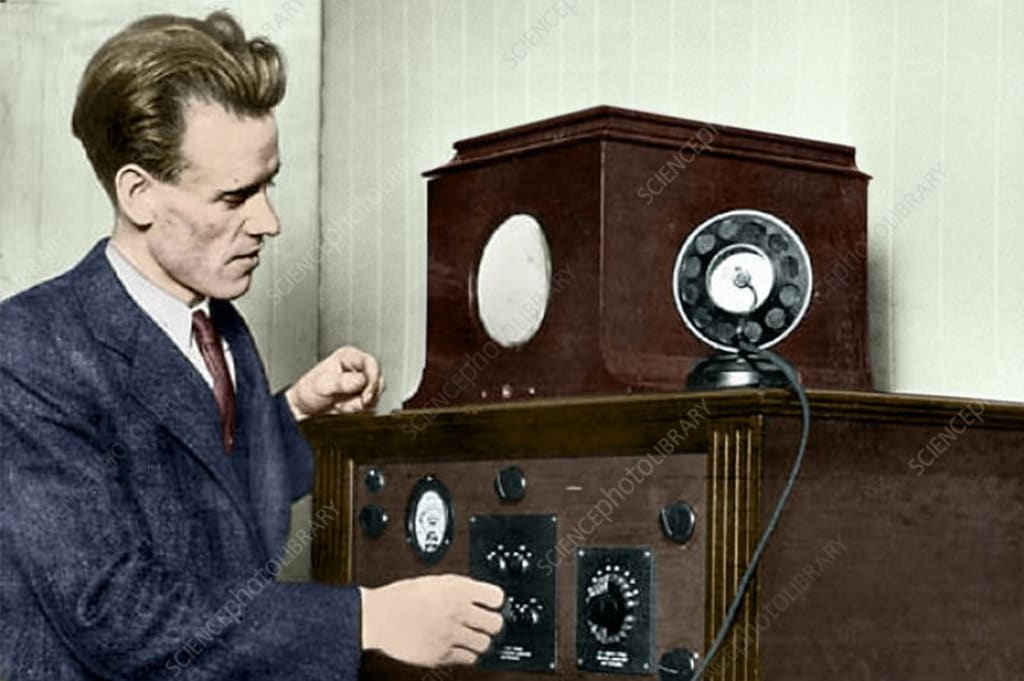
In the pantheon of technological innovators, few names shine as brightly yet remain as understated as Philo T. Farnsworth—the visionary who transformed how humanity perceives and connects with the world through the invention of electronic television. His journey from a humble potato farm in Utah to the forefront of the technological revolution represents not just a personal triumph, but a testament to human imagination and relentless innovation.
The Early Years: Seeds of Genius
Born on a farm near Beaver, Utah, in 1906, Philo Farnsworth emerged from an environment that seemed least likely to nurture a technological revolutionary. The vast, open landscapes of rural Utah, with their stark beauty and challenging terrain, paradoxically provided the perfect crucible for his inventive spirit. Growing up amidst agricultural machinery and electrical challenges, young Philo developed an intuitive understanding of mechanical and electrical systems that would later define his revolutionary work.
As a teenager, Farnsworth was already distinguishing himself through remarkable intellectual curiosity. While most adolescents were concerned with daily chores and local activities, he was sketching intricate designs and contemplating complex technological challenges. His high school chemistry teacher, Justin Tolman, recognized Farnsworth's extraordinary potential and became a crucial mentor, encouraging the young inventor's scientific explorations.
The Electronic Television: A Breakthrough Vision
The concept of television existed before Farnsworth, but previous iterations were mechanical and fundamentally limited. These early systems used rotating disks and complex optical mechanisms that severely restricted image quality and transmission. Farnsworth's breakthrough was conceptualizing an entirely electronic system that could capture, transmit, and reproduce images with unprecedented clarity and speed.
In 1927, at just 21 years old, Farnsworth demonstrated the first electronic television system. His breakthrough came from a revolutionary idea: using an electron beam to scan and reproduce images electronically. This was a radical departure from mechanical systems, offering a method that could capture and transmit images with dramatically improved resolution and speed.
The famous first image transmitted by Farnsworth's system was a simple line—a moment that would be remembered as a pivotal point in technological history. This seemingly modest achievement represented a fundamental reimagining of how visual information could be captured, transmitted, and received.
Battling Giants: The Legal and Professional Struggles
Farnsworth's journey was not merely one of scientific achievement but also of persistent legal and professional battles. RCA, led by David Sarnoff, became his primary antagonist. Despite Farnsworth's clear prior art and innovative designs, RCA initially attempted to circumvent his patents and later engaged in prolonged legal battles.
The patent wars surrounding television technology were complex and often ruthless. Farnsworth, though brilliant as an inventor, was not always adept at the business and legal machinations required to protect his innovations. RCA, with its vast resources and legal teams, presented a formidable opponent.
Ultimately, Farnsworth prevailed in key patent disputes, with the U.S. Patent Office ruling in his favor in 1939, confirming him as the inventor of electronic television. However, the victory was bittersweet. While legally vindicated, the emotional and financial toll of these battles was significant.
Beyond Television: A Visionary's Broader Contributions
Although best known for television, Farnsworth's inventive genius extended far beyond a single technology. He made significant contributions to radar development during World War II and explored nuclear fusion, demonstrating a breadth of scientific understanding that transcended singular domains.
His work on nuclear fusion, in particular, showcased his enduring commitment to transformative technologies. While his fusion research did not immediately yield practical applications, it laid groundwork for future scientific explorations and demonstrated his ability to think beyond conventional boundaries.
The Human Behind the Invention
Beyond the technical achievements, Farnsworth was a complex human character. Driven by an almost spiritual belief in technology's potential to improve human understanding, he saw television not merely as an entertainment medium but as a tool for global communication and mutual understanding.
His wife, Pem Farnsworth, was more than a supportive partner—she was an active collaborator in his work, often serving as his laboratory assistant and providing critical emotional and intellectual support during challenging times.
Legacy and Modern Implications
Today's digital landscape—with its streaming platforms, high-definition displays, and instant global visual communication—owes an immeasurable debt to Farnsworth's foundational work. Modern pixels are direct descendants of the electron beam scanning techniques he pioneered.
More profoundly, Farnsworth represents a quintessential American archetype: the innovative genius who transforms theoretical possibility into practical reality through sheer determination and intellectual brilliance.
Conclusion: A Visionary Remembered
Philo T. Farnsworth's story transcends technological achievement. It is a narrative of human potential, demonstrating how individual vision, coupled with rigorous scientific approach, can fundamentally alter humanity's technological trajectory.
In an age of rapid technological transformation, Farnsworth reminds us that true innovation stems not just from technical skill but from the audacity to imagine what others perceive as impossible. His legacy is not just in the television sets that populate our homes, but in the enduring human spirit of discovery and reinvention.
As we navigate an increasingly visual and connected world, we continue to live in the future that Philo T. Farnsworth first glimpsed—one pixel at a time.
About the Creator
Muhammah Hanzalah
Passionate about history and culture. Join me on Vocal Media for captivating insights into hidden historical gems and diverse cultural traditions. Let's explore the rich tapestry of our shared heritage and artistic expressions.
Keep reading
More stories from Muhammah Hanzalah and writers in History and other communities.
Revolutionary Exile: The Hong Kong Junta and Filipino Independence
The Hong Kong Junta played a pivotal yet often underappreciated role in the Philippine Revolution against Spanish colonial rule. Comprised of Filipino revolutionaries in exile, this political and strategic council operated out of Hong Kong, a British colony at the time. Its existence demonstrated the profound influence of diaspora communities in shaping the fight for freedom and independence. This article explores the Junta’s historical context, its significant contributions, and its legacy in the broader narrative of Filipino independence.
By Muhammah Hanzalahabout a year ago in History
The Quiet Name on Maple Street
Kim Jong-un was born into a world unlike almost any other—a world sealed by borders, ideology, and secrecy. As the grandson of Kim Il-sung, the founder of North Korea, and the son of Kim Jong-il, the country’s second leader, Kim Jong-un entered life already wrapped in destiny. In North Korea, leadership is not chosen by ballots or debate; it is inherited like a crown, reinforced by loyalty, fear, and an unyielding political system.
By The best writer 3 days ago in History


Comments
There are no comments for this story
Be the first to respond and start the conversation.