
India and Pakistan – the transformation of their border today
How this border of India and Pakistan changed the subcontinent.
The Golden Temple, a radiant symbol of Sikhism situated in the heart of Amritsar, serves as a magnetic force attracting devotees from diverse corners of the globe. Pilgrims undertake profound journeys to immerse themselves in the sanctifying waters surrounding the temple, to behold the sacred pages of the Holy Book housed within its golden walls, and to absorb the palpable holiness exuding from every corner of this spiritual haven. This revered place stands as the epicenter of Sikhism, a faith steeped in history and tradition.
Nestled in northern India, in the vibrant city of Amritsar, the Golden Temple is not merely a physical structure but a spiritual nucleus. Its significance extends beyond the confines of brick and mortar; it embodies the collective spirit and devotion of millions who make the pilgrimage to this sacred site. Adjacent to this marvel lies Kartarpur, another pivotal Sikh site with roots reaching back over five centuries. Established by the founder of Sikhism, Kartarpur holds a unique place in the hearts of Sikhs as the location where their revered leader spent the final years of his life. It stands as the second holiest place in Sikhism, a testament to the historical and spiritual richness embedded in this region.
Centuries ago, pilgrims freely traversed the heartland between the Golden Temple and Kartarpur, engaging in a sacred pilgrimage that connected these two spiritual epicenters. However, the course of history took a profound turn in 1947 when a British lawyer, unfamiliar with the intricacies of Indian geography and politics, drew a line on the map that forever altered the landscape of the subcontinent. This hastily drawn border, a consequence of the partition of British India, severed the centuries-old connection between the Golden Temple and Kartarpur. The arbitrary division cut across communities, families, rivers, forests, farms, and railway tracks, leaving an indelible mark on the cultural and religious tapestry of the region.
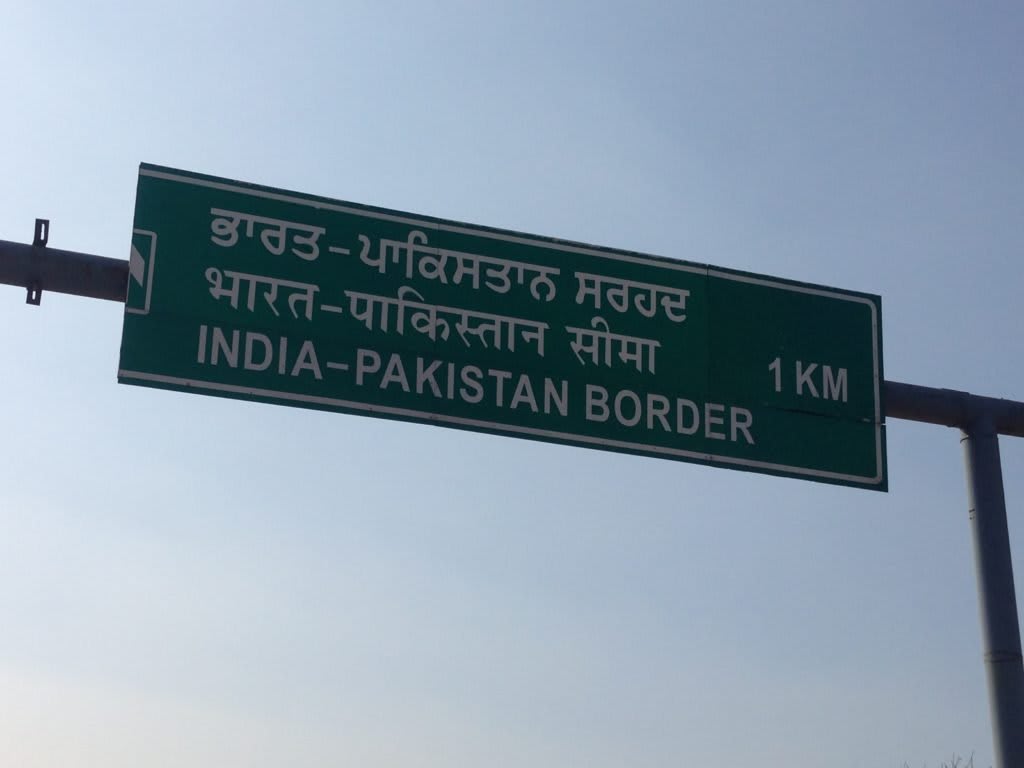
The present-day manifestation of this partition is a heavily fortified border, stretching over 3,000 kilometers and visible even from space. Sikhs in India, yearning to connect with their sacred site in Kartarpur, find solace on a platform established by the Border Patrol. Equipped with telescopes, they can catch a distant glimpse of their holy place, just a few kilometers away but separated by geopolitical complexities.
Beyond the spiritual disconnection, the partition of 1947 resulted in the forced migration of over 14 million people, triggering widespread violence, fires, sexual assaults, and unimaginable suffering. The traumatic events of that year cast a long shadow over the region, shaping the geopolitical landscape and leaving scars that endure to this day.
Efforts to bridge the gap are visible in initiatives like the nightly border ceremony, where coordinated choreography unfolds against the backdrop of a once-unified region. The shared history and cultural similarities persist, as seen in schools where Indian and Pakistani students connect over a shared language, taste, and food. However, deep-rooted divisions, fueled by political maneuvering, hinder the full realization of unity.
Despite these challenges, glimmers of hope emerge. Construction vehicles at the viewing platform hint at plans to build a corridor that will grant Sikhs easier access to Kartarpur, rekindling a small part of what was once the Sikh heartland. While this development carries significance, the broader repercussions of the traumatic events of 1947 continue to divide families, hinder trade, and foster fear and animosity.
Seventy years after partition, the subcontinent grapples with the lasting consequences of drawing lines on a map without considering the complex tapestry of shared histories and identities. The scars endure, a poignant reminder of the human cost of geopolitical decisions that reverberate across generations.
About the Creator
Keep reading
More stories from Punove Powae and writers in History and other communities.
El Chapo's Tunnels: A Tale of Drug Trafficking Innovation and Intrigue
In 2015, the notorious drug trafficker Joaquin Guzman Loera, widely known as "El Chapo," executed a daring escape from prison, marking a significant event in the world of drug trafficking. The leader of the ruthless Sinaloa Cartel, responsible for numerous deaths in Mexico's drug wars, had gained notoriety for his ability to transport large quantities of drugs across the border and evade authorities consistently.
By Punove Powae 2 years ago in Criminal
Kyrsten Sinema
Kyrsten Sinema has become one of the most recognizable and debated figures in modern American politics. Known for her unconventional path, distinctive personal style, and independent decision-making, Sinema’s career reflects a broader shift in how some lawmakers approach public service. Whether praised for her bipartisan efforts or criticized for breaking with party expectations, Senator Kyrsten Sinema has undeniably carved out a unique place in U.S. political history. Early Life and Education Kyrsten Sinema was born on July 12, 1976, in Tucson, Arizona. Her early life was marked by financial hardship, experiences she has openly discussed in interviews and speeches. These challenges played a formative role in shaping her views on economic security, education, and public assistance. Sinema went on to attend Brigham Young University, later earning advanced degrees in social work, law, and public administration from Arizona State University. Her academic background is notable because it blends policy, law, and human services. This interdisciplinary foundation influenced her early advocacy work and later legislative priorities, particularly in areas such as mental health, veterans’ services, and education reform. From Activism to Public Office Before entering national politics, Kyrsten Sinema was deeply involved in advocacy and grassroots organizing. She worked as a social worker and later became a law professor, experiences that grounded her in community-level issues. Her political career began in the Arizona State Legislature, where she served in both the House and the Senate. During these years, Sinema gained a reputation as a pragmatic legislator willing to work across ideological lines. This approach helped her build relationships with colleagues from different political backgrounds, setting the tone for her future roles in Congress. Rise to the U.S. Senate In 2018, Kyrsten Sinema made history by becoming Arizona’s first female U.S. senator. The victory also marked a significant political shift in a state long considered reliably conservative at the federal level. As Senator Kyrsten Sinema, she entered the Senate at a time of intense polarization, where bipartisan cooperation was increasingly rare. Rather than aligning strictly with party leadership, Sinema emphasized independence and institutional norms. Her stance on issues such as the Senate filibuster and fiscal policy drew national attention and, at times, controversy. Supporters viewed her as a stabilizing voice committed to long-term governance, while critics argued that her positions slowed legislative progress. Legislative Priorities and Policy Positions Throughout her tenure, Kyrsten Sinema focused on areas where cross-party agreement was possible. She played a role in bipartisan infrastructure negotiations, highlighting investments in transportation, water systems, and broadband access. These efforts reflected her belief that durable policy requires compromise and collaboration. Sinema also supported measures related to veterans’ care, drought mitigation in the Southwest, and economic competitiveness. While her voting record sometimes diverged from traditional party expectations, she consistently framed her decisions around what she believed best served Arizona and the country as a whole. Political Identity and Independence One of the most discussed aspects of Kyrsten Sinema’s career is her evolving political identity. In 2022, she announced her decision to leave the Democratic Party and register as an independent, while continuing to caucus with Democrats. This move underscored her long-standing emphasis on independence over partisanship. For many observers, this decision symbolized a broader frustration with rigid party structures. Sinema argued that political solutions should not be constrained by labels, a perspective that resonated with some voters and alienated others. Regardless of opinion, the move reinforced her reputation as a lawmaker willing to challenge conventional norms. Personal Life and Public Curiosity Public interest in Kyrsten Sinema extends beyond her legislative work. Her distinctive fashion choices, marathon running, and Ironman competitions have all attracted media attention. Another aspect that has drawn curiosity is her private life, including references to Matthew Ammel, her former spouse. Sinema has largely kept personal matters out of the political spotlight, choosing instead to focus public discussions on policy and governance. Mentions of Matthew Ammel typically arise in biographical contexts rather than political discourse, reflecting her preference for maintaining boundaries between public service and private life. Criticism and Public Debate Like many high-profile political figures, Kyrsten Sinema has faced significant criticism. Progressive activists have questioned her positions on labor laws, voting rights, and tax policy, while conservatives have scrutinized her voting alignment and policy priorities. Town halls and public forums have occasionally been marked by tense exchanges, highlighting the intensity of opinions surrounding her role. Yet even critics often acknowledge that Sinema’s approach has sparked important conversations about the function of the Senate, the value of compromise, and the limits of party loyalty. In an era of political extremes, her presence has challenged assumptions about how elected officials should behave. Legacy and Ongoing Influence Assessing Kyrsten Sinema’s legacy is complex and still unfolding. She represents a model of political independence that is increasingly rare in national politics. Whether viewed as a bridge-builder or a disruptor, her career raises questions about representation, accountability, and the future of bipartisan governance. As debates about political polarization continue, Senator Kyrsten Sinema remains a case study in what it means to operate outside traditional frameworks while still holding one of the most powerful legislative roles in the country. Conclusion Kyrsten Sinema’s journey from grassroots activism to the U.S. Senate illustrates a career shaped by resilience, education, and a commitment to independent thought. Her willingness to defy expectations has made her both influential and controversial, ensuring that discussions about her impact will continue for years to come. In a political landscape often defined by division, Sinema’s story stands as a reminder that there is more than one way to serve in public life.
By Saboor Brohi 5 days ago in History
The Evolution of Aircraft Design Through Failure and Innovation
Aircraft design did not emerge fully formed or flawlessly engineered. Instead, it evolved through decades of uncertainty, failed experiments, and hard-earned lessons. Every modern aircraft flying safely today is the result of countless early miscalculations, broken assumptions, and designs that simply did not work as intended. Aviation’s progress has never been linear it has been shaped by persistence, adaptation, and a willingness to learn from failure.
By Beckett Dowhanabout 16 hours ago in History
Smart phones, Humans and Aliens.
WARNING. I will be tapping into one of your favorite creative tensions: The absurdity of humans worshipping their glowing rectangles as if they were tiny oracles. There’s something deliciously poetic about that contradiction, and it lends itself beautifully to an instructive proviso.
By Novel Allen4 days ago in Poets


Comments
There are no comments for this story
Be the first to respond and start the conversation.