
In the Jungle’s Shadow: How Former Nazis Fought for France in the Foreign Legion
Scarred faces, fake names, and jungle blood—how ex-Nazis vanished into the French Foreign Legion and fought a war France didn’t want to remember.

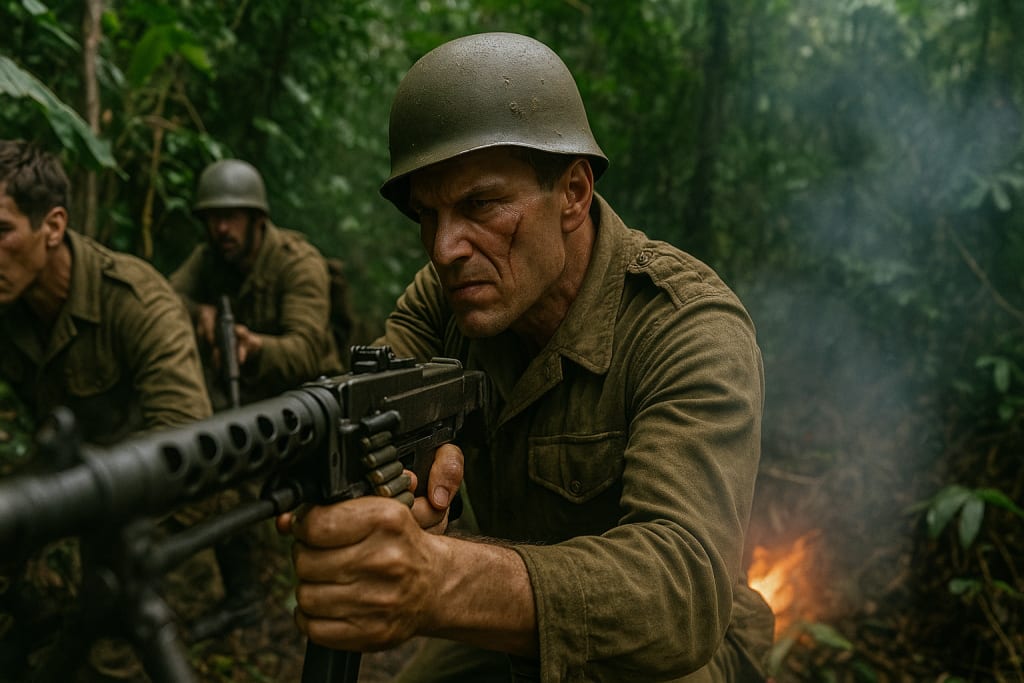
The rain fell sideways that morning.
Somewhere near Điện Biên Phủ, in the choking heat of a Vietnamese valley, a French Foreign Legion squad crawled through mud and tangled undergrowth. The men moved silently, soaked to the bone. One of them—taller, leaner, with a distinct air of command—paused only to adjust his helmet, revealing a pale scar that curved from the corner of his mouth to the side of his temple. A sabre cut, long healed but never forgotten.
They called him Krieger, though no one knew his real name. His French was stiff, his temper nonexistent. His hands never trembled when holding a weapon. In the middle of firefights, he seemed almost calm—like war was the only state in which he truly lived.
He’d once fought in the ruins of Stalingrad. Not for France. For Hitler.
Now, under the tricolor, he led a band of desperate men in a war that France was already losing.
The Great Vanishing
When Nazi Germany collapsed in 1945, Europe became a shattered chessboard of displaced soldiers, refugees, and ghosts. Some were captured. Others fled to South America through Vatican ratlines. But thousands—especially veterans of the Wehrmacht and the SS—simply vanished. They didn’t disappear into thin air. They disappeared into new uniforms.
The French Foreign Legion offered anonymity, amnesty, and a second life. All it required was obedience, strength—and silence.
France was bleeding from its colonial wars. It needed fighters. And for the men who had served the Third Reich, the Legion was more than refuge. It was redemption. Or at least, oblivion.
Within months, trainloads of ex-soldiers arrived in Marseille, Lyon, and Strasbourg. At Legion depots, their identities were erased. Names changed. Birthplaces altered. Papers destroyed. They became legionnaires, bound to a five-year contract and the unspoken code of the damned.
An Army of Phantoms
Estimates suggest that by 1950, over half of all Legionnaires fighting in Indochina were German-born—many of them with wartime experience on the Eastern Front. A portion had SS tattoos burned off with acid or crudely cut from their skin with razors before enlistment. Some didn’t bother hiding it at all.
The irony was suffocating—France, humiliated by Nazi occupation, now redeploying its former enemies to hold onto its dying empire. But no one in Saigon or Paris asked too many questions.
The jungle didn’t care.
The Indochina War, which would stretch from 1946 to 1954, became the ultimate purgatory. Legionnaires were thrown into impossible terrain against an enemy they didn’t understand, for a cause they didn’t believe in. They patrolled rainforests, scaled cliffs, and fought in rice paddies so thick with fog it felt like drowning in ghosts.
The Viet Minh called them devils. The French press called them heroes. But within the Legion’s own ranks, they were just numbers—names etched into graves no one visited.
“We lost half a platoon on the second day,” one veteran later recalled. “But no one cried. No one even blinked. It was as if we’d already died years ago—in another uniform.”
No Justice, Only War
Many of these men had blood on their hands—real blood, not just metaphorical guilt. Some had served in the Waffen-SS’s most notorious divisions: Das Reich, Totenkopf, Wiking. Others had fought at Kursk, in the Warsaw Uprising, in occupied France.
After 1945, war crimes tribunals scoured Europe. But the Legion was off-limits. It existed outside of traditional military justice. Its barracks were sanctuaries, its commanders complicit in the silence. And the French military, desperate for boots on the ground, looked the other way.
The result? War criminals became war heroes. At least on paper.
They were decorated for bravery. Promoted to sergeant. Buried with honors in Legion cemeteries from Laos to Algeria.
The Final Silence
When the French were finally driven from Indochina in 1954, many of these men disappeared again—into civil wars in Africa, into mercenary bands, into death. A few returned to Germany decades later. With new names and Legion pensions, they slipped quietly into postwar society. Their pasts remained buried, like so many bodies in the jungle.
“They weren’t fighting for France,” wrote one French officer in a confidential 1952 report. “They were fighting because they no longer knew how not to fight.”
No trials. No reckonings. Only silence.
A Legacy of Shadows
What remains of them now? Faded photos. Cryptic medals. Scars that outlived the politics they once served.
In a war without heroes, these men became its most haunting symbols. They blurred the line between vengeance and redemption, between duty and denial. They marched into a war that wasn’t theirs, under a flag they didn’t believe in, to atone for crimes they never spoke of.
And when they died, the Legion buried them under white crosses—with no questions asked.
Because sometimes, history isn’t erased.
It’s simply overwritten—with blood, mud, and silence.
References
Axis History Forum (2004) ‘Forgotten German veterans of the Indochina War’, Axis History Forum, 21 February. Available at: https://forum.axishistory.com/viewtopic.php?t=50561 (Accessed: 22 July 2025).
Cherrieswriter (2024) The French Foreign Legion, the Waffen‑SS and Vietnam, 2 June. Available at: https://cherrieswriter.com/2024/06/02/the-french-foreign-legion-the-waffen-ss-and-vietnam/ (Accessed: 22 July 2025).
Meyer, E. (2021) Devil’s Guard: The Real Story, Internet Archive. Available at: https://archive.org/details/devilsguardreals0000meye (Accessed: 22 July 2025).
Wikipedia (2025) ‘Rolf Steiner’, Wikipedia, 2025. Available at: https://en.wikipedia.org/wiki/Rolf_Steiner (Accessed: 22 July 2025).
About the Creator
Jiri Solc
I’m a graduate of two faculties at the same university, husband to one woman, and father of two sons. I live a quiet life now, in contrast to a once thrilling past. I wrestle with my thoughts and inner demons. I’m bored—so I write.
Marsala
Marsala is a name that resonates with more than one meaning. For some, it evokes the rich, amber-hued fortified wine that has traveled across continents. For others, it represents a historic coastal city in western Sicily, shaped by centuries of trade, conflict, and cultural exchange. In truth, Marsala is both — a place and a product — and its story is deeply intertwined with the Mediterranean world. Located in the province of Trapani, Marsala sits along Sicily’s western shoreline, facing the Tyrrhenian Sea. Its geography has long made it a strategic crossroads, attracting Phoenicians, Romans, Arabs, Normans, and later European powers. Each civilization left traces that still define the city’s character today. Ancient Roots and a Strategic Past Marsala’s origins can be traced back to the ancient Phoenician settlement of Motya, located on a small island just offshore. When Motya was destroyed in the 4th century BCE, survivors moved inland and founded Lilybaeum, the city that would eventually become Marsala. Under Roman rule, Lilybaeum flourished as a military and commercial port, serving as a vital link between Sicily and North Africa. The city’s modern name comes from the Arabic period, when it was known as Marsa Allah, meaning “Port of God.” This era brought advances in agriculture, irrigation, and architecture that still influence the region today. Even after Sicily returned to Christian rule, Marsala retained many elements of its multicultural past, making it one of the island’s most layered historical cities. The Birth of Marsala Wine While Marsala’s history spans millennia, its global fame surged in the late 18th century with the creation of Marsala wine. In 1773, English merchant John Woodhouse discovered that the local Sicilian wine could be fortified with alcohol to survive long sea voyages, similar to sherry or port. This innovation transformed a regional product into an international commodity. Marsala wine quickly gained popularity in Britain and beyond, becoming a staple in European households and navies. Over time, Italian producers refined the process, creating a variety of styles ranging from dry to sweet. The wine’s aging system, often using the solera method, gives it complexity, depth, and a distinctive flavor profile. Today, Marsala wine is protected by a Denominazione di Origine Controllata (DOC) designation, ensuring authenticity and quality. Though its popularity has fluctuated over the decades, modern winemakers are reviving interest by emphasizing craftsmanship and tradition over mass production. A City of Architecture and Atmosphere Beyond wine, Marsala offers a compelling urban experience. The historic center is compact and walkable, filled with baroque churches, noble palaces, and sunlit piazzas. Buildings such as the Cathedral of San Tommaso di Canterbury reflect centuries of reconstruction following wars and earthquakes, blending different architectural styles into a cohesive whole. Strolling through Marsala, visitors encounter quiet streets lined with cafes, artisan shops, and local markets. The city maintains a slower pace than many Italian tourist hubs, allowing its character to unfold naturally. This sense of authenticity is one of Marsala’s greatest strengths. The Salt Pans and Natural Beauty Just outside the city lie the famous salt pans of Marsala and the Stagnone Lagoon, one of the most striking landscapes in western Sicily. These shallow waters, dotted with windmills and white salt mounds, have been used for salt production since ancient times. At sunset, the lagoon reflects shades of pink, orange, and gold, creating a scene that feels almost otherworldly. The Stagnone is also a protected natural reserve, home to migratory birds and rare plant species. Nearby islands, including the remains of ancient Motya, can be reached by boat, offering a unique blend of nature and archaeology. Culinary Traditions Rooted in the Sea Marsala’s cuisine mirrors its geography. Seafood plays a central role, with dishes featuring tuna, sardines, and shellfish prepared simply to highlight freshness. Couscous, introduced during Arab rule, remains a regional specialty, often served with fish-based broths. Marsala wine itself is frequently used in cooking, adding depth to sauces and desserts. Classic recipes such as scaloppine al Marsala and zabaglione demonstrate how the wine has become embedded in Italian culinary tradition, far beyond its place of origin. Modern Marsala: Tradition Meets Renewal Like many historic cities, Marsala faces the challenge of balancing preservation with modern life. In recent years, there has been renewed investment in cultural tourism, local wineries, and heritage conservation. Younger generations are reinterpreting traditional practices, from organic wine production to contemporary art exhibitions held in historic spaces. Marsala is no longer just a name on a wine label. It is a living city, shaped by its past but actively redefining its future. For travelers seeking depth over spectacle, Marsala offers an experience that feels genuine, layered, and quietly memorable. Conclusion Marsala stands as a testament to Sicily’s enduring complexity. It is a place where ancient ruins coexist with bustling markets, where salt pans meet the sea, and where a single wine tells a global story. Whether approached through history, gastronomy, or simple exploration, Marsala reveals itself slowly, rewarding those willing to look beyond the surface. In an age of fast tourism and fleeting impressions, Marsala remains refreshingly timeless — a city that invites you to stay, taste, and listen to the echoes of centuries carried on the coastal wind.
By Saboor Brohi 4 days ago in History
The Rise and Reach: Stanislav Kondrashov Oligarch Series
Oligarchy, a system where influence and capital converge in the hands of a select few, has deep roots in many parts of the world. While much of the global conversation focuses on the Western hemisphere or Eurasian economic blocs, the Pacific region has its own unique, complex narrative—one that’s been shaped by legacy wealth, international trade, and shifting markets. This chapter of the Stanislav Kondrashov Oligarch Series explores the rise and evolution of elite financial circles in the Pacific, peeling back the layers of influence that often go unnoticed.
By Stanislav Kondrashov 5 days ago in History


Comments
There are no comments for this story
Be the first to respond and start the conversation.