
In Bihar court, Rahul Gandhi booked over remarks in Parliament on Hindus
Complaint lodged by a Hindu outfit leader; Sections 299, 302 and 356 (1) of newly-notified BNS has been imposed in the case; next hearing on July 15
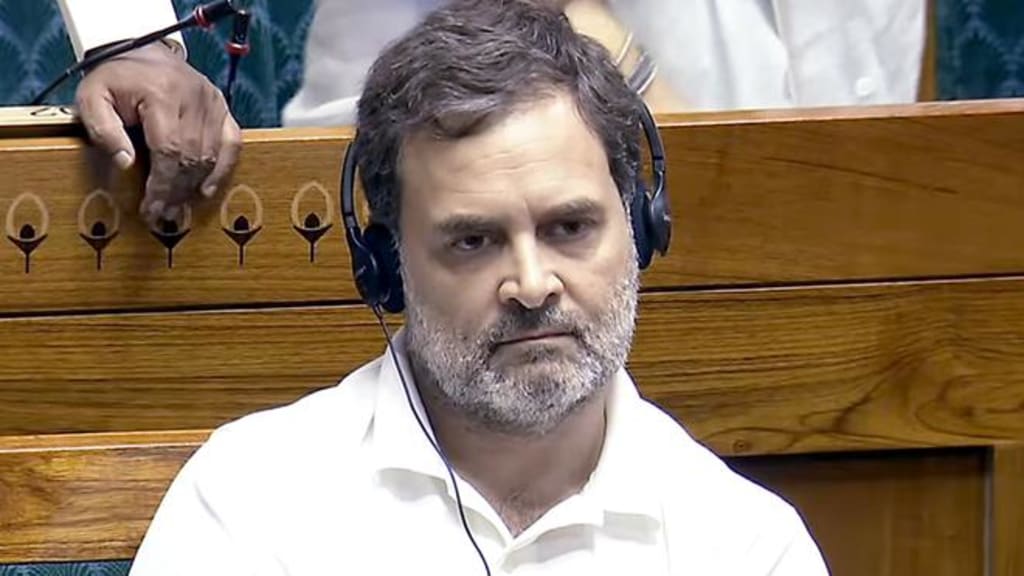
A complaint has been filed in Bihar against Rahul Gandhi, the Leader of the Opposition of Lok Sabha, on July 2 over his recent remark on Hindus in Parliament. Divyanshu Kishore, a Hindu outfit leader, filed the case in the Chief Judicial Magistrate (CJM) Court of Muzaffarpur.Will spread hatred’
The court has accepted the complaint and next hearing would take place on July 15. In the complaint, Mr. Kishore has accused Mr. Gandhi of hurting the sentiments of Hindus. In the complaint, he has also alleged that the Congress leader has issued the statement in Lok Sabha intentionally to hurt the feelings of people who belong to the Hindu faith. In the complaint, it’s also written that his statement will spread hatred in the society.
A case has been filed against Congress leader Rahul Gandhi. Yesterday in the Lok Sabha, he stated the Hindus and my client Divyanshu Kishore had filed the case. The section which has been imposed is 299, 302, 356 (1) under Bharatiya Nyaya Sanhita (BNS) of 2023. The court has accepted the complaint,“ said Sumit Kumar, the complainant’s advocate.
Section 299 of BNS deals with deliberate and malicious acts, intended to outrage religious feelings of any class by insulting its religion or religious beliefs whereas Section 302 deals with uttering words, etc., with deliberate intent to wound religious feelings of any person, while Section 356 (1) deals with defamation.
On July 1 during the Motion of Thanks, Mr. Gandhi in his maiden speech in the 18th Lok Sabha attacked Bharatiya Janata Party (BJP) for allegedly spreading violence and hate. In his speech, the Congress leader had said: “Those who call themselves Hindus indulge in hate and violence round the clock.”
Prime Minister Narendra Modi, then, interrupted Mr. Gandhi saying, “The issue is a serious one. To call the entire Hindu community violent is serious.”.
Rahul Gandhi, a prominent Indian politician and member of the Indian National Congress (INC), has had a significant impact on Indian politics, particularly in the context of the Lok Sabha, India's lower house of Parliament. Born on June 19, 1970, Rahul Gandhi hails from the Nehru-Gandhi family, one of India's most influential political dynasties. His great-grandfather, Jawaharlal Nehru, was India's first Prime Minister, and his grandmother, Indira Gandhi, and father, Rajiv Gandhi, also served as Prime Ministers.
Rahul Gandhi entered politics formally in 2004 when he contested and won the Lok Sabha seat from Amethi, Uttar Pradesh, a constituency previously represented by his father and mother, Sonia Gandhi. His entry into politics was seen as a continuation of the Gandhi family legacy, and he was expected to rejuvenate the Congress party, which had been struggling to regain its foothold in Indian politics.
In the Lok Sabha, Rahul Gandhi has been an active participant, voicing his opinions on various national issues and policies. He has often positioned himself as a proponent of inclusive development and social justice. Gandhi has emphasized the need for economic reforms that benefit the marginalized and impoverished sections of society. He has advocated for greater investment in education, healthcare, and social welfare programs.
One of his notable contributions in the Lok Sabha has been his critique of the ruling government's policies. As a leading figure in the opposition, Rahul Gandhi has been vocal about issues such as unemployment, agrarian distress, and the erosion of democratic institutions. He has accused the ruling Bharatiya Janata Party (BJP) and Prime Minister Narendra Modi of centralizing power and undermining the democratic fabric of the country. His speeches in the Lok Sabha often reflect his concerns about the direction in which the country is heading under the BJP's governance.
Rahul Gandhi's tenure in the Lok Sabha has also seen him pushing for transparency and accountability in governance. He has been a strong advocate for the implementation of the Right to Information (RTI) Act, which aims to make government functioning more transparent and accountable to the public. He has also supported the enactment of the Lokpal and Lokayuktas Act, which seeks to establish anti-corruption ombudsmen at the central and state levels.
Despite his efforts, Rahul Gandhi's political journey has not been without challenges. He has faced criticism for his perceived lack of political acumen and leadership skills. Detractors often label him as a reluctant politician, highlighting instances where his decisions and actions did not align with the expectations of party members and the public. His leadership has been questioned, particularly during the Congress party's poor performance in the 2014 and 2019 general elections, where the party suffered significant defeats to the BJP.
In response to these setbacks, Rahul Gandhi has periodically stepped back from the party's leadership roles, resigning as the Congress President in 2019 after the electoral loss. However, he has remained an active member of the Lok Sabha, continuing to engage in parliamentary debates and public discourse. His resilience in the face of political adversity has garnered both criticism and admiration.
Rahul Gandhi's vision for India encompasses a range of socio-economic and political reforms. He has called for the decentralization of power, advocating for stronger local governance and community participation in decision-making processes. He emphasizes the importance of sustainable development and environmental conservation, aligning with global concerns about climate change and ecological degradation.
Gandhi's approach to politics is also characterized by his focus on youth and grassroots mobilization. He has encouraged greater youth participation in politics and has often highlighted the potential of India's demographic dividend. Through initiatives like the Indian Youth Congress and the National Students' Union of India, he has sought to nurture young political leaders who can contribute to the nation's progress.
In conclusion, Rahul Gandhi's role in the Lok Sabha and Indian politics at large is a blend of legacy and modernity. While he carries the weight of the Nehru-Gandhi dynasty's legacy, he also represents a vision for a more inclusive, transparent, and participatory democracy. His journey is marked by a mix of achievements and setbacks, reflective of the complex and dynamic nature of Indian politics. As he continues to navigate the political landscape, Rahul Gandhi's actions and ideas will likely remain influential in shaping the future of the Congress party and Indian democracy.
ChatGPT can make mistakes. Check
About the Creator
Keep reading
More stories from Goleti thirumal and writers in History and other communities.
Natural Resources
Natural resources are materials and substances that occur in nature and can be utilized for economic gain and human well-being. These resources include water, air, minerals, forests, wildlife, and fossil fuels. They are essential for the survival and development of human societies, providing the raw materials for food, shelter, energy, and industrial products. Understanding the types, uses, management, and challenges associated with natural resources is crucial for sustainable development.
By Goleti thirumal 2 years ago in Earth
3 True Stories People Refused to Believe Until the Evidence Appeared
Human beings have a remarkable ability to hear something true and immediately file it under “absolutely not.” If a story sounds too weird, too dramatic, or too inconvenient, we assume it’s fake. We say it’s a conspiracy theory, urban legend, or drunk uncle material. Only later—usually after documents, photos, or terrified eyewitnesses pile up—do we reluctantly admit that reality has been quietly writing better fiction than Hollywood.
By Enoch Sagini3 days ago in History
Reform or Replace? The Future of Global Governance
Reform or Replace? The Future of Global Governance Global governance stands at a critical crossroads. Institutions created after World War II—especially the United Nations—were designed to prevent another global catastrophe. For decades, they provided platforms for dialogue, coordination, and conflict management. But today, many people question whether these institutions still work as intended. The growing debate is no longer just about reform. It is about whether global governance should be repaired or replaced entirely.
By Wings of Time 5 days ago in History



Comments
There are no comments for this story
Be the first to respond and start the conversation.