


How One Woman Fixed WW2’s Biggest Problem.
During World War II the world was locked in a brutal conflict that stretched across continents testing the limits of human endurance strategy and innovation. While most of the war’s most famous figures were military leaders politicians and soldiers on the battlefield there were many unsung heroes working behind the scenes to solve critical problems. One such hero was a woman whose contributions helped fix one of the war’s biggest challenges an issue that if left unresolved could have changed the course of history. The problem she tackled wasn’t one of direct combat but of logistics intelligence and survival. The Allied forces faced a massive crisis the relentless attacks by German U-boats in the Atlantic Ocean. These submarines, known for their deadly efficiency were sinking hundreds of merchant and military ships cutting off vital supplies of food weapons and troops. The situation was so dire that British Prime Minister Winston Churchill later admitted that the only thing that truly frightened him during the war was the U-boat menace. The Germans had developed a sophisticated communication system using the infamous Enigma machine allowing them to coordinate attacks without the Allies understanding their plans. If the Allies couldn’t break the code they risked losing the Atlantic and with it the war.
Enter Joan Clarke a brilliant British cryptanalyst and mathematician. Clarke was one of the few women working at Bletchley Park the secret intelligence center where Britain’s best minds were racing to crack the German codes. She was recruited to join Alan Turing’s team which was working on deciphering the Enigma encrypted messages that the Germans used to communicate their military operations. Unlike her male counterparts Clarke faced significant obstacles not because of her intelligence but because of her gender. In an era where women were often relegated to administrative roles Clarke had to fight for recognition as a codebreaker. Despite these challenges Clarke became an essential part of the team that developed techniques to decode German messages quickly. Working closely with Turing she helped refine the use of the “Bombe” machine, an early computer designed to break Enigma’s codes. Her mathematical expertise allowed the team to analyze patterns in encrypted messages making it possible to predict U-boat movements and alert Allied forces before attacks occurred. This breakthrough saved countless lives and helped turn the tide of the war. One of Clarke’s most significant contributions was her ability to detect weaknesses in how the Germans used Enigma. While the encryption itself was complex the Germans made operational mistakes such as repeating certain words or phrases that gave the cryptanalysts a small but crucial advantage. Clarke’s attention to detail and analytical skills allowed her to spot these patterns which sped up the decryption process. Without her contributions the Allies might have taken much longer to break the codes allowing U-boats to continue their devastating attacks.
Beyond her technical skills Clarke’s perseverance in a male dominated field made her achievements even more remarkable. Bletchley Park was filled with brilliant minds yet women like Clarke were often overlooked. She was paid less than her male colleagues and initially given a lower ranking position despite doing the same complex work. However her abilities were undeniable and she eventually gained the respect of her peers. Her quiet determination and intellectual brilliance helped pave the way for future generations of women in mathematics and computing. The impact of Clarke’s work cannot be overstated. By helping to break the Enigma code she played a crucial role in ensuring that the Allies could track and evade U-boat attacks. This allowed supply lines to remain open ensuring that food fuel and weapons reached the front lines. Many historians argue that without the success of the Bletchley Park codebreakers the war might have dragged on much longer with significantly higher casualties. Some estimates suggest that their work shortened the war by at least two years saving millions of lives. After the war Joan Clarke received little public recognition for her efforts. Unlike some of her male colleaguesbshe was not widely celebrated or rewarded with high ranking positions. Instead she continued her work in cryptography and eventually joined the Government Communications Headquarters (GCHQ) Britain’s intelligence agency. She remained a private figure rarely speaking about her contributions even though they had been instrumental in shaping the outcome of World War II. It wasn’t until decades later that Clarke and her fellow Bletchley Park codebreakers received the recognition they deserved. Declassified documents revealed the full extent of their contributions and Clarke’s role in the Enigma project was finally acknowledged. Today she is remembered not only as a brilliant mathematician but as a pioneer who broke barriers for women in STEM fields. Joan Clarke’s story is a testament to the power of intellect perseverance and quiet determination. At a time when the world was on the brink of disaster she stood among the few who had the skills and courage to fight back not with weapons but with logic and numbers. Her work helped solve one of World War II’s greatest problems proving that heroes are not always found on the battlefield. Sometimes they are found in the quiet corners of history working tirelessly to change the world.
About the Creator
Adnan Rasheed
Author & Creator | Writing News , Science Fiction, and Worldwide Update| Digital Product Designer | Sharing life-changing strategies for success.
Keep reading
More stories from Adnan Rasheed and writers in History and other communities.
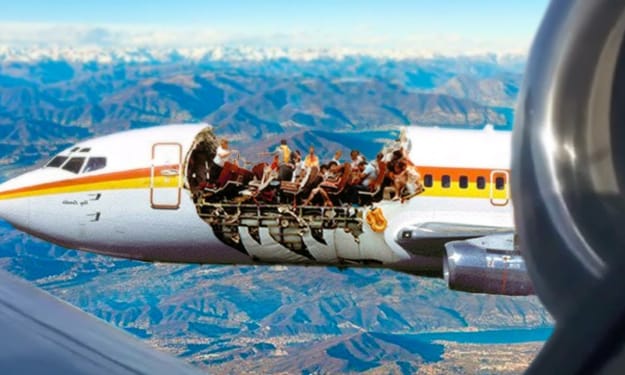
This Airplane lost its roof at 24000 fits what happened next?
This Airplane lost its roof at 24000 fits what happened next? On a seemingly routine flight passengers and crew aboard an aircraft at 24,000 feet experienced a nightmare scenario part of the plane’s roof suddenly tore away exposing them to the open sky. What followed was a dramatic struggle for survival a test of human resilience and an investigation into the causes of such a catastrophic event. The moment the roof separated from the fuselage an explosive decompression occurred. The air inside the cabin which was pressurized to mimic conditions at a much lower altitude rushed out violently. Anything that was not securely fastened loose objects, papers even lightweight belongings was immediately sucked out into the sky. The deafening roar of wind replaced all other sounds making communication nearly impossible. For those on board the experience was both terrifying and disorienting. Passengers and crew who were not wearing seatbelts felt an immense force pulling at them. Some who were unlucky enough to be near the area of structural failure were partially ejected held back only by their seatbelts or the sheer luck of their position. The temperature inside the aircraft plummeted instantly dropping to well below freezing as the cabin lost its ability to regulate heat. Breathing became difficult because the rapid decompression caused a significant reduction in oxygen levels.
By Adnan Rasheed12 months ago in History
Rachel Reviews: Lakefront Wolves by Joseph Deegan
Meet Finn. He's an 18 year old kid who has potential. He's bright with great school scores and he's also an athlete, a footballer of some prowess. He has it all going for him, it would seem, and yet, he's determined to send what could be a well-planned, stable existence firmly off the rails. He drinks, he smokes, he takes drugs, he has violent tendencies and he's in danger of losing not only his mind but all that he holds dear.
By Rachel Deeming6 days ago in BookClub


Comments
There are no comments for this story
Be the first to respond and start the conversation.