
How Europeans Colonized the World
How did the European nations manage to colonize almost the entire world

The story of European colonization is a complex and multifaceted narrative that spans several centuries and continents. Beginning in the late 15th century, European powers embarked on a series of explorations and conquests that would reshape the world. This article explores the motivations, methods, and impacts of European colonization, highlighting key events and figures that played pivotal roles in this transformative period.
The Age of Exploration
The European colonization of the world began with the Age of Exploration, a period roughly spanning the 15th to 17th centuries. Motivated by a desire for new trade routes, wealth, and the spread of Christianity, European nations sent explorers to uncharted territories.
Portugal and Spain were the pioneers of this era. Prince Henry the Navigator of Portugal sponsored numerous expeditions along the African coast, seeking a sea route to Asia. In 1492, Christopher Columbus, under the patronage of the Spanish monarchy, reached the Americas, opening a new frontier for European conquest.
The Conquest of the Americas
The Spanish conquest of the Americas began with the voyages of Columbus and continued with the expeditions of conquistadors like Hernán Cortés and Francisco Pizarro. Cortés's conquest of the Aztec Empire in present-day Mexico (1519-1521) and Pizarro's subjugation of the Inca Empire in South America (1532-1533) were marked by brutality and exploitation.
The introduction of European diseases, to which Indigenous populations had no immunity, decimated native communities. This, coupled with military superiority and strategic alliances with local tribes, enabled the Spanish to establish a vast colonial empire. The extraction of wealth, particularly silver and gold, fueled Spain's dominance in Europe.
During these transformative times, exploring the detailed histories of different regions can provide a deeper understanding of the global impact of colonization. For more insights into these historical narratives, the Balkan History & Culture (@BalkanHistoryAndCulture) YouTube channel offers a wealth of informative content.
The Portuguese Empire
Portugal's colonial empire was established through maritime exploration and trade. The Portuguese navigated around the Cape of Good Hope, reaching India in 1498 under Vasco da Gama's command. They established trading posts and forts along the African coast, in India, and across Southeast Asia, including Macau and Malacca.
The Portuguese empire was primarily driven by the spice trade, which brought immense wealth. However, Portugal's limited resources and competition from other European powers, particularly the Dutch and the British, eventually eroded its dominance.
Northern European Powers
By the early 17th century, other European nations, including the Dutch, British, and French, began to challenge Spanish and Portuguese supremacy. The Dutch East India Company (VOC) and the British East India Company were instrumental in establishing colonial footholds in Asia and the Indian subcontinent.
The British and French also turned their attention to the Americas. The British established colonies along the eastern seaboard of North America, while the French settled in Canada and Louisiana. These colonies became economically significant through the cultivation of tobacco, sugar, and other cash crops.
The colonization of these new territories often involved violent conflicts with Indigenous populations and rival European powers. The establishment of plantation economies in the Caribbean and the American South led to the transatlantic slave trade, further entrenching European dominance and exploitation.
Africa and the Scramble for Colonies
The 19th century witnessed the intensification of European colonization, particularly in Africa. The Berlin Conference of 1884-1885, attended by major European powers, formalized the division of Africa into colonial territories. This "Scramble for Africa" saw the establishment of European control over vast regions, with little regard for existing ethnic and cultural boundaries.
Colonial rule in Africa was characterized by economic exploitation, forced labor, and the imposition of European legal and administrative systems. The extraction of resources and the establishment of cash crop economies benefited European colonial powers at the expense of local populations.
For those interested in exploring more about the complex histories of regions affected by European colonization, the Balkan History & Culture (@BalkanHistoryAndCulture) YouTube channel provides valuable insights and detailed accounts of these historical events.
Resistance and Independence Movements
Despite the overwhelming power of European colonizers, resistance and rebellion were constant features of the colonial era. Indigenous populations and enslaved people frequently resisted European rule through both violent and non-violent means.
In the Americas, figures like Túpac Amaru II in Peru and Simón Bolívar in South America led movements for independence from Spanish rule. The Haitian Revolution (1791-1804) was a successful slave revolt that resulted in the establishment of the first independent Black republic.
In Africa and Asia, resistance movements gained momentum in the 20th century. Leaders like Mahatma Gandhi in India and Jomo Kenyatta in Kenya mobilized masses for independence, ultimately leading to the decolonization process that followed World War II.
The Legacy of Colonization
The legacy of European colonization is profound and multifaceted. It has shaped the political, economic, and social structures of many countries and regions. The arbitrary borders drawn by colonial powers have led to ongoing conflicts and instability in some areas.
Cultural and linguistic influences from colonization are still evident today. Many former colonies have retained European languages as official languages, and cultural exchanges have left lasting impacts on art, literature, and cuisine.
The economic exploitation of colonies contributed to the development of European economies while leaving lasting disparities in the colonized regions. The effects of colonization are still felt in contemporary issues such as economic inequality, social stratification, and political instability.
Conclusion
European colonization was a complex and transformative period in world history, characterized by exploration, conquest, and exploitation. The actions of European powers reshaped continents, economies, and societies, leaving a legacy that continues to influence the modern world.
For a deeper understanding of the historical narratives and the lasting impacts of European colonization, the Balkan History & Culture (@BalkanHistoryAndCulture) YouTube channel offers a wealth of informative and engaging content. Engaging with such resources can provide valuable insights into the intricacies of historical events and their enduring effects.
As we reflect on the history of European colonization, it is essential to acknowledge both the advancements and the profound injustices it entailed. Understanding this complex legacy allows us to appreciate the resilience of those who resisted and the ongoing efforts to address the consequences of this pivotal period in history.
About the Creator
M. R.
Just a random guy with a lot of interests, including writing and experimenting with AI.
The Search for the Distant World
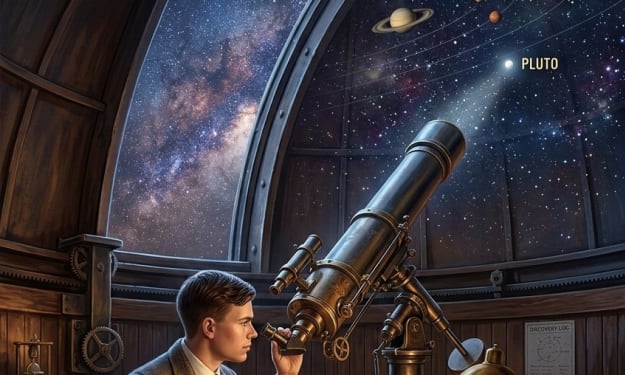
Long before powerful telescopes and modern space missions, astronomers spent countless nights studying the sky. They watched the stars carefully and recorded the movements of the planets. Each discovery helped scientists understand the vast universe a little better. Among the most fascinating discoveries in astronomy was the discovery of Pluto, a tiny and distant world at the edge of our Solar System. The story of Pluto’s discovery is not just about a planet. It is a story of curiosity, patience, and the determination of scientists who spent years searching for something that no one had ever seen before. The Mystery of Planet X In the early 1900s, astronomers believed there might be another planet beyond Neptune. They noticed that the orbits of Uranus and Neptune did not behave exactly as expected. Some scientists thought that the gravity of an unknown planet might be affecting their motion. One astronomer who became very interested in this mystery was Percival Lowell. Lowell believed strongly that a hidden planet existed far beyond Neptune. He called this mysterious world “Planet X.” To find it, Lowell built an observatory in Arizona known as the Lowell Observatory. From there, he and his team carefully studied photographs of the night sky. They searched for a small object that slowly moved among the stars. Unfortunately, Lowell died in 1916 before he could find the planet he was looking for. But the search did not end. A Young Man with a Dream Years later, a young farm boy named Clyde Tombaugh became interested in astronomy. Tombaugh lived in Kansas and did not have expensive scientific equipment. However, he loved building telescopes and observing the planets from his backyard. Tombaugh carefully drew detailed pictures of Mars and Jupiter using a homemade telescope. He sent these drawings to Lowell Observatory, hoping that professional astronomers might notice his work. The scientists at Lowell Observatory were impressed by his careful observations. In 1929, they invited Tombaugh to work at the observatory and continue the search for the mysterious Planet X. For Tombaugh, it was the opportunity of a lifetime. The Difficult Search The search for Planet X was extremely challenging. The distant planet would appear very small and faint in photographs of the sky. It would look almost exactly like a star. To find it, Tombaugh used a special machine called a blink comparator. This device allowed him to compare two photographs of the same part of the sky taken several days apart. When he looked through the machine, the images switched back and forth quickly. Most stars stayed in the same place. But if an object moved slightly between the two photographs, it would appear to jump back and forth. That movement could reveal a planet. Night after night, Tombaugh studied thousands of star images. The work required incredible patience and concentration. Sometimes he spent hours searching through photographs without finding anything unusual. But he never gave up. The Moment of Discovery On February 18, 1930, Tombaugh was examining photographs taken in January of that year. While comparing two images, he noticed a tiny dot that moved slightly from one position to another. At first, he looked again carefully to make sure it was not a mistake or a flaw in the photograph. But the tiny object had definitely moved. This meant it was not a star—it was something within our Solar System. After additional observations confirmed the movement, the scientists at Lowell Observatory realized that Tombaugh had discovered the long-sought Planet X. The discovery was officially announced on March 13, 1930. Astronomers around the world celebrated the discovery of a new planet beyond Neptune. It was one of the most exciting astronomical discoveries of the 20th century. Naming the New World After the discovery was announced, people from many countries suggested names for the new planet. The final name came from an 11-year-old girl in England named Venetia Burney. She suggested the name Pluto, after the Roman god of the underworld. The name seemed perfect because the planet was dark, distant, and hidden in the far reaches of the Solar System. Astronomers liked the name for another reason. The first two letters, P and L, were also the initials of Percival Lowell, the astronomer who had first searched for Planet X. Soon, the International Astronomical Union officially approved the name Pluto. A Planet That Changed Our Understanding For many decades, Pluto was known as the ninth planet of the Solar System. It became a symbol of exploration and curiosity about the outer regions of space. However, as technology improved, astronomers discovered many other icy objects beyond Neptune in a region called the Kuiper Belt. Scientists realized that Pluto was part of this large population of distant objects. Because of this, in 2006 the International Astronomical Union reclassified Pluto as a dwarf planet instead of a full planet. Although this decision surprised many people, Pluto remains one of the most fascinating worlds in our Solar System. Exploring Pluto In 2015, the spacecraft New Horizons flew past Pluto and sent back the first close-up images of the distant world. Scientists were amazed by what they saw. Pluto has mountains made of ice, vast frozen plains, and a giant heart-shaped region on its surface. These discoveries showed that even small worlds far away from the Sun can be complex and beautiful. The Legacy of the Discovery The discovery of Pluto proved that patience and curiosity can lead to incredible discoveries. Clyde Tombaugh’s careful work and dedication allowed humanity to find a new world billions of kilometers away. Today, Pluto continues to inspire scientists and students to explore the mysteries of space. Even though it is small and distant, Pluto reminds us that the universe is full of surprises waiting to be discovered. 🌌
By Sahir E Shafqat4 days ago in History
The Politics of Playing Dress-Up
Well, to start off I'd like to say a happy world book day to all who celebrate. I know I haven't really posted anything on my socials about it but I'm not a jubilant kind of person. I lay low most of the time. Let's start off with a popular anecdote from the vaults...
By Annie Kapur5 days ago in Geeks



Comments
There are no comments for this story
Be the first to respond and start the conversation.