

The letter X holds a ubiquitous presence in various aspects of our lives, from signing letters to rating movies and even naming generations and apps. Despite being the fourth least common letter in the English language, X has gained immense popularity. This seemingly irrational fascination with X finds its roots in the world of mathematics, where X emerged as a symbol around 400 years ago to represent the unknown in equations.
Before the advent of X in mathematics, human mathematical inquiries were predominantly centered on known quantities. Ancient civilizations like the Babylonians started introducing problems that incorporated unknown values. These unknowns weren't merely the results but integral components of the questions themselves, marking a significant leap in mathematical history. These early mathematical conundrums laid the foundation for algebra, and one of the earliest examples of such equations is the quadratic equation.
Interestingly, the usage of X as a symbol for the unknown wasn't immediate. Ancient mathematicians relied on full sentences to articulate problems, with each culture employing its unique terminology. It wasn't until the Middle East, during the ninth century, that the concept of the unknown significantly influenced mathematics, thanks to Persian scholar al-Khwarizmi. He not only provided algorithms for solving algebraic problems but also coined the term "al-Jabr" (algebra), meaning "the restoration of broken parts."
The transition from written words to symbolic notation began in the 1500s when French mathematician Francois Viete combined symbols and words in equations. This shift aimed to make the relationships and patterns within algebra more comprehensible. However, by the late 1700s, people across different regions had developed their symbolic notations, making it challenging for mathematicians to understand one another's work.
Around a hundred years ago, a French mathematician popularized the use of X as the symbol for the unknown, a practice that was widely adopted by mathematicians worldwide. The exact reason for this choice remains somewhat of a mystery, with various theories attempting to explain it. One theory attributes it to the Spanish translation of al-Khwarizmi's work, suggesting that the Spanish adopted the Greek symbol "chi" (Χ) due to a lack of the "shh" sound. Another theory links the choice of X to Rene Descartes, who employed it more frequently than other letters to represent the unknown in equations. Some believe Descartes may have chosen X because it was less common in the French language, or simply because the printer had more spare X's when publishing his book.
Regardless of its origin, the use of X for the unknown in mathematics has profoundly impacted the way we perceive and explore the universe. It has provided insights into patterns that shape our world and empowered us to calculate the unknown, predict outcomes, and make significant scientific discoveries. Beyond mathematics, X also symbolizes the unknown in various contexts, from Malcolm X's adoption of the letter to represent his unknown African name to X-rays and the X chromosome. The sense of mystery and intrigue associated with X, along with its ability to name the unknown, has solidified its place in our cultural consciousness, leading to its prominent use in product names like SpaceX, Model X Tesla, and more.
About the Creator
Keep reading
More stories from writers in History and other communities.
Cleopatra – The Last Queen of the Nile
Cleopatra VII Philopator, known to history simply as Cleopatra, was the last active ruler of the Ptolemaic Kingdom of Egypt. Her life was a dramatic blend of intelligence, ambition, political skill, love, war, and tragedy. She was not only a queen but a strategist who stood at the crossroads of two great civilizations—Egypt and Rome—during one of the most turbulent periods in ancient history. Cleopatra was born in 69 BCE in Alexandria, the shining capital of Egypt. Though she ruled Egypt, she was not ethnically Egyptian. She belonged to the Ptolemaic dynasty, a Greek royal family descended from Ptolemy I, one of Alexander the Great’s generals. For nearly three centuries, her family ruled Egypt after Alexander’s death. Yet unlike many of her ancestors, Cleopatra embraced Egyptian culture. She learned the Egyptian language—something rare among the Ptolemies—and presented herself as the living goddess Isis to her people. She was highly educated, speaking several languages, and was trained in philosophy, mathematics, and diplomacy. Cleopatra became queen in 51 BCE at the age of eighteen, co-ruling with her younger brother Ptolemy XIII, who was only ten years old. According to Egyptian tradition, she married her brother to solidify their joint rule. However, their relationship quickly turned into rivalry. Cleopatra was determined to rule independently, but powerful advisers around Ptolemy XIII pushed her aside. Soon, she was forced into exile from Egypt. But Cleopatra was not one to accept defeat. During her exile, she gathered an army and planned her return. Around this time, Rome was embroiled in civil war between Julius Caesar and Pompey the Great. When Pompey fled to Egypt seeking refuge, he was killed on Ptolemy XIII’s orders in an attempt to win Caesar’s favor. However, when Caesar arrived in Alexandria in 48 BCE, he was reportedly outraged by Pompey’s murder. Cleopatra saw opportunity in chaos. According to legend, she had herself secretly brought to Caesar wrapped in a carpet (or bed sack) so she could meet him privately. Whether the story is fully true or not, what is certain is that Cleopatra impressed Caesar with her intelligence, charm, and political vision. An alliance—and romance—soon followed. With Caesar’s military support, Cleopatra defeated her brother’s forces. Ptolemy XIII drowned in the Nile during the conflict. Cleopatra was restored to the throne, this time co-ruling with another younger brother, Ptolemy XIV. Soon after, she gave birth to a son, Ptolemy XV, known as Caesarion, whom she claimed was Julius Caesar’s child. Cleopatra later traveled to Rome and stayed there as Caesar’s guest. Her presence in Rome caused scandal and fascination. To some Romans, she was exotic and powerful; to others, she was a dangerous foreign queen influencing their leader. In 44 BCE, Julius Caesar was assassinated by Roman senators. Cleopatra quickly returned to Egypt, recognizing that Rome had once again become unstable. After Caesar’s death, a new power struggle erupted in Rome. Three men formed the Second Triumvirate: Octavian (Caesar’s adopted heir), Mark Antony, and Lepidus. Mark Antony eventually became ruler of Rome’s eastern territories, which included Egypt’s neighboring regions. In 41 BCE, Antony summoned Cleopatra to meet him in Tarsus. Cleopatra once again demonstrated her mastery of political theater. She arrived on a magnificent barge decorated in gold and purple sails, presenting herself as the goddess Isis. Antony was captivated. Their meeting marked the beginning of one of history’s most famous love affairs. But their relationship was not merely romantic—it was strategic. Antony needed Egypt’s wealth to fund his military campaigns, and Cleopatra needed Roman protection to secure her throne. They became partners in both love and politics. Cleopatra bore Antony three children. Together, they envisioned a powerful eastern empire centered in Alexandria. However, their alliance created tension in Rome. Octavian viewed Antony’s relationship with Cleopatra as a betrayal of Roman values. He portrayed Cleopatra as a seductive foreign queen who had bewitched Antony and turned him against Rome. Roman propaganda painted her as dangerous and manipulative. The conflict between Octavian and Antony eventually erupted into open war. In 31 BCE, their forces clashed in the naval Battle of Actium. Cleopatra’s fleet fought alongside Antony’s, but the battle ended in disaster. Facing defeat, Cleopatra withdrew her ships. Antony followed her, leaving his fleet to collapse. Octavian emerged victorious. After Actium, Octavian pursued them to Egypt. In 30 BCE, his forces invaded Alexandria. Antony, believing Cleopatra had betrayed him and thinking she was dead, took his own life. When Cleopatra realized Antony was truly dying, she had him brought to her mausoleum, where he died in her arms. Cleopatra knew her fate was sealed. Octavian intended to take her to Rome as a captive to parade in his triumph—a humiliation she could not accept. Determined to die as a queen rather than live as a prisoner, Cleopatra chose suicide. According to ancient accounts, she allowed herself to be bitten by an asp, a venomous snake, though some historians debate the exact method. Cleopatra died in 30 BCE at the age of thirty-nine. With her death, the Ptolemaic dynasty ended, and Egypt became a province of the Roman Empire. Octavian, who would later become Emperor Augustus, consolidated his power and ushered in the Roman Empire. Cleopatra’s legacy has endured for over two thousand years. Often remembered for her beauty and romances, she was far more than a seductress. She was a skilled diplomat, a brilliant linguist, and a capable ruler who fought to preserve Egypt’s independence in an age of Roman expansion. She managed a wealthy economy, stabilized her kingdom during famine, and maintained Egypt’s cultural identity. Her story is ultimately one of resistance against overwhelming odds. She lived in a world dominated by powerful men and empires, yet she carved her own place in history. Though her reign ended in defeat, her name never faded. Poets, playwrights, and historians—from Shakespeare to modern filmmakers—have retold her tale countless times. Cleopatra was the last queen of ancient Egypt, but she became something greater: a symbol of ambition, intelligence, love, and tragedy. In her rise and fall, we see the end of one world and the birth of another. Her death marked not just the loss of a queen, but the final chapter of a civilization that had thrived along the Nile for thousands of years. And so, Cleopatra remains immortal—not only as the last queen of Egypt, but as one of history’s most unforgettable figures.
By The best writer 2 days ago in History
The General’s Tooth
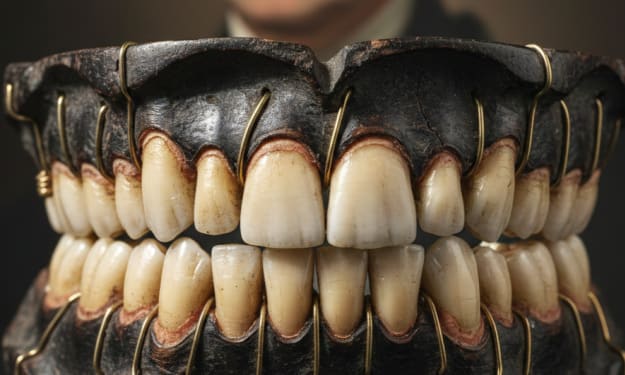
History is often told through the polished lens of oil paintings and marble statues. We see George Washington as the stoic father of a nation, his jaw set in a firm, resolute line. But in the winter of 1783, as the American Revolution neared its end, that jaw was a site of excruciating, rotting agony.
By LUNA EDITHa day ago in History
Affection and Healing for Yourself
During the night of the last quarter moon, I gathered my ritual supplies. I carefully handled the chunk of black tourmaline that would protect me from your overall negative and narcissistic energy. I carefully walked the house with my stick of selenite in hand, asking the universe to cleanse our working space.
By Alisha Wilkins ✒️🦋🖋️4 days ago in Fiction
🅼🅸🅳🅽🅸🅶🅷🆃 🆂🅽🅰🅲🅺🆂
"It's 10 in Tuscon! We all know what that means... It's Time for Midnight Snacks with your man, Gerald Gee! Ready to spend the night together? Me too! I'm full of snacks and can't wait to regurgitate them all back into your hungry ears. Crack a brew! Pop some corn! Anything to get ready for one hell of a show where the talk maybe cheap but the words cut deep...
By Lamar Wigginsa day ago in Fiction



Comments
There are no comments for this story
Be the first to respond and start the conversation.