
How did this universe actually appear?
What the science says?
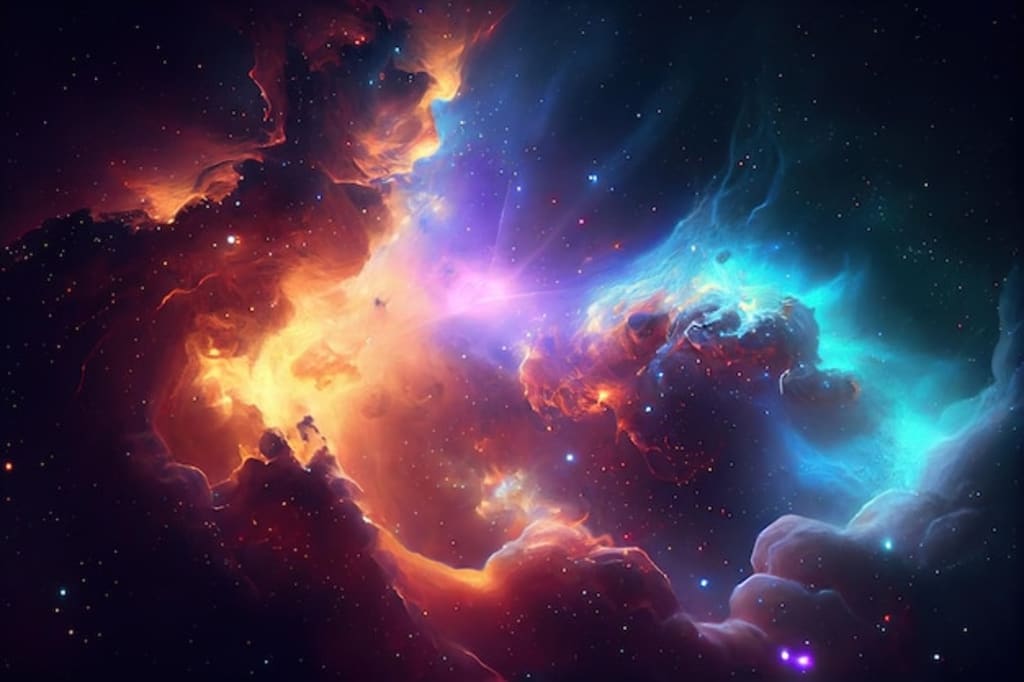
The origin of the universe is one of the most profound and complex questions in science, and it has fascinated humans for centuries. While many early cultures and religions provided their own creation stories to explain the universe’s beginnings, modern science has developed a range of theories based on observations, experiments, and mathematical models. The prevailing theory today is the Big Bang Theory, which posits that the universe began as an extremely hot, dense point that expanded rapidly around 13.8 billion years ago. In addition to the Big Bang Theory, there are also hypotheses that seek to explain the conditions before or beyond the Big Bang, as well as theories about the possibility of multiverses or cyclic universes. Here’s an exploration of how our current understanding explains the universe's origins.
The Big Bang Theory: Our Best Explanation So Far
The Big Bang Theory suggests that the universe started from a single, incredibly dense and hot point, often referred to as a "singularity." This singularity contained all the energy and matter that would form the universe as we know it today. According to this theory, about 13.8 billion years ago, a massive expansion event occurred, causing the universe to begin growing rapidly. This expansion did not occur in an existing space; rather, it was the expansion of space itself. This concept is often misunderstood as an explosion outward into empty space, but it is more accurately described as space stretching and expanding in all directions.
The evidence for the Big Bang Theory comes from several key observations. One of the most compelling pieces of evidence is the cosmic microwave background radiation (CMB), which is faint electromagnetic radiation spread uniformly throughout the universe. Discovered by accident in 1965 by Arno Penzias and Robert Wilson, the CMB is understood to be the residual heat from the Big Bang, providing a "snapshot" of the universe when it was about 380,000 years old.
Another line of evidence is the observed redshift of galaxies, which was first discovered by Edwin Hubble in the 1920s. Hubble found that galaxies are moving away from each other, and that their speed increases with distance. This redshift effect supports the idea that the universe is expanding, as described by the Big Bang Theory. Additionally, the relative abundance of light elements, such as hydrogen, helium, and lithium, aligns with predictions from the Big Bang Theory about nucleosynthesis (the formation of atomic nuclei) in the early universe.
The Early Universe: From Quarks to Galaxies
Right after the Big Bang, the universe was in a state of extreme temperature and density. In the first fraction of a second, the fundamental forces we observe today—gravity, electromagnetism, and the strong and weak nuclear forces—were unified in a single force. As the universe expanded and cooled, these forces gradually separated. This period, called "cosmic inflation," is thought to have occurred in the first few moments of the universe's life and is characterized by a rapid exponential expansion.
Following inflation, the universe entered a stage where elementary particles, like quarks and electrons, began to form. Quarks combined to form protons and neutrons, and eventually these particles combined to form the nuclei of simple atoms, such as hydrogen and helium. After about 380,000 years, the universe cooled enough for electrons to combine with nuclei to form neutral atoms. This allowed photons, or particles of light, to travel freely for the first time, creating the cosmic microwave background radiation that we can still detect today.
As millions of years passed, these clouds of gas began to clump together under the influence of gravity, eventually forming stars and galaxies. Stars ignited nuclear fusion reactions in their cores, producing heavier elements like carbon, oxygen, and iron, which were spread across the cosmos when stars exploded as supernovae. These elements would later form planets, asteroids, and eventually the building blocks of life on Earth.
Beyond the Big Bang: Alternative Theories and Hypotheses
While the Big Bang Theory is widely accepted, scientists continue to explore other ideas to fill in the gaps of our understanding, especially about what might have preceded the Big Bang or what lies beyond our observable universe. One alternative is the idea of a multiverse, which proposes that our universe is just one of many universes, each with its own properties and physical laws. Some versions of the multiverse hypothesis suggest that new universes are constantly being created, a process that could explain why our universe has properties that allow life to exist.
Another hypothesis is the cyclic model, which suggests that the universe goes through endless cycles of expansion and contraction, often referred to as "Big Bangs" and "Big Crunches." In this view, our universe might be just one phase in an eternal cycle, with each universe giving rise to the next. This idea challenges the notion that time began with the Big Bang, proposing instead that the universe has always existed in one form or another.
Quantum Mechanics and the Nature of the Singularity
The singularity at the beginning of the Big Bang presents a challenge to physicists because, at that point, the laws of physics as we currently understand them break down. Quantum mechanics, the branch of physics that deals with the behavior of particles on the smallest scales, might hold answers to what happened at the moment of the Big Bang. Some theories, like quantum gravity and string theory, attempt to combine quantum mechanics with general relativity to describe what might have happened at the singularity. However, we currently lack a complete theory of quantum gravity, so the exact conditions of the universe’s origin remain unknown.
The Continuing Quest for Answers
The study of the universe’s origins continues to be an active field of research. With advanced telescopes and particle accelerators, scientists are pushing the limits of what we can observe and experiment with. Instruments like the James Webb Space Telescope are providing unprecedented views of distant galaxies, shedding light on the universe's early stages. At the same time, particle physics experiments, like those at the Large Hadron Collider, aim to recreate conditions similar to those immediately following the Big Bang, providing insights into the fundamental particles and forces that shaped our universe.
In conclusion, while the Big Bang Theory provides a robust framework for understanding the beginning of our universe, many questions remain unanswered. Theories about multiverses, cyclic universes, and quantum phenomena at the singularity continue to challenge and refine our understanding of how the universe came into existence. The quest to understand the universe’s origin pushes the boundaries of science, philosophy, and human curiosity, reminding us of the mystery and complexity of existence itself.
About the Creator
The Astrologer Prime Minister
The king was seated among his courtiers. A competition was ongoing among them to bring good news to His Majesty. The king was delighted, for every piece of good news was like honey to his ears. He felt that he was the most successful ruler in the world. In his kingdom, even lions and goats drank from the same waterhole.
By Sudais Zakwan3 days ago in History
Fifteen Dead After Philippines Ferry With 300 Passengers Sinks
: At least 15 people have died and hundreds have been rescued after a passenger ferry carrying more than 300 people sank early on Monday, January 26, 2026, off the coast of the southern Philippines, authorities said. The tragedy has sparked a massive search and rescue operation, highlighted persistent safety concerns in inter‑island maritime travel, and left families anxiously awaiting news of loved ones.
By Salaar Jamali2 days ago in History



Comments
There are no comments for this story
Be the first to respond and start the conversation.