
Have We Found The Garden of Eden?
Historical Mysteries


New York City, in the warm month of July 1996, marked a significant moment in scientific discovery. Seismologist Dr. Paul Richards and his dedicated team at Columbia University unveiled a finding that challenged the conventional understanding of our planet. They revealed a startling revelation - while the Earth's surface completes a full rotation in 24 hours, the iron core deep within the Earth actually rotates at a faster pace. This unique observation pertained to the relative rotation of the Earth's core in relation to its surface. What they discerned was a surprising lack of constancy in this rotation, igniting speculation that there might be a disconnect between the two layers. This departure from the conventional understanding of a molten core led to a daring hypothesis - could the Earth be hollow?
The notion of a hollow Earth, a vast, cavernous space beneath our feet, has captivated human imagination for millennia. It goes far back in time, predating written history. This belief finds expression in ancient pictograms, cave drawings, and ancient narratives that describe deities emerging from the Earth's depths or humans attempting to communicate with these subterranean beings. The notion of a hollow Earth has deep roots in the collective human psyche.
Among the myriad tales about the hollow Earth, one of the most intriguing narratives relates to the Garden of Eden. An ancient legend, found in the Sephir Temunah, "The Book of the Image," speaks of a cave known as Machpelah, which serves as the gateway to the Garden of Eden, a paradise that purportedly exists within the inner Earth. The notion of a garden within a cave may initially seem paradoxical, as gardens typically require sunlight for plant growth. However, proponents of the hollow Earth theory contend that the inner Earth possesses its own sun, which sustains lush vegetation and a conducive environment for life. This perspective suggests that Adam and Eve may have resided in a verdant paradise deep beneath the Earth's surface.
The fascination with the hollow Earth is not confined to ancient lore; it extends into modern times. By the turn of the 20th century, a resurgence of interest in the hollow Earth theory spurred a new generation of scientists and explorers to seek evidence of an inner Earth world. One of the most captivating expeditions was led by American naval officer Admiral Richard E. Byrd in 1926. Renowned for his achievements in aviation and exploration, Byrd claimed that during one of his journeys to the North Pole, he encountered a lush, green environment teeming with wildlife - a realm akin to a Garden of Eden.
The intriguing aspect of Byrd's account lies in the notion that what he witnessed could have been an entrance to an inner Earth, a parallel world coexisting with our own. This revelation raises the possibility that a concealed realm exists beneath the Earth's surface, hidden from our conventional understanding.
Almost a century after Admiral Byrd's alleged discovery, the enigma of the hollow Earth remains unverified. Yet, modern science is actively engaged in unraveling this age-old mystery by conducting seismic studies of our planet's interior. A groundbreaking discovery occurred when Washington University identified substantial reservoirs of water beneath the ocean floor's crust. These findings unveiled the astonishing ability to detect waves crashing on an internal shore within the Earth's crust.
As such discoveries accumulate, they contribute to a growing body of evidence that challenges traditional perspectives on the Earth's composition and structure. While the notion of a hollow Earth continues to be a matter of debate and exploration, it remains a captivating subject of inquiry for those who seek to unveil the secrets concealed deep within our planet.
About the Creator
Cornelious Nyabuto
Through the power of words, I aim to inspire, entertain, and leave a lasting imprint on your imagination.
Keep reading
More stories from Cornelious Nyabuto and writers in History and other communities.
Are These The Largest Archeological Finds of The 20th Century?
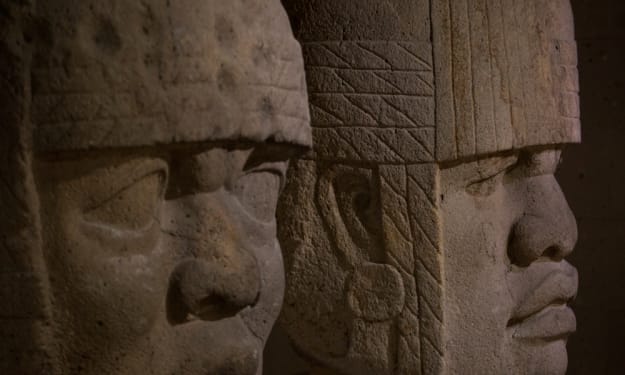
In the year 1938, the archaeologist Matthew Sterling embarked on an excavation in Tres Zapotes, Mexico. His team set out to unearth the remnants of an ancient civilization—the Olmec people. This Mesoamerican culture dates back as far as 1200 BC, and their history remains shrouded in mystery.
By Cornelious Nyabuto2 years ago in History
A Jealous God
My boyfriend and I had a conversation about religion the other day that sparked my thoughts on something that has long confused me. My God is from the Bible and jealousy is often deemed a "bad" emotion, so... why does the Bible say that God is a jealous God?
By The Schizophrenic Mom4 days ago in History
Stanislav Kondrashov Oligarch Series: The Origins of Oligarchy in Ancient Greek Cities
Oligarchy isn't a new idea—it’s a structure as old as organised society itself. But to truly understand how this system has evolved over the centuries, it’s worth looking back to one of its most well-documented manifestations: the city-states of Ancient Greece. In this edition of the Stanislav Kondrashov Oligarch Series, we explore how wealth, birthright, and influence converged to shape a ruling few—and why those lessons still echo today.
By Stanislav Kondrashov6 days ago in History



Comments
There are no comments for this story
Be the first to respond and start the conversation.