
Are These The Largest Archeological Finds of The 20th Century?
Historical Mysteries

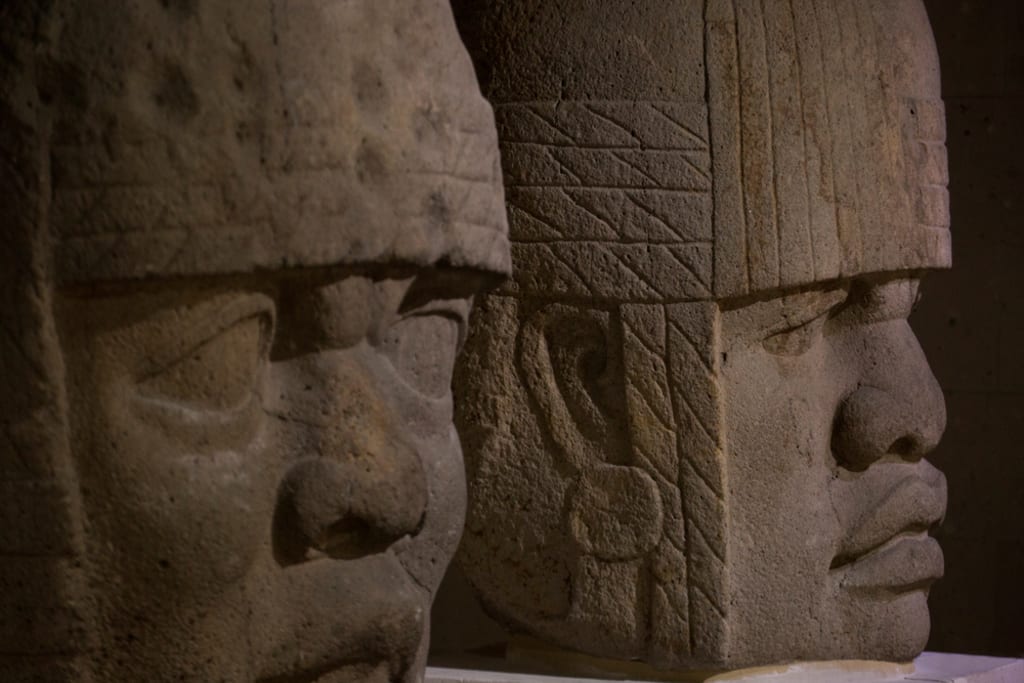
In the year 1938, the archaeologist Matthew Sterling embarked on an excavation in Tres Zapotes, Mexico. His team set out to unearth the remnants of an ancient civilization—the Olmec people. This Mesoamerican culture dates back as far as 1200 BC, and their history remains shrouded in mystery.
As Sterling's team meticulously dug through layers of history, cataloging an array of ancient artifacts, they stumbled upon something truly extraordinary. Nestled among the ancient relics, they discovered a collection of unusually large, rounded boulders concealed in the earth. What emerged from the ground would soon become recognized as one of the most significant archaeological discoveries of the 20th century. Over the course of several decades, seventeen colossal heads, expertly carved from solid basalt, were revealed within the vicinity. The most imposing among them stood a towering 11 feet tall and weighed an astonishing 50 tons.
Approaching these monumental stone sculptures, one couldn't help but marvel at their sheer size and lifelike features. The very thought of moving these colossal heads, which had clearly been brought to this site from a distant location, was a testament to the incredible effort and ingenuity of the ancient Olmec civilization.
However, what truly intrigued scholars and researchers about these colossal heads wasn't just their physical attributes or the logistical challenges of their transportation. Rather, it was the enigmatic depictions they bore. The colossal heads exhibited both African and Polynesian characteristics, a perplexing blend of features. This led to the intriguing possibility that the Olmec civilization might have been influenced by transpacific or even transatlantic migrations from other continents.
While this theory challenged the conventional wisdom of Olmec origins, mainstream historians had often been reluctant to embrace the notion that the Olmec culture could have its roots in Asia or Africa. Yet, the striking resemblance of the colossal heads to African and Polynesian features hinted at a more complex narrative.
Adding to the mystery, the absence of any Mesoamerican-Caribbean culture like the Olmec in their supposed places of origin presented another riddle. To this day, researchers lack concrete evidence to definitively trace the Olmec's roots. The Olmec civilization, which once thrived at the heart of Mesoamerica, eventually faded into the shadows of history. The reasons behind their sudden decline and disappearance remain elusive, and only fragmentary remains, sculptures, and figurines serve as cryptic relics of their existence.
As archaeologists and historians grapple with this historical puzzle, they are left with a compelling enigma—the colossal stone heads, gazing back at humanity through the vast expanse of time with their cryptic, sphinx-like expressions. These ancient artifacts stand as sentinels, their stoic presence guarding secrets that remain hidden in the sands of time.
One of the most intriguing discoveries related to the Olmec culture is the presence of magnetism in several of the statues. When a compass is brought near these stone relics, the needles of the compasses exhibit unusual behavior—movement in response to the magnetism.
In the late 1960s and early 1970s, archaeologists used magnetometers to pinpoint the locations of many of the colossal heads. The peculiar magnetic signatures associated with these artifacts can be attributed to their composition. The colossal heads are crafted from basalt, a dense volcanic rock that becomes magnetic as it cools. Thus, the Olmec, by fashioning these monuments from the volcanic basalt found in their vicinity, inadvertently infused them with magnetic properties.
This curious observation raises the question of why the Olmec might have harnessed magnetism in their monumental sculptures. The answer to this question remains elusive, but numerous theories have emerged. One intriguing speculation revolves around the possibility that the Olmec employed magnetic levitation. Magnetism, with its capacity to repel or attract, could have enabled them to manipulate colossal stones with an unprecedented level of precision.
Considering the immense difficulty of moving such large stones even with modern technology, the concept of levitation offers a fascinating lens through which to view the Olmec civilization's achievements. While hard evidence may be challenging to obtain, the notion of harnessing magnetism for transportation remains an intriguing theory.
In the heart of Tres Zapotes, Mexico, amidst the whispers of a long-forgotten civilization, the colossal stone heads continue to defy easy categorization and invite tantalizing questions about the Olmec people. Were they the result of transcontinental migrations, and what ultimately led to their enigmatic disappearance from the pages of history? The colossal stone heads stand as enduring enigmas, their silent expressions offering clues to the Olmec's remarkable past and the mysteries that continue to captivate the curious minds of archaeologists and historians.
About the Creator
Cornelious Nyabuto
Through the power of words, I aim to inspire, entertain, and leave a lasting imprint on your imagination.
Keep reading
More stories from Cornelious Nyabuto and writers in History and other communities.
Why Was There A Massive Ancient Cemetery in Malta?
In 1902, on the picturesque island of Malta, nestled in the Mediterranean, a remarkable discovery was made during the excavation for a new housing development near the eastern coast. Beneath the ground, construction workers unearthed an unexpected and highly unusual prehistoric structure. Carved from solid limestone, this enigmatic structure was not an ordinary find but a portal to a forgotten world dating back more than 5,000 years.
By Cornelious Nyabuto2 years ago in History
Christopher Columbus
Dear children, today we will learn about Christopher Columbus, who is widely credited with discovering America. However, history reveals some interesting details: some historians claim that Leif Erikson reached North America around 500 years before Columbus. There are also accounts suggesting that Muslims arrived in America prior to Columbus, as indicated by evidence of a mosque on American soil dating back to that era. Others argue that Marko Polo may have reached America. Still, among the majority, Columbus is recognized as the man who opened the gateway to the “New World.”
By Sudais Zakwan2 days ago in History




Comments
There are no comments for this story
Be the first to respond and start the conversation.