
Halfway to War - All the Way Home
How a boy became both a soldier and civilian on the same day


In the autumn of 1918, a chilly breeze drifted across the fields of Randolph County, Arkansas. Nineteen-year-old Abe Rayford was feeding the chickens when his stepmother, Ollie, came running up the dirt path from the post office, waving an envelope in her hand.
“Abe!” she shouted breathlessly. “It’s from the government!”
He wiped his hands on his overalls, his heart thudding before she even finished speaking. “Let me see.”
The envelope bore the stark black type of the U.S. War Department, stamped “URGENT.” His hands shook as he pulled out the folded notice. He didn’t have to read far—he knew what it was. President Wilson had called it a fight to make the world safe for democracy. The order instructed Abe to report to the induction station in Little Rock by early November.
He didn’t sleep much over the next few nights. The hum of crickets and frogs in the ditch became his only company as he imagined himself in France—wearing a uniform, carrying a rifle, maybe writing letters home from a muddy trench. He’d never been farther north than St. Louis. Now he was expected to cross an ocean.
Ollie packed him a small satchel and tucked in a hand-sewn handkerchief, her initials stitched in the corner. She handed it to him gently, her eyes lingering on his face like it might be the last time she saw it.
On the morning of November 11, 1918—the very day peace would be declared—the whole town, and folks from nearby, turned out at the depot in Walnut Ridge. They packed the platform, waving small flags, handing out sandwiches and canteens. Abe's pa clapped a hand on his shoulder—firm but silent.
“You come back whole, son. That’s all I ask.”
Abe nodded, swallowing hard.
The train pulled in with a thunderous rumble, steam hissing like a living thing. Dozens of boys like him climbed aboard—farmhands, clerks, sharecroppers, sons of cotton pickers and mill workers. Strangers, but all the same: scared, proud, and stubborn. Some laughed nervously. Others just stared out the windows.
As the train pulled away, Abe leaned out the window for one last look at home. His mother was crying. His father wiped away a tear, too.
Around mid-morning, the train slowed near Newport. A telegraph operator rushed out, waving a sheet of paper and shouting before the train even stopped. Abe saw cheering. Some people wept.
“It’s over! Armistice signed this morning! It’s done!”
Abe stood, stunned. Then he dropped back into his seat. What did it mean?
Still dazed, he grabbed his satchel and stepped off the train onto the platform. Around him, telegrams flew, whistles blew, and the news spread like wildfire: The eleventh hour of the eleventh day of the eleventh month—peace at last.
He didn’t get back on the train.
He found a truck headed north and hitched a ride back home, where the fields waited, the harvest needed tending, and life could start again.
No one ever came after him. There were too many young men and too few reasons to argue with peace.
He told the story for years to come—how he was on his way to war when the world changed. How he stepped off a train and back into his life.
And he never forgot the sound of that announcement—delivered like a miracle through the steam and steel of a moving train.
Abe was my grandfather, and this is a true story.
About the Creator
Vickie Radovich
Retired and celebrating life, one story at a time. Wife, mom, and proud grandma ❤️ 😁 Love coffee until wine time☕️🍷
Keep reading
More stories from Vickie Radovich and writers in History and other communities.
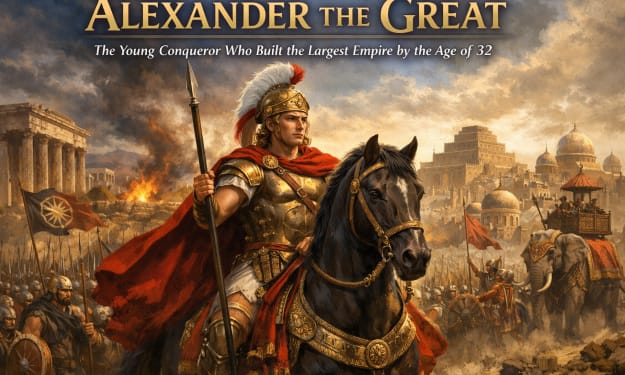
Alexander the Great: The Young Conqueror Who Built the Largest Empire by the Age of 32
Throughout human history, only a few leaders have managed to reshape the world in a single lifetime. Among them stands Alexander the Great, a remarkable young ruler who created one of the largest empires the ancient world had ever seen—before dying at just 32 years old. His life was short but filled with extraordinary achievements that changed the course of history.
By Irshad Abbasi 2 days ago in History



Comments (1)
What a thing to happen! So lucky, eh? And what a family story to share!