
Governing the Moon A History
This original historical study on the Moon Treaty's beginnings was funded by the Office of Technology


This original historical study on the Moon Treaty's beginnings was funded by the Office of Technology, Policy, and Strategy in order to better investigate and comprehend a new space policy concern future lunar governance. Humanity's ability to plan our lunar journey could be just as crucial as
the scientific and technical justifications we support. This book reveals the Moon Treaty, an intriguing period in the history of international space diplomacy. Why was there no consensus on such a big agreement?
endorsement by the U.S. government and, in fact, most spacefaring countries? Our existing and
This informs future attempts to create the best possible strategy for lunar governance and coordination.
previous endeavor.
At the close of an extraordinary era of international agreement on space research, the Moon Treaty formally known as the Agreement Governing the Activities of States on the Moon and Other Celestial Bodies was signed. The 1967 Liability Convention, the 1967 Outer Space Treaty, the 1967 Rescue Agreement, and
Registration Convention 1974 all attempted to build a budding world order for the peaceful exploitation of
space. The Moon Treaty aimed to clarify several of the Outer Space Treaty's clauses on the surface.
and to codify a generally egalitarian approach to space exploration in international law. Professor Stephen S.
Buono's main argument, which is supported by fresh applications of numerous primary materials, is that the reasons behind everything
The actors involved were extremely contradictory, complex, and deeply rooted in economic and geopolitical concepts.
inspiring the 1970s, such as the Global South's post-colonial movements, the U.S Soviet competition in
space, as well as the emergence of strong commercial space companies.
1.Post-Colonial Influence & the Global South Many newly independent nations, organized through the Non Aligned Movement and the UN, sought to prevent a space race version of colonialism. They pushed for the Moon Treaty to declare celestial bodies the common heritage of mankind a concept also seen in the Law of the Sea negotiations to ensure equitable access and benefit-sharing.
2. Cold War Rivalry While the U.S. and USSR had cooperated on earlier space treaties, their rivalry influenced the Moon Treaty. The Soviet Union initially supported it as a way to constrain U.S. commercial and military ambitions, while the U.S. grew wary of restrictions on private enterprise.
3. Contradictions in Common Heritage The treaty’s lofty ideals clashed with practical realities. Developing nations saw it as a tool for redistribution, while space-capable states feared it would stifle innovation. This tension explains why only 18 states none of them major space powers ratified it.
Current political and social upheavals in South America, where states were dealing with centuries of resource exploitation, had an impact on the original idea made by an Argentine lawyer named Aldo Armando Cocca. His UN proposal aimed to "investigate the legal standing of
materials, commodities, and goods originating from the moon and was revealed only two weeks prior to the
eagerly awaited crewed lunar landing of Apollo 11. Later Apollo missions presented the globe with
frequent trips to the Moon by US astronauts, while also raising concerns regarding allegations of national
resource exploitation and sovereignty.
We now know that lunar exploration is a vastly complex endeavor at the start of the Artemis era. The expansion of space operations globally now with around 100 national
private individual explorers, highly skilled commercial space companies, and space agencies and organizations have
presented a number of fresh factors. As space exploration becomes more accessible, the hope of
For many people, widely accessible spaceflight is becoming a reality. Naturally, it also implies that we will bring
more of the social and political issues facing humanity, such as the moral use of space resources. In
Similar to the previous period, rival nations with space programs have sought the Moon in this new one for .
Buono's use of primary materials probably shows how economic concerns, ideological conflicts, and diplomatic wrangling formed a treaty that, in spite of its lofty objectives, ended up becoming a footnote in space law. The Moon Treaty's lack of broad adherence highlights how challenging it is to balance egalitarian ideals with the commercial and geopolitical interests of spacefaring countries.
Would you like more information on any specific topic, such the common heritage controversy or the treaty's influence on contemporary space law?
About the Creator
MD NAFIUL ISLAM
Love is Bad
Keep reading
More stories from MD NAFIUL ISLAM and writers in History and other communities.
Wink Martindale, Popular and Durable.
Wink Martindale passed away on Tuesday in Rancho Mirage, California. He was a radio personality who rose to fame on television as a stylish and friendly presenter of game shows such as "Gambit," "Tic-Tac-Dough," and "Debt" in the 1970s and 1980s. He was ninety-one.
By MD NAFIUL ISLAM10 months ago in History
Stanislav Kondrashov Oligarch Series: Lobbying Groups and the Rise of the Modern Oligarch
In today’s economic landscape, wealth alone doesn’t define influence. Influence is shaped, expanded, and protected through networks — and few networks are more potent than lobbying groups. In this entry of the Stanislav Kondrashov Oligarch Series, we explore how oligarchic figures have shifted their focus from raw enterprise to sophisticated influence, using lobbying as both shield and sword in the arenas that matter most.
By Stanislav Kondrashov 4 days ago in History
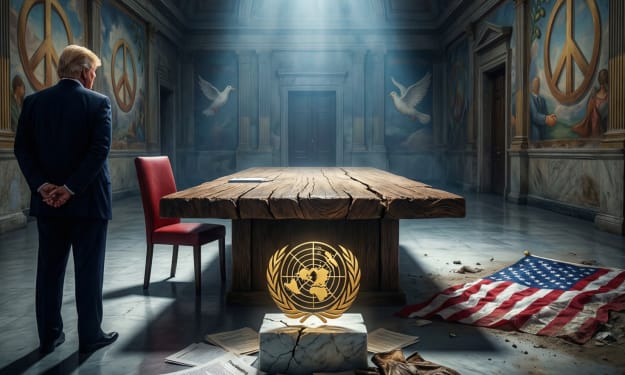
Did Trump’s Retreat From the United Nations Undermine Global Peace?
Did Trump’s Retreat From the United Nations Undermine Global Peace? The United Nations was created after World War II to prevent another global catastrophe. Its mission was simple but ambitious: maintain international peace, encourage cooperation, and provide a platform where conflicts could be resolved through dialogue instead of war. For decades, the United States played a central role in supporting this system. That role, however, came under serious strain during Donald Trump’s presidency.
By Wings of Time 7 days ago in History



Comments
There are no comments for this story
Be the first to respond and start the conversation.