
Godse vs. Gandhi: Ideologies and Assassination
Nathuram Godse: Understanding the Man Behind Gandhi’s Assassination

Introduction to the Tragic
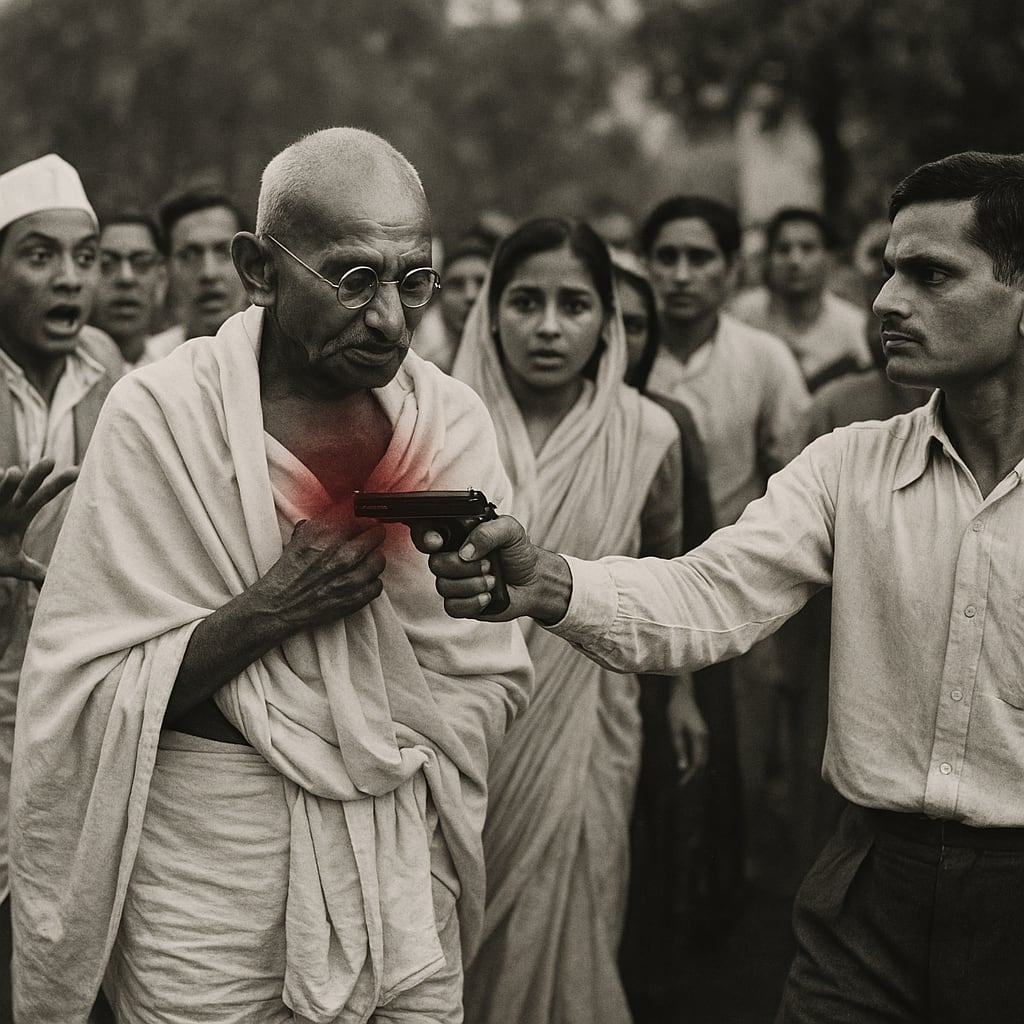
Day On January 30, 1948, Mahatma Gandhi's life was abruptly ended by Nathuram Godse, who fired three bullets into the leader who had been pivotal in India's struggle for freedom. This act turned Godse, a staunch Hindu nationalist, into a permanent villain in history’s eyes, often labeled merely as the murderer of a saint. Yet, the complexity of his motivations and the historical context that catalyzed such drastic actions demand a deeper examination. Was Godse merely a cold-hearted assassin, a disenfranchised patriot, or a symbol of a nation struggling to find its identity post-independence?
Godse's Ideological Journey
Godse was born in 1910 in Pune and was far from being an uneducated extremist. He was a thoughtful individual who engaged with the core ideas of Hindu nationalism through intellectual pursuits and journalistic endeavors, notably through publications like Agrani and Hindu Rashtra, which echoed Vinayak Damodar Savarkar's philosophy of Hindutva. Godse viewed Gandhi's steadfast adherence to nonviolence and his decisions during the Partition as catastrophic for India, culminating in millions of deaths and leading to the controversial transfer of ₹55 crores to Pakistan—a nation then in conflict with India over Kashmir. Godse’s trial defense, often misunderstood or dismissed as the ravings of a madman, articulated a potent critique of Gandhi’s policies, reflecting a broader discontent that resonated with a segment of the Indian populace.
The Trial: A Theatrical Justice?
The proceedings of Godse's trial, held at the Red Fort between 1948 and 1949, resembled more a performance than an exercise in justice. The trial was marked by severe restrictions on the press, suppression of Godse's statements, and a shrouded execution that seemed orchestrated to prevent him from becoming a martyr. Significant details like the absence of an autopsy for Gandhi and the mysterious disappearance of the murder weapon pointed to a possible manipulation of facts by the Congress government. Was Nehru’s subsequent unchallenged ascent a mere coincidence, or a convenient outcome of Gandhi’s elimination?
Reevaluating Gandhi’s Legacy
Gandhi's legacy, though monumental, is not without its criticisms. His early support for the British during the Boer War, ineffective compromises such as the Gandhi-Irwin Pact, and his passive responses to catastrophic events like the Jallianwala Bagh massacre paint a picture of a leader whose ideals often resulted in impractical outcomes. Historians argue that it was not Gandhi’s nonviolent movement but rather the Royal Indian Navy mutiny of 1946 that pushed the British towards granting India independence. Moreover, Gandhi’s policies during the early days of India's partition fostered deep divisions rather than unity—evident in his insistence on paying Pakistan during a time of war and his enforcement of harsh measures on Hindu refugees.
Public Reaction and Congress’s Control
The assassination elicited mixed reactions across India: while urban areas saw widespread mourning, there was noticeable ambivalence and even quiet opposition in rural parts, where the toll of partition was most acutely felt. Godse's execution divided public opinion, with many viewing it as justified, while others saw it as the silencing of a significant counter-narrative. The Congress government's response, including the banning of provocative books and the censorship of dissenting voices, suggested an attempt to consolidate power by controlling the narrative, possibly masking deeper political maneuvers by Nehru and his allies.
Conclusion: Weighing the Layers of History
The act committed by Nathuram Godse on that fateful day in January did not merely end a life—it sparked a complex debate about the nature of India’s path to independence and the actions of its revered leader. As we continue to unravel the layers of this pivotal event, it becomes clear that history is not merely about heroes and villains but about the vast greys in between. To explore more about this contentious piece of history, visit Debating Nathuram Godse: Murderer or Misguided Patriot at [insert-your-blog-url-here]. Engage with the discussion, share your insights, and contribute to a deeper understanding of a story that continues to shape India.
Visit This Site for More
https://hinduinfopedia.in/nathuram-godse-murderer-patriot-or-fractured-youth/
This is the next blog for further investigation on the topic
https://hinduinfopedia.in/gandhis-murder-was-nehru-involved/
About the Creator
Jai Kishan
Retired from a career as a corporate executive, I am now dedicated to exploring the impact of Hinduism on everyday life, delving into topics of religion, history, and spirituality through comprehensive coverage on my website.
Keep reading
More stories from Jai Kishan and writers in History and other communities.
The Delhi Riots of 2020: A Coordinated Attack
The Violence That Wasn’t Spontaneous February 2020 saw Delhi engulfed in violence, with 53 people dead and hundreds injured. While many attribute the riots to the Citizenship Amendment Act (CAA), deeper analysis reveals that the CAA was merely an excuse—an event hijacked to fuel political and religious unrest. With foreign interference, radical elements, and political opportunists involved, the riots had far more sinister undertones. Even in 2025, with legal cases dragging on, the larger conspiracy remains evident.
By Jai Kishan10 months ago in History
Julius Caesar: The Rise and Fall of a Legend
The Rise and Fall of Julius Caesar In the first century BCE, the Roman Republic stood as one of the most powerful states in the ancient world. Its armies conquered vast territories, its laws shaped civilizations, and its Senate governed through a delicate balance of tradition and authority. Into this complex political world was born Gaius Julius Caesar in 100 BCE—a man whose ambition, brilliance, and fate would forever change Roman history.
By The best writer 2 days ago in History
The Bronze Crown of Lydia
In the seventh century BCE, when kingdoms rose and fell like waves upon the shores of time, there stood a prosperous land called Lydia, nestled between mountains and rivers in what is now known as Anatolia. Lydia was famous for its fertile soil, its skilled artisans, and above all, its wealth. Gold flowed from the Pactolus River, and merchants traveled from distant lands to trade silk, spices, and stories. But the greatest story of Lydia was not written in gold—it was written in choice, pride, and consequence.
By The best writer about an hour ago in History



Comments (1)
An interesting look at the man, but I still feel he was a murderer who attempted to enter the history books violently when he could have done so much more without a gun.