
Ghosts of the American Promise
A Son's Tribute to His Silent Hero

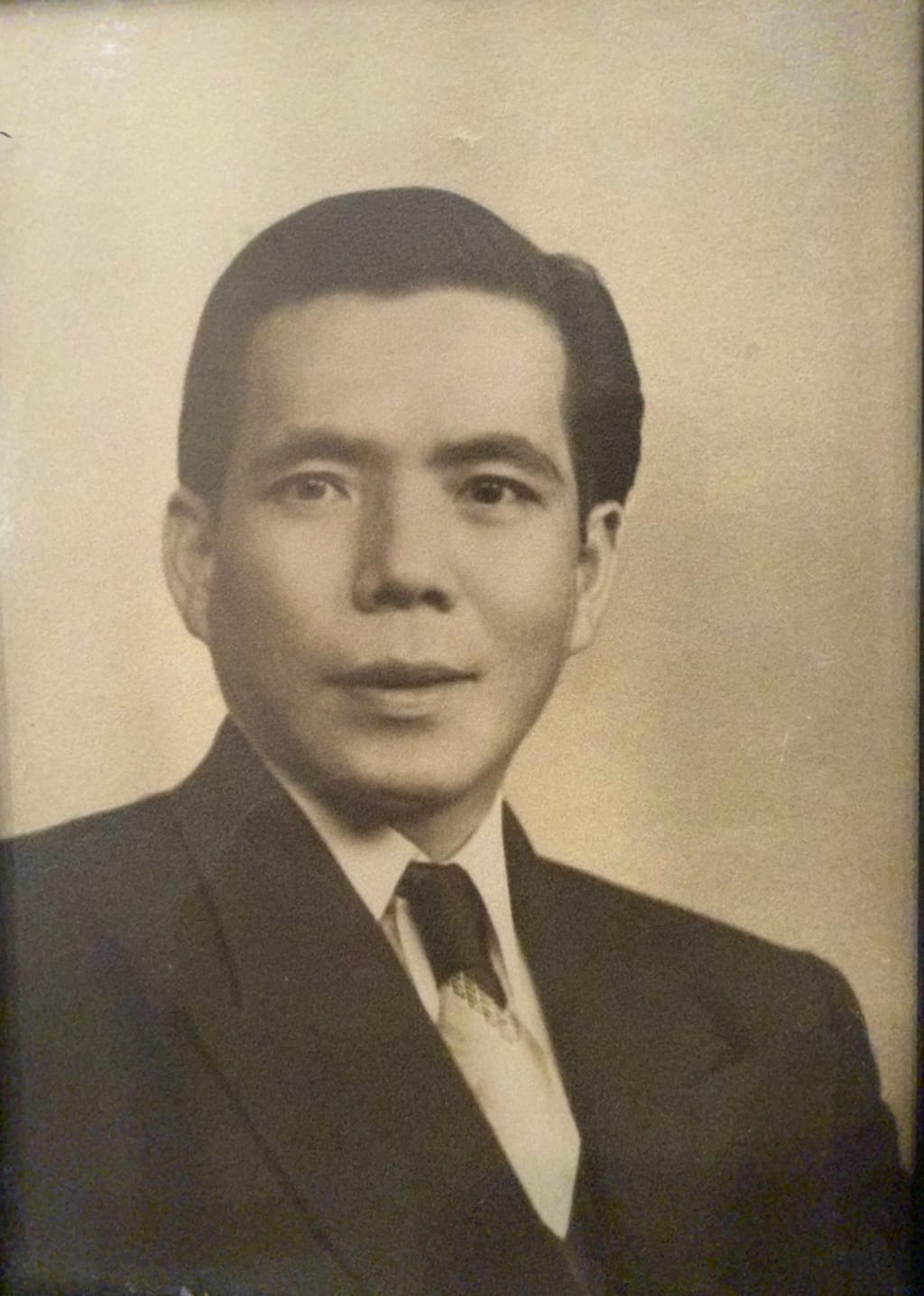
History books often tell us what happened, but they rarely convey what it felt like. They list dates and treaties, acts of Congress, and wars won or lost. However, they often overlook the human struggle—the stories of those whose lives shaped America from the ground up but who were excluded from its promises. My father, Yiu Hon Chan, was one of them.
He wasn’t the kind of man you’d find in a history book, though his life tells a story that every American ought to hear. He was a Chinese immigrant who came to the United States not seeking gold, but rather dignity. He sought a future and found work. He gave sweat to this country, but it never gave him citizenship. He lived in its shadows, labored on its soil, and died never having belonged to it.
My father’s story begins in the ruins of post-war China, when political upheaval and poverty drove thousands to flee the mainland. For him, America wasn’t just a place—it was an idea. But the idea was distorted by the complex reality that greeted Chinese immigrants long before his arrival. Long before he was born, Chinese workers were brought to the United States to build America’s railroads. They tunneled through granite in the Sierra Nevada mountains across the Great Plains, and bridged rivers with dynamite and sweat.
Thousands died. Few were honored. None were offered a path to citizenship. The 1882 Chinese Exclusion Act ensured this outcome. It was the first important law in the United States to prohibit immigration based on race. It rendered the Chinese both essential and invisible. They constructed the infrastructure that linked the coasts, yet they were excluded from the nation that claimed to unify. That act wasn’t repealed until 1943, during World War II, when the U.S. needed China as an ally against Japan. Even then, the quota for Chinese immigrants was limited to a meager 105 people per year. It was an apology carved in ice.
By the time my father arrived in the 1950s, the wounds left by the Exclusion Act still throbbed. Though the law was gone, the suspicion remained. My father was viewed not as a newcomer seeking opportunity, but as an alien who didn’t quite belong. He found work where he could, often in restaurants as a waiter, doing backbreaking labor for meager pay. He never complained—not because he lacked the words, but because complaining wouldn’t change his reality. He knew the rules: Be silent. Work hard. Don’t expect anything in return.
Even when he tried to adjust his status, to finally belong to the country he served through labor and loyalty, he found doors closed. Bureaucracy, suspicion, and a thousand unwritten rules barred the way. He remained a “resident alien,” as the green card coldly stated. The irony of being labeled an alien in a place where you raise a child, pay taxes, and live your entire adult life is hard to describe. But for my father, it wasn’t ironic—it was exhausting.
He died in 1967 of an aneurysm at the age of 46. A sudden rupture, yes—but one likely brought on by the years of cumulative stress: the long hours, the constant fear of deportation, the silent endurance of humiliation and exclusion. He was a man who gave everything and asked for so little. He didn’t live to see citizenship, but he hoped—fiercely—that I would live to see more.
And that’s why, despite the pain of his story, I write this today. Because the past has a way of repeating itself when we fail to tell its truths. Today, we once again find ourselves debating whether Chinese students, many of whom pay full tuition to study in the United States, should be allowed in our universities. Politicians speak in sweeping generalities, portraying these young scholars as potential spies rather than future scientists, doctors, or entrepreneurs. Some even propose revoking visas or closing the doors entirely.
But in doing so, we risk repeating the mistakes of the past. We forget that the railroads weren’t just built with steel—they were built with sacrifice. That America’s greatness came not from exclusion, but from inclusion. That the price of building a nation should not be eternal exile from its embrace.
Chinese students today pay full freight to attend our schools. Their tuition often subsidizes American students who pay in-state rates. They work harder because they must prove themselves twice over, just like my father once taught me. And yet they, too, are being told that their presence is unwelcome. That their ambitions are threats. Their dreams of becoming part of America are misguided.
I often wonder what my father would say now, 58 years after his death, watching history turn back on itself. He wouldn't be surprised, but he would be saddened. He believed deeply in the power of America, not just as a country but also as a promise: that if you worked harder, learned more, and gave your best, you could belong. He instilled that in me from a young age. "You’re half Chinese and half Puerto Rican,” he would say, “but you must be fully prepared.”
Education was the great equalizer, he believed. Not just because it opened doors, but because it gave you the tools to push them open when others tried to close them. He made sure I understood that to survive in America—let alone thrive—I had to be better educated, better positioned, and better prepared than anyone else in the room. It was his message that motivated me to pursue and complete a Ph.D in Economics and strive to advance my career on Wall Street.
I used to think his message came from ambition. Now I realize he expressed it out of fear.
He knew what it felt like to be “almost American.” To be tolerated but never embraced. To see your labor appreciated but your humanity ignored. And he was determined that I would not live in that twilight zone between inclusion and rejection.
That legacy shaped me. It made me aware not only of my privilege but of the price others paid for it. It made me question what we teach when we teach history. We teach about the building of the railroads, but not the men who built them and died forgotten. We teach about Ellis Island, but not Angel Island, located in the San Francisco Bay, where Asian immigrants, who included Chinese and Japanese, were detained for weeks, even months, interrogated, and humiliated. We praise the Statue of Liberty but ignore the signs that once read, “No dogs or Chinese allowed.”
These are the stories we leave out. But they are the ones that matter most.
Because they remind us that the American Dream has never been a given—it has always been a fight. And the people who fought hardest for it were often the ones denied its benefits. My father never saw the dream fulfilled, but he made sure I had a chance to pursue it. That’s what immigrant parents do. They plant trees whose shade they’ll never enjoy.
I write this not as a grievance, but as a warning. The cycle is repeating. And if we are not careful, we will once again close our doors to the very people who make this country stronger. We will once again confuse fear with patriotism, exclusion with protection.
My father may have died without ever becoming a U.S. citizen, but he lived with purpose. He may have been denied legal status, but he left behind a legacy of resilience, discipline, and fierce love. That legacy lives in me.
And so, I write his story—our story—not just to honor him, but to fill in the silences that history has left behind.
America is more than the sum of its legislation. It is the sum of its people—the seen and the unseen, the documented and the undocumented, from many diverse countries, the remembered and the forgotten.
My father was one of the forgotten. But today, I remember, and hope others will too.
About the Creator
Anthony Chan
Chan Economics LLC, Public Speaker
Chief Global Economist & Public Speaker JPM Chase ('94-'19).
Senior Economist Barclays ('91-'94)
Economist, NY Federal Reserve ('89-'91)
Econ. Prof. (Univ. of Dayton, '86-'89)
Ph.D. Economics
Keep reading
More stories from Anthony Chan and writers in History and other communities.
Fleeting Leaves
Autumn leaves drift down, Beauty fades as time rushes Life, too, feels so brief.
By Anthony ChanExclusive • 6 months ago
A 4,400-Year-Old Priestess Tomb Discovered in Egypt
Archaeologists in Egypt have uncovered the remarkable tomb of a priestess that dates back approximately 4,400 years, offering new insight into religion, culture, and daily life during the height of the ancient Egyptian civilization. The discovery was made near the famous pyramids on the Giza Plateau, one of the most important archaeological areas in the world. Experts believe the tomb belonged to a high-ranking priestess named Hetpet, who lived during Egypt’s Fifth Dynasty, around 2400 BC. 
By Irshad Abbasi 4 days ago in History
Bomb Scare
It was 2027, and the world never thought it would happen. A missle hit the United States, but it wasn't where they had anticipated. A little town in the northeast was hit by a missile strike, they didn't know why, and they didn't know exactly where it hit, but they did know it was a coastal community, somewhere between Maine and Delaware.
By Gregory Payton7 days ago in Fiction


Comments
There are no comments for this story
Be the first to respond and start the conversation.