
Geographical Location of Bangladesh and Its Importance in Industrial Development: An Analysis
Bangladeshs geographical location is not just a cartographic location but a strategic hub for the industry and economy of South and Southeast Asia. This article analyzes why this region is so important for industrial development.
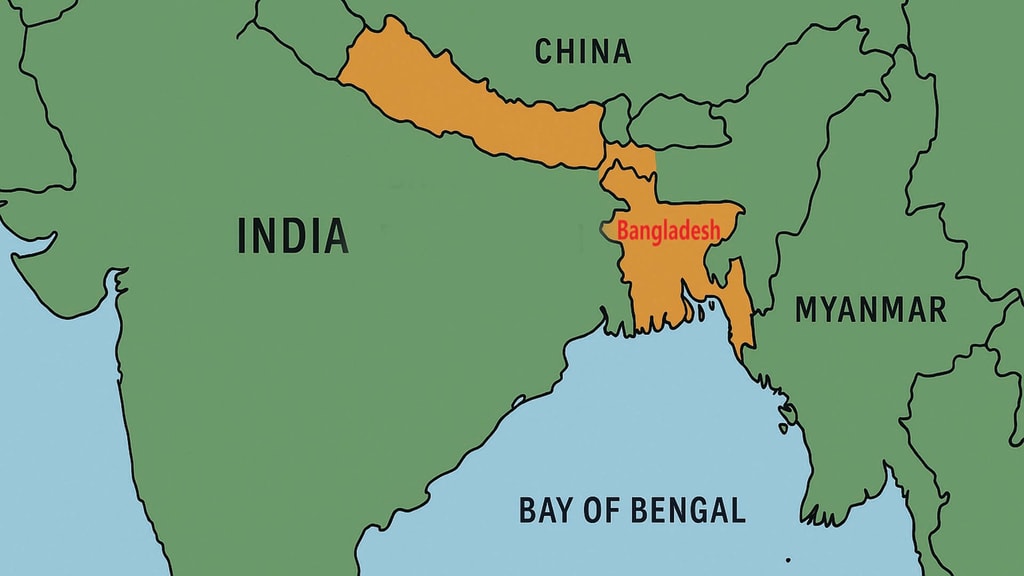
Bangladeshs geographical position in the world: A strategic power in terms of industry and economy.
Bangladesh is a small but important country in South Asia whose geographical position carries a unique importance in the eyes of the world economy. Surrounded by India Myanmar Nepal China and the Bay of Bengal this country is considered a junction of South and Southeast Asia not only geographically but also economically and strategically.
Geographical position of Bangladesh
The geographical coordinates of Bangladesh are 20°34 to 26°38 north latitude and 88°01 to 92°41 east longitude. The country is bordered by India to the north India and Myanmar to the east India to the west and the Bay of Bengal to the south. This location has made Bangladesh a natural bridge between South Asia and Southeast Asia.
Bangladesh is a riverine country with an area of about 147570 square kilometers. Major rivers like the Padma Meghna and Jamuna have always influenced the geography and economy of Bangladesh.
Why are they so important for industry and trade?
1. Regional connectivity hub
Bangladesh can act as a logistics hub as it is a junction between South and Southeast Asia. The Chittagong and Mongla seaports the Padma Bridge the Bangabandhu Railway Bridge and the under-construction deep seaport of Payra—all of which are preparing Bangladesh for future international trade.
In particular Bangladesh can be used as a transit facility by economically powerful countries like China, India, Nepal and Bhutan. India is already transporting goods through Bangladesh to connect with Tripura Assam and Meghalaya.
2. Potential for labor-intensive industries
Bangladesh has a huge working youth force. This labor force attracts the attention of foreign investors to build low-cost productive industries. Bangladeshs ready-made garment (RMG) sector is the second largest in the world accounting for more than 80% of the countrys total export earnings.
Bangladesh occupies a strategic position in the global supply chain due to its geographical proximity to countries such as South China South Korea Vietnam and Thailand.
3. Port and seaport facilities
Chittagong and Mongla ports are among the most important seaports in South Asia. India Nepal and Bhutan are able to import and export goods using these ports. This facility will make Bangladesh a regional transit hub in the future.
In addition, its location adjacent to the Bay of Bengal has created huge opportunities for Bangladesh in extracting marine resources developing a marine economy (blue economy) developing deep sea ports, and developing a maritime transport system.
4. Supporting the development of agro based industries
Bangladeshs fertile land and river system are ideal for agriculture. Food and agro-based industries have developed around the production of rice jute, tea fish etc. Geographically the riverine areas of the south, the tea-growing areas of the north and the jute and cottage industry-based areas of the west have created a strong foundation for domestic industry.
5. Potential for tourism industry
The geographical diversity of Bangladesh has created huge potential for tourism. Places like Coxs Bazar Sundarbans tea gardens of Sylhet the hills of Bandarban etc. attract domestic and foreign tourists. Developing the tourism industry in these areas will greatly increase the local economy and employment.
6. Interest of multinational industrial entrepreneurs
Due to its geographical location multinational companies are bringing Bangladesh under the China-plus-one strategy. That is they are interested in investing in Bangladesh as an alternative manufacturing center alongside China. This has increased the potential for industrialization in the electronics automobiles pharmaceuticals IT and light engineering sectors.
Challenges
However, geographical advantages alone are not enough some challenges still remain
• Weak infrastructure
• Shortage of skilled human resources
• Bureaucratic complexity
• Political instability
• Impact of climate change
These problems need to be resolved and we must move towards sustainable industrial development.
Future outlook
Bangladesh has already adopted Vision 2041 where the goal is to transform into a developed technology-based industrial-based economy. To implement this vision the geographical location must be fully utilized:
• Making Chittagong and Mongla world-class ports
• Infrastructure development in industrial areas
• Creating skilled human resources
• Formulating environment-friendly industrial policies
• Expanding international connectivity (rail, road water and air)
Conclusion
Bangladeshs geographical location is not just a point on a map but it is a strategic strength. With appropriate planning and effective implementation it is possible to turn this location into the center of industrial and economic development. In this era of globalization Bangladesh has the power to transform geographical advantage into economic success.
About the Creator
Md.Moniruzzaman
I am Md. Moniruzzaman from Bangladesh. Call: +880 1791 634976
Keep reading
More stories from Md.Moniruzzaman and writers in History and other communities.
The Forgotten Flame of Justice: When a Farmer Faced a Fearsome Governor
"In a world ruled by fear, one farmer dared to seek justice — and changed everything." In the luminous history of Islam, countless stories of justice and fairness shine bright. Yet, some remain hidden, lost in the folds of time. Today, I bring you one such forgotten tale — the story of a humble farmer and the feared governor, Al-Hajjaj ibn Yusuf.
By Md.Moniruzzaman9 months ago in History




Comments
There are no comments for this story
Be the first to respond and start the conversation.