
Galileo Galilei: The Father of Modern Science
How Galileo's Discoveries in Astronomy, Physics, and Method Transformed Scientific Thought Forever
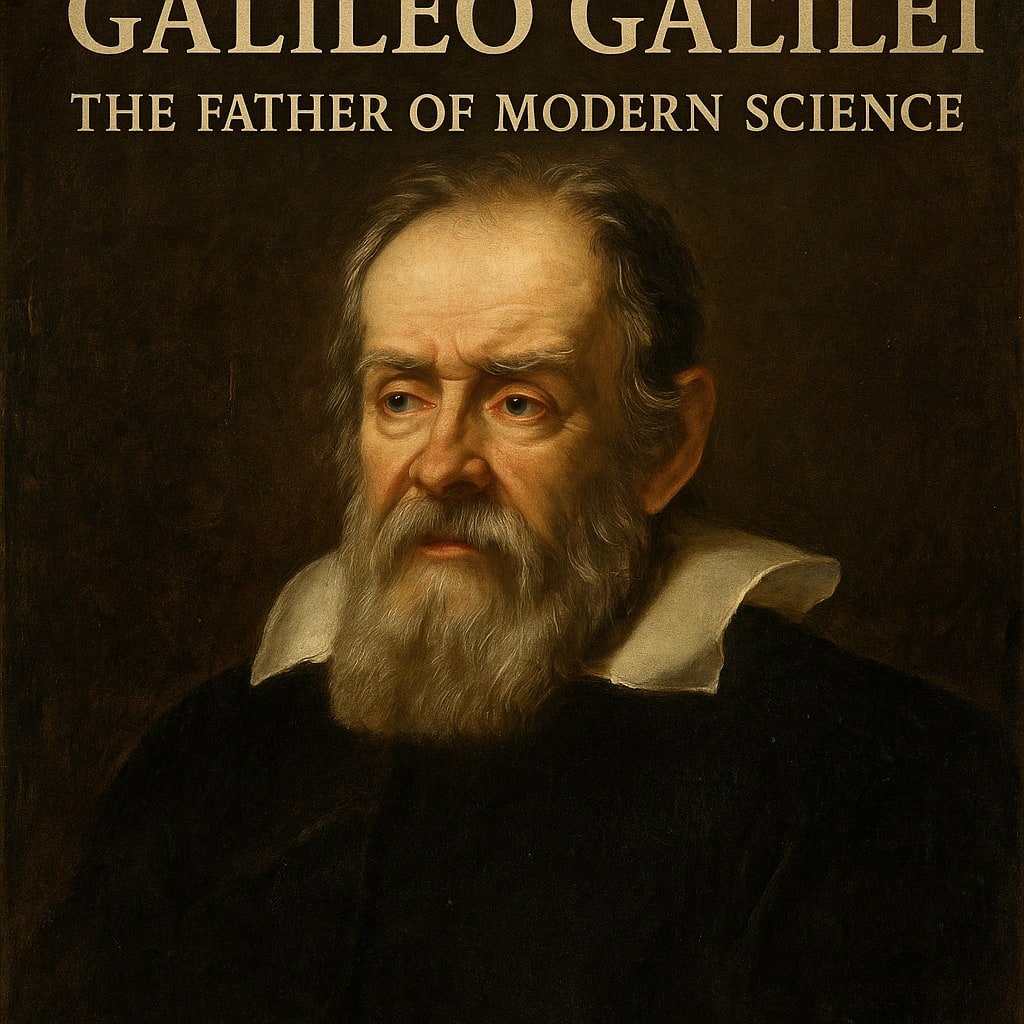
Galileo Galilei (1564–1642) is widely regarded as one of the most influential scientists in history. Often called the “Father of Modern Science,” Galileo played a key role in the Scientific Revolution of the 16th and 17th centuries. Through his groundbreaking work in physics, astronomy, and scientific methodology, he challenged traditional beliefs, defended the use of observation and experimentation, and paved the way for the development of modern science. Despite fierce opposition from religious authorities of his time, Galileo’s legacy endures in nearly every branch of science today.
Early Life and Education
Galileo was born on February 15, 1564, in Pisa, Italy. He was the eldest of six children in a family that valued education and music. His father, Vincenzo Galilei, was a musician and music theorist who encouraged Galileo to think independently. Galileo originally studied medicine at the University of Pisa, but his true passion was mathematics and natural philosophy (what we now call science). He eventually left medical studies to pursue these interests.
While at university, Galileo began conducting experiments and questioning the traditional ideas of the time, especially those of the ancient Greek philosopher Aristotle, whose teachings had dominated scientific thought for centuries. This spirit of inquiry would define his entire career.
Discoveries in Physics
One of Galileo's major contributions was to the study of motion. Contrary to Aristotle's belief that heavier objects fall faster than lighter ones, Galileo proposed that all objects fall at the same rate in a vacuum, regardless of their mass. He demonstrated this idea through experiments, including his famous (though possibly apocryphal) dropping of spheres from the Leaning Tower of Pisa.
Galileo also explored kinematics—the study of motion—developing concepts such as acceleration and inertia that would later influence Isaac Newton. He introduced mathematical analysis into the study of physics, turning it into a quantitative science rather than a purely philosophical one.
The Telescope and Astronomy
Although Galileo did not invent the telescope, he was the first to use it systematically to observe the heavens. In 1609, he improved upon existing telescope designs and began studying celestial bodies. What he saw would shake the foundations of the universe as it was then understood.
Among his discoveries were:
The moons of Jupiter (now called the Galilean moons): These four moons (Io, Europa, Ganymede, and Callisto) orbited Jupiter, not Earth, providing strong evidence that not everything revolved around Earth.
The phases of Venus: These phases could only be explained if Venus orbited the Sun, supporting the heliocentric model proposed by Copernicus.
Sunspots: Imperfections on the Sun’s surface showed that celestial bodies were not perfect, contrary to Church teachings.
The rough surface of the Moon: Galileo observed mountains and craters on the Moon, again challenging the belief in heavenly perfection.
These observations strongly supported the Copernican model of the solar system, in which the Earth and other planets orbit the Sun, rather than the Ptolemaic model, which placed Earth at the center of the universe.
Conflict with the Church
Galileo’s support of the heliocentric model put him at odds with the Catholic Church, which upheld the geocentric model as religious doctrine. In 1616, the Church declared heliocentrism to be "formally heretical." Galileo was warned not to teach or promote it.
Despite this warning, Galileo continued his research and in 1632 published "Dialogue Concerning the Two Chief World Systems," a book comparing the heliocentric and geocentric models. Though written carefully, the book clearly favored the Copernican view. This led to Galileo being tried by the Roman Inquisition in 1633. He was found guilty of heresy and forced to recant. He spent the rest of his life under house arrest.
Even while confined, Galileo continued to write. His final book, "Two New Sciences," summarized much of his work in physics and was smuggled out of Italy for publication in the Netherlands.
Scientific Method and Legacy
Perhaps Galileo's most lasting contribution was his emphasis on observation, experimentation, and mathematics in the study of nature. He insisted that knowledge should be based on evidence, not authority, helping to lay the foundations of the scientific method.
His courage in standing up for scientific truth, even in the face of persecution, made him a symbol of intellectual freedom and reason. In 1992, more than 350 years after his trial, the Catholic Church formally acknowledged that Galileo had been right.
Conclusion
Galileo Galilei was more than a brilliant scientist—he was a revolutionary thinker who dared to question centuries of accepted belief. His discoveries in astronomy and physics, along with his bold defense of reason and evidence, helped transform science into the disciplined, rigorous field it is today. Galileo’s life reminds us of the power of curiosity, courage, and critical thinking in the quest for truth. His impact is still felt every time we look through a telescope, perform a physics experiment, or question the world around us.
About the Creator
Keep reading
More stories from Anwar Jamil and writers in History and other communities.
Charles Darwin: The Man Who Unlocked the Mystery of Life
Charles Darwin (1809–1882) is one of the most important figures in the history of science. His theory of evolution by natural selection revolutionized biology and forever changed the way we understand life on Earth. By proposing that all species, including humans, evolved over time from common ancestors, Darwin challenged long-held religious and scientific beliefs. His work laid the foundation for modern evolutionary biology and has had a profound impact on many other fields, from medicine to anthropology.
By Anwar Jamil9 months ago in History


Comments
There are no comments for this story
Be the first to respond and start the conversation.