
From Whisper to Roar
The Voice of One From Whisper to Roar 2. Unheard No More From Whisper to Roar 3. Echoes of a Silent Soul From Whisper to Roar 4. The Rise of a Voice From Whisper to Roar 5. When Silence Breaks From Whisper to Roar 6. The Power Within From Whisper to Roar

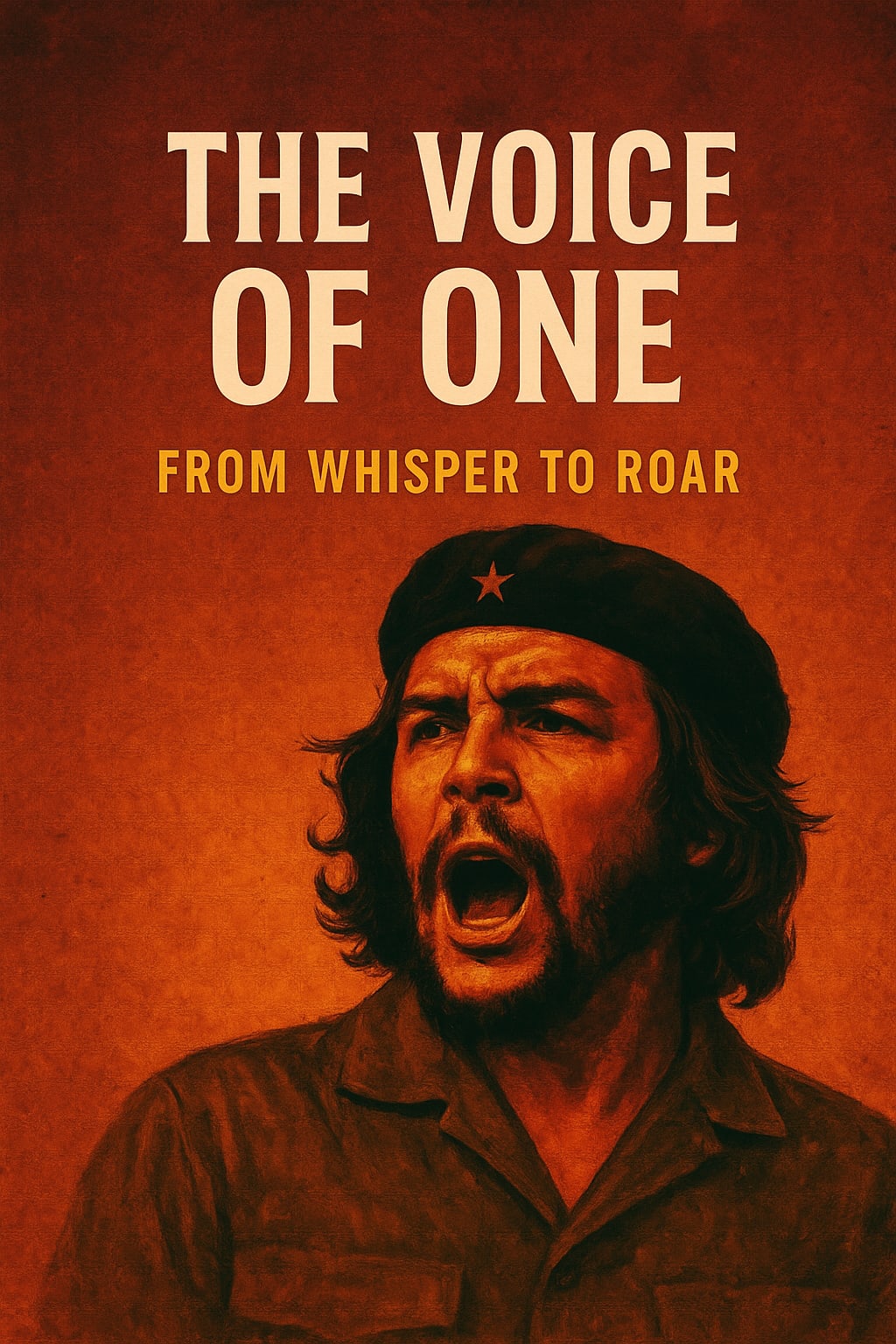
Ernesto "Che" Guevara, born on June 14, 1928, in Rosario, Argentina, became one of the most iconic figures in the 20th century. His journey from a young, intellectual medical student to a revolutionary figure is marked by his deep commitment to social justice and his desire to change the world. Che’s story is one of dedication, sacrifice, and ultimately, martyrdom in the pursuit of his ideals.
Che’s early life was not easy. He was born into a middle-class family, but his childhood was marred by asthma, which affected his health and restricted his activities. Despite these challenges, Che developed a strong intellectual curiosity, particularly in literature and history. He was influenced by the political environment in Argentina and the larger Latin American context, which was marked by inequality and oppression. His parents, though supportive, had differing views on political activism, but Che’s thoughts were slowly being shaped by the struggles of the common people around him.
Che began his studies at the University of Buenos Aires, pursuing a degree in medicine. While studying, Che became increasingly aware of the inequalities in Latin American society, which were deeply rooted in colonialism, imperialism, and economic exploitation. His interest in social issues led him to question the status quo. Che’s travels across Latin America would further cement his views on the need for revolution.
In 1951, Che set out on a road trip across South America with his friend Alberto Granado. The two traveled on a motorcycle, and the trip was life-changing for Che. He encountered widespread poverty, social injustice, and the harsh realities of life for the majority of the population. One of the most significant moments during his travels occurred when he visited the leper colony of San Pablo in Peru. There, he was struck by the suffering of the lepers and their abandonment by society. This experience awakened a deeper sense of purpose in him and strengthened his resolve to fight for the marginalized and oppressed people of Latin America.
After returning to Argentina in 1952, Che resumed his medical studies but soon realized that his role as a doctor alone could not address the systemic issues he had witnessed. His frustration with the limitations of medicine led him to turn his attention to political activism. He was drawn to the idea of armed revolution as a means to bring about radical change in Latin America.
In 1954, while living in Mexico, Che met Fidel Castro and his brother Raúl Castro, who were planning the overthrow of the Cuban dictator Fulgencio Batista. Che quickly became involved in the Cuban revolution, joining Fidel and his group of revolutionaries as they prepared for the historic assault on Cuba. On December 2, 1956, the group set sail for Cuba, and after a difficult journey, they landed on the island. Over the next two years, Che played a crucial role in the guerrilla warfare that eventually led to the fall of Batista’s government.
Che Guevara’s leadership in the Cuban Revolution was marked by his tactical brilliance and commitment to the cause. He became one of Fidel Castro’s most trusted comrades, and his expertise in guerrilla warfare and his ability to inspire others earned him respect from both his fellow revolutionaries and the Cuban people. After the successful overthrow of Batista in January 1959, Che became a key figure in the new Cuban government. He served in several important roles, including President of the National Bank and Minister of Industry. His vision for a socialist Cuba included land reforms, nationalization of industries, and the redistribution of wealth to the poor.
However, Che’s ambitions extended beyond Cuba. He believed that the Cuban Revolution was just the beginning of a larger struggle for liberation across Latin America and the world. In 1965, Che left Cuba, determined to spread revolution to other countries. His first stop was the Congo, where he attempted to lead a guerrilla movement against the Belgian-backed government. Unfortunately, the mission in the Congo was a failure, largely due to logistical issues and the lack of local support for the revolution. Che’s frustration with the failure in Africa deepened, but he remained committed to his cause.
In 1966, Che moved to Bolivia, where he believed the conditions were ripe for revolution. His goal was to rally the rural poor and organize a guerrilla movement that could challenge the Bolivian government. However, the Bolivian mission faced numerous difficulties, including a lack of support from the local population, limited resources, and the involvement of the CIA, which provided intelligence to the Bolivian military. Despite Che’s leadership and determination, the movement was unsuccessful.
On October 8, 1967, Che was captured by the Bolivian military after being betrayed by local informants. The next day, on October 9, he was executed in the small town of La Higuera, Bolivia. Che was only 39 years old. His death marked the tragic end of a man who had devoted his life to the cause of revolution and the liberation of the oppressed.
In the years following his death, Che Guevara’s image became a symbol of resistance and revolution. His iconic photograph—featuring him in a beret with a stern expression—became one of the most widely recognized images in the world. To many, Che is seen as a martyr, a man who sacrificed everything for the belief that a better world was possible. His writings, particularly his Motorcycle Diaries, which recount his travels through Latin America, continue to inspire generations of activists and revolutionaries.
However, Che’s legacy is not without controversy. Some criticize his methods, particularly his support for armed struggle and his role in the violent purges in Cuba following the revolution. His strict Marxist ideology, which prioritized the use of violence to achieve social change, has been a source of debate among scholars and political commentators. Despite this, Che Guevara remains an iconic figure in world history, symbolizing the fight against imperialism, inequality, and oppression.
Che Guevara’s life journey—from a young, idealistic doctor to a revolutionary leader—illustrates the power of conviction and the lengths to which individuals can go to fight for what they believe in. His story is one of courage, sacrifice, and a commitment to justice that has left a lasting mark on the world. Whether viewed as a hero or a controversial figure, Che Guevara’s impact on global politics and revolutionary movements remains undeniable.
About the Creator
Keep reading
More stories from Dr Afaq Ahmad and writers in History and other communities.
"She Vanished After One Text — And Her Phone Never Turned Off"
The Girl in the Red Rain The rain never felt right in Grenton. It didn’t wash away the dirt—it soaked it deeper. On nights like this, the town held its breath, as if it knew something terrible was coming.
By Dr Afaq Ahmad 11 months ago in Criminal



Comments (1)
How politically it became that Guevara’s leadership became in the Cuban Revolution, which spread throughout the world, is well written.