
From Steel to Strength: The Evolution of Waist Shaping and Self-Perception.
In the drawing rooms of the 1800s, elegance came at a cost. The corset—tight, rigid, and relentless—wasn't just a garment.


In the drawing rooms of the 1800s, elegance came at a cost. The corset—tight, rigid, and relentless—wasn't just a garment. It was a social statement. Women wore them to demonstrate refinement, discipline, and societal alignment. The narrower the waist, the more desirable the image. But the cost? Discomfort. Pain. Restriction.
Today, that obsession with shaping hasn’t disappeared. It has transformed. The modern waist trainer doesn’t promise submission—it offers support. It’s no longer a symbol of societal control, but a personal tool for confidence.
From Steel to Strength: The Evolution of Waist Shaping and Self-Perception
In the richly adorned drawing rooms of the 1800s, elegance came at a breathless price. The corset—rigid, laced, and unyielding—was more than an undergarment. It was a tool of transformation, a social contract stitched in steel. To wear one wasn’t a matter of preference. It was a declaration of status, discipline, and femininity—crafted under the weight of cultural expectation.
Today, that hunger for aesthetic precision still exists. But something fundamental has changed. What was once imposed has become intentional. The corset’s modern descendant—the waist trainer—doesn’t command obedience. It offers collaboration. And in that shift lies a quiet revolution.
The Corset Era: Aesthetic Obedience in Iron
By the mid-19th century, the corset had become the uniform of womanhood. It was everywhere—in fashion plates, etiquette guides, bridal trousseaux. The narrow waist it sculpted wasn’t just a silhouette; it was a symbol. Respectable women didn’t merely wear corsets—they became them.
Constructed with whalebone or steel, often tightened to excruciating degrees, the corset carved the female figure into a cultural ideal. It lifted the bust, narrowed the waist, and rigidly held the torso. But it also displaced organs, restricted breathing, and, in some cases, caused permanent damage. And yet, its grip held for generations. Why?
Because beauty—especially for women—has always been entangled with control. In a world where women lacked autonomy, their appearance became their armor, their currency, and sometimes their only form of social mobility. The corset was the visible symbol of invisible pressure.
A Cultural Pivot: From Restriction to Expression
As the 20th century dawned, tremors of change began to shake the fashion world. The suffragette movement, industrialization, and women’s increasing presence in the workforce cracked the corset’s stronghold. By the 1920s, loose flapper dresses whispered of freedom.
But not everyone celebrated the shift. For some, losing the corset felt like losing structure—literally and metaphorically. That’s the irony: even as women broke free, many longed for the feeling of being held together.
The waist remained a focal point. Belts, shapewear, and posture-correcting garments evolved through the decades. But unlike the corset, these items were framed as choices, not obligations. Fashion began to speak the language of empowerment—not enforcement.
---
The Rise of the Waist Trainer: Function Meets Form
Fast forward to today’s gym bags and social media feeds, and you’ll find a new icon of shape—the waist trainer. Far from the suffocating relics of the past, today’s trainers use soft, elastic fabrics like neoprene and polyester blends. They flex with the body, not against it.
Many include adjustable hooks, Velcro, or zippers. Some are thermal, increasing sweat during workouts. Others are designed for posture support during work or recovery. The modern waist trainer isn’t hidden beneath gowns—it’s flaunted over leggings in mirror selfies.
It’s not about obedience anymore. It’s about optimization.
This shift matters.
Because when you choose to wear something that enhances your presence—rather than erases your comfort—you reclaim agency. You say: this is how I want to feel. Not how I’m expected to look.
Mind Over Mirror: The Psychological Edge
Let’s be honest. Clothes have never been just fabric. They’re feelings. They’re posture and memory and identity. And few items change how we feel about ourselves as immediately as something that wraps the center.
Modern waist trainers do something deeper than compress. They communicate.
They say: “Stand tall.”
They say: “Center yourself.”
They say: “Be aware of your body—not ashamed of it.”
For many users, wearing a waist trainer is a ritual of intention. A reminder to move with discipline. To feel supported—literally and emotionally. There’s no magic in the neoprene. The magic is in how the user interprets it.
That’s what separates it from its ancestor.
The corset silenced. The waist trainer supports.
Misuse and Modern Caution: The Darker Edge
Of course, not all modern use is healthy. Waist trainers can become problematic when worn obsessively or marketed as overnight transformations. Some influencers blur the line between inspiration and deception, pushing body ideals that require more than just stretchy fabric.
Medical experts caution that excessive compression can cause acid reflux, shallow breathing, or even long-term muscle weakness. Like any tool, effectiveness depends on use.
The healthiest users treat waist trainers as one piece of a broader self-care system: paired with hydration, mindful movement, and realistic expectations. In this framework, the garment doesn’t “fix” the body—it aligns with it.
The Visual Legacy: From Bondage to Balance
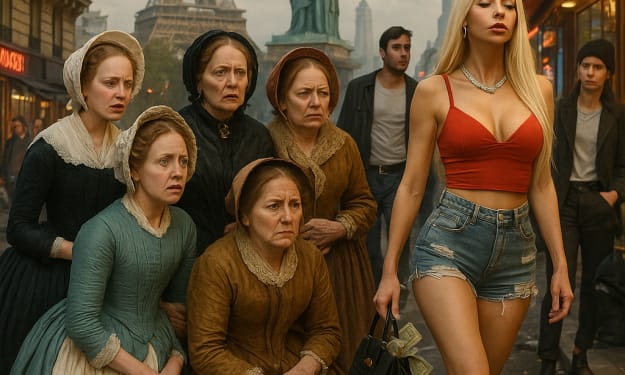
Side-by-side comparisons tell the story best. The rigid steel corset, bound with ribbon and shame. The modern waist trainer, curved and athletic, worn during reps or under power suits.
Where one says: “Don’t move,” the other says: “Move better.”
Where one demanded conformity, the other invites awareness.
And yet, both share a legacy—proof that the waist remains a site of meaning. Not just for beauty, but for identity.
The Waist as Metaphor: Why It Still Matters
Why the waist? Why, after centuries of liberation, do we still gravitate to garments that shape it?
Because the waist is the body’s axis. It’s the bridge between upper and lower, the balance point, the center. To shape it is to acknowledge it. To wrap it is to honor its power.
Even linguistically, the waist shows up in metaphors of strength: “gird your loins,” “tighten your belt,” “stay centered.”
The obsession, then, isn’t vain. It’s primal.
Social Media and the Visibility Revolution
In the age of Instagram and TikTok, the waist trainer has gained a second life. Influencers post transformations. Brands create lines in neon, metallics, and lace. Wearing one isn’t private anymore. It’s performance.
But that visibility comes with pressure. Not just to look good—but to constantly document the journey of becoming. The waist trainer becomes both the tool and the proof.
That’s where it diverges from the corset again. The corset was hidden. The trainer is seen. It is claimed. It is part of a public declaration: I’m working on me.
The Balance Between Power and Peace
Ultimately, the power of the waist trainer isn’t in the material. It’s in the moment of choice.
To use it without shame.
To set it aside without guilt.
To redefine strength not as constriction—but as alignment.
Some days, strength is standing tall in structure. Other days, it’s lounging in softness. The freedom to move between the two—that’s the real revolution.
The Body as a Conversation, Not a Battlefield
When you look at a waist trainer today, you’re not seeing a relic. You’re seeing a symbol of evolution. Of how far we’ve come from dressing to impress others, to dressing to express ourselves.
Fashion is no longer about submission. It’s about expression.
The waist—once a battleground for control—can now be a center of calm, of pride, of inner alignment.
And that, perhaps, is the quietest and strongest shape of all.
About the Creator
Sayed Zewayed
writer with a background in engineering. I specialize in creating insightful, practical content on tools. With over 15 years of hands-on experience in construction and a growing passion for online, I blend technical accuracy with a smooth.
Keep reading
More stories from Sayed Zewayed and writers in History and other communities.
From Modesty to Exposure: The Timeline of Moral and Fashion Decline from 1850 to Now.
Throughout human history, fashion has not only been a reflection of beauty or status it has been a barometer of culture, values, and morality. From the layered modesty of the 1800s to the hyper-revealed trends of the 21st century, the shift in clothing mirrors something deeper: a transformation, and perhaps a collapse, of traditional values and educational foundations. This essay traces that journey through time and dives into the gradual erosion of boundaries social, familial, spiritual and how they manifest in the way we dress.
By Sayed Zewayed9 months ago in History
The Forbidden City, China – The Richest Palace in History
No other palace—ancient or modern—matches its scale, longevity, and accumulated wealth. Origins and Construction The Forbidden City was constructed between 1406 and 1420 during the reign of the Ming Dynasty’s Yongle Emperor. Over one million workers, including artisans, craftsmen, and laborers, were involved in its construction. Materials were sourced from across China—rare woods from the south, marble from nearby quarries, and precious metals from imperial mines.
By Say the truth 4 days ago in History
If America Walks Away from NATO, the World Will Feel the Shock
If America Walks Away from NATO, the World Will Feel the Shock For more than seventy years, NATO has stood as a symbol of collective security and shared responsibility. It was never a perfect alliance, but it worked because it was built on a simple idea: when nations stand together, wars are less likely to happen. Today, however, that foundation is being shaken—not by foreign enemies, but by growing voices inside the United States questioning whether NATO is still worth it.
By Wings of Time 13 minutes ago in History



Comments
There are no comments for this story
Be the first to respond and start the conversation.