
From Jungle to Nation: The Untold Story of Greater Iqbal Park
How a wild forest by the Ravi River transformed into the birthplace of Pakistan’s dream.

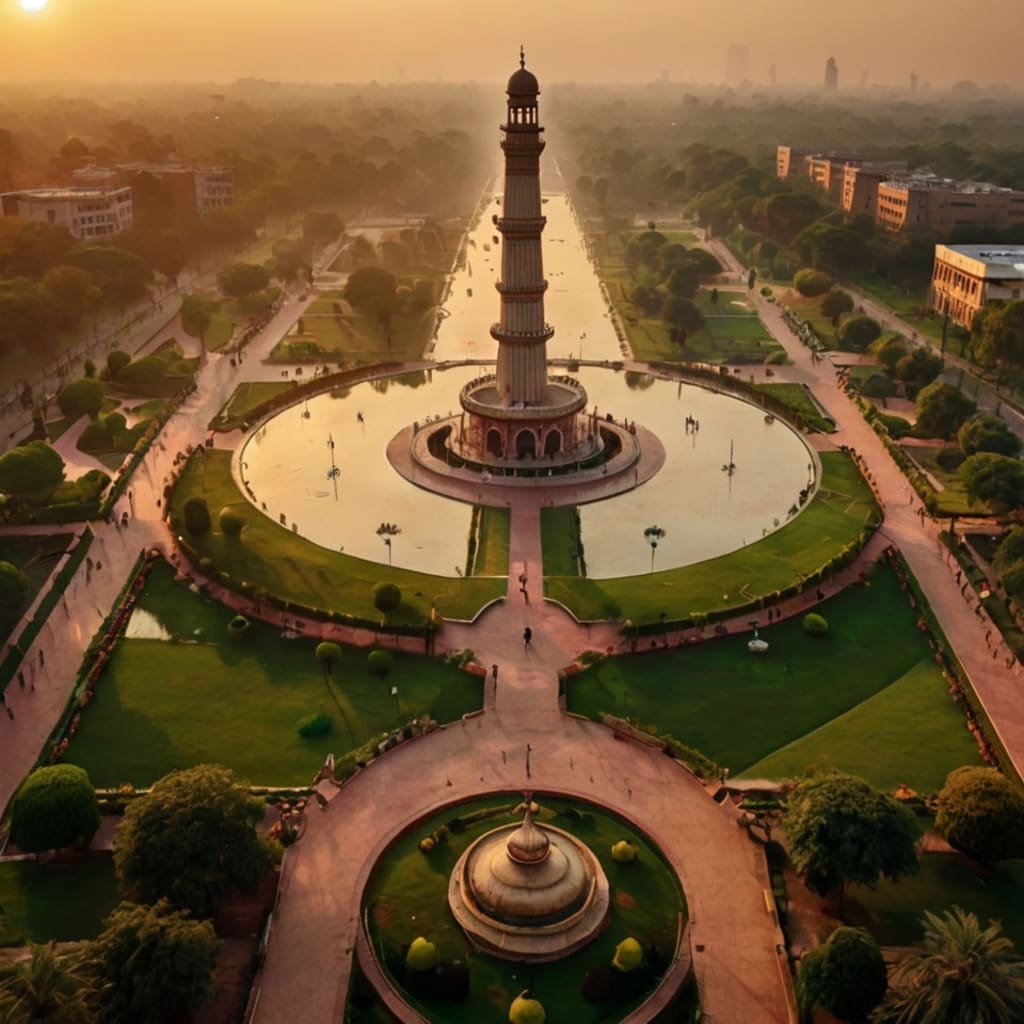
From Jungle to Nation: The Untold Story of Greater Iqbal Park
Written by: Raheela Mughal
Once upon a time, in the heart of Lahore, where the mighty Ravi River once flowed beside the grand Badshahi Mosque and the towering walls of the Akbari Fort, there lay a vast and mysterious landscape. Centuries ago, the Ravi’s waves shimmered through this land, but as time passed, the river slowly changed its course and drifted away to its present path. The area it left behind turned into a wide, open plain — a place where the echoes of history would one day shape a nation.
But before it became the celebrated Greater Iqbal Park, it was not a place of beauty or joy. Slowly, nature claimed the abandoned riverbed, and a thick, dark forest grew in its place. This wild forest stretched from Shalimar Gardens all the way to Badami Bagh. It was so dense and frightening that even in broad daylight, people hesitated to pass through it. The rustling of leaves and the cries of wild birds gave the forest an eerie silence — as though it guarded secrets of centuries gone by.
By the time of the Sikh rule, this forest had become a dangerous refuge for robbers and bandits. It was no longer a place of life but one of fear and mystery. People living nearby avoided it altogether. When the British eventually took control of Punjab, they saw the forest not as a wonder of nature but as a threat to their rule. To prevent rebels and outlaws from hiding within it, they ordered the entire forest to be cleared.
And so, the trees fell one by one, and the jungle disappeared, leaving behind a vast barren plain. The British army quickly took over the land and turned it into a military parade ground, known as “Pulton Maidan.” Here, British soldiers would march proudly during their parades, horses would race, and spear-throwing competitions were held. The field, once wild and feared, now echoed with the sounds of drums, hooves, and cheering crowds.
As evening fell, the people of the walled city of Lahore would stroll through the open grounds, enjoying the cool breeze and the sight of the sunset over the old city. Gradually, the barren plain began to change once again — this time into a garden of life. Around 1930, mango and other fruit trees were planted throughout the area. The British authorities also covered the ground with green grass and flowering plants, giving it a new identity.
In honor of the then Viceroy of India, Lord Minto, the garden was named Minto Park. For decades, this name became famous across Lahore and remained etched in the memory of its people long after the end of British rule. During those days, Lahore was a much smaller city, confined mainly to the fort and its surrounding neighborhoods. Because of its location close to the city center, Minto Park became the most beloved public gathering place for ordinary citizens.
Most other parks and gardens of that era were reserved exclusively for the British elite or the rich landlords. But Minto Park was different — it belonged to the people. Families would come here for picnics, children played freely, and poets, wrestlers, and common folk alike shared the same ground. It was a place where Lahore’s heart beat openly — vibrant, diverse, and full of life.
Over time, Minto Park became the stage for countless events and memories. Literary gatherings were held here, where poets and thinkers shared their words under the open sky. Mighty wrestling matches and traditional kabaddi tournaments drew huge crowds. During the spring festival of Basant, colorful kites filled the air as people of every religion and background celebrated together. It was a symbol of Lahore’s unity, culture, and spirit.
The park’s western side was reserved for sports and public performances — football, hockey, cricket, and wrestling matches brought together thousands of spectators. It was not merely a park; it was the soul of a city in love with its traditions and dreams.
But the most remarkable chapter in the park’s history came in March 1940. From March 22nd to 24th, the All India Muslim League held its historic 27th annual session right here in Minto Park. On March 23, 1940, a resolution was presented that would forever change the destiny of millions — the Pakistan Resolution, also known as the Lahore Resolution. The following day, March 24, this resolution was approved, marking the birth of a new vision — the dream of an independent homeland for the Muslims of the Indian subcontinent.
From that moment, Minto Park was no longer just a garden — it became sacred ground, the birthplace of Pakistan’s idea. Every blade of grass, every tree, seemed to whisper the story of freedom and unity.
Years later, to honor this monumental event, a majestic monument was built at the very spot where the resolution had been passed — Minar-e-Pakistan. The tower stands tall today, a symbol of strength, faith, and perseverance. Around it, the garden was expanded, redesigned, and renamed Greater Iqbal Park, in tribute to Allama Muhammad Iqbal, the visionary poet whose dreams had inspired the creation of Pakistan.
Today, Greater Iqbal Park is one of the most beautiful and visited places in Lahore. Children play on its lawns, families picnic by its fountains, and history breathes through its pathways. The park tells stories — of rivers that changed their course, of forests that turned into cities, of people who fought for freedom, and of a dream that became a nation.
From the roaring waves of the Ravi to the shining tower of Minar-e-Pakistan, this land has witnessed centuries of transformation. It has seen rulers rise and fall, empires come and go, and yet it remains — a symbol of Lahore’s eternal spirit.
So, dear children, whenever you visit Greater Iqbal Park, remember — you are standing on the very ground where history was made. The same place where the dream of Pakistan first took shape, where voices of courage and hope once echoed, and where the heart of a nation still beats proudly today.
— The End —
About the Creator
Martin Luther King Jr.: The Voice of Peace and Justice
Martin Luther King Jr. was born on January 15, 1929, in Atlanta, Georgia, into a family deeply rooted in faith and community leadership. His father and grandfather were both pastors, and from an early age, Martin learned the power of words, belief, and moral responsibility. Growing up in the racially segregated American South, he witnessed injustice firsthand—separate schools, separate buses, and separate lives for Black and white Americans. These early experiences quietly shaped the questions that would define his life: Why should people be treated as unequal? And how could such injustice be peacefully undone?
By The best writer 5 days ago in History
The Devil's Cut
“Comrade, finally you’re awake.” The voice was smooth, sensual. A flickering incandescent bar was all that lit the white, sterile room. All Vladimir remembered was everything going black. He tried to move his arms and found them strapped to the gurney.
By Matthew J. Fromm6 days ago in Fiction


Comments
There are no comments for this story
Be the first to respond and start the conversation.