
From Cricket Legend to Political Powerhouse
The Journey of a Sports Icon Who Transformed into Pakistan’s Most Influential Leader

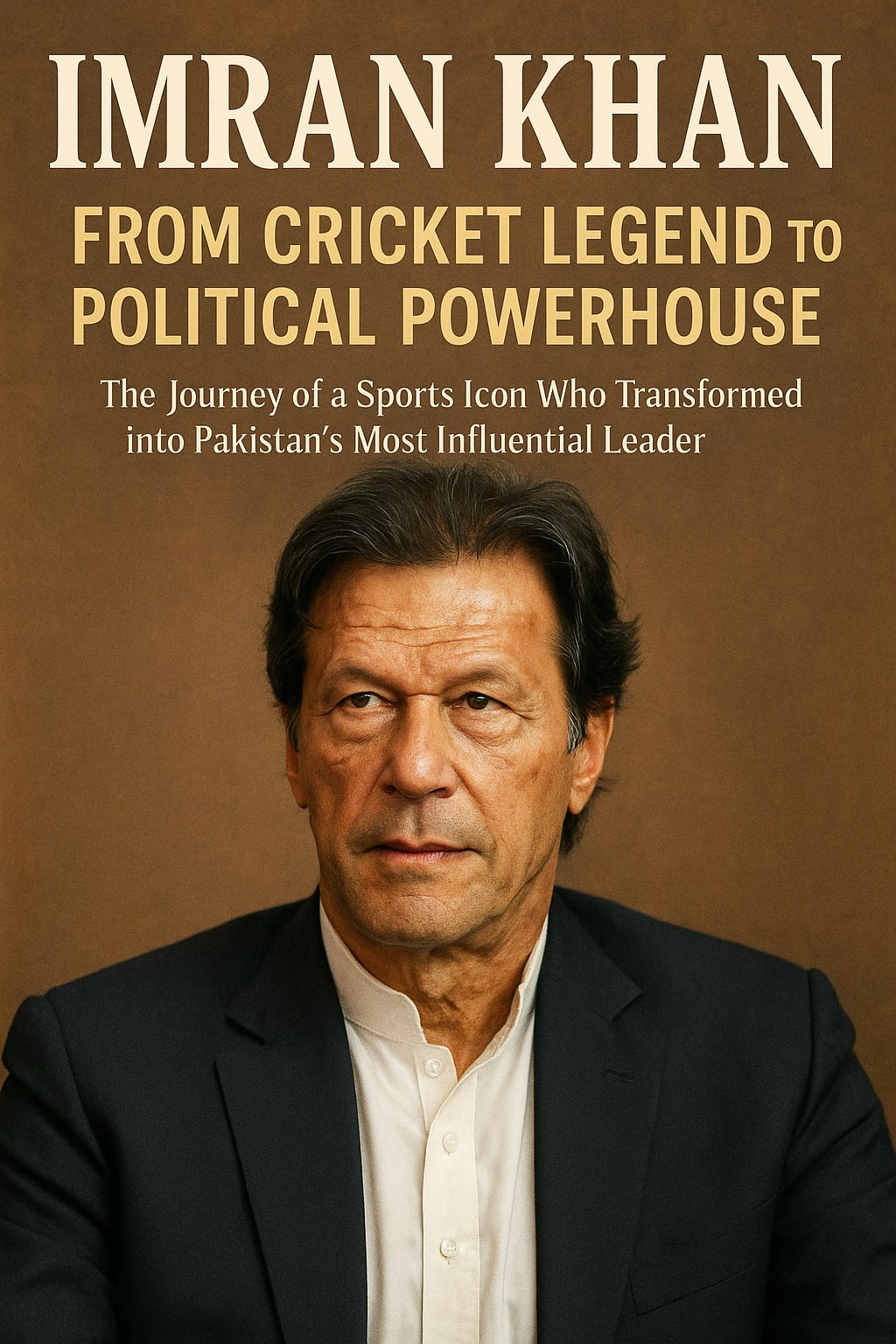
Imran Khan's life is one of remarkable transformation—from a world-renowned cricketer to a philanthropic visionary, and ultimately to the Prime Minister of Pakistan. His story is not just about personal evolution but also about the shifting tides of a nation searching for a leader who could inspire real change. Charismatic, driven, and often polarizing, Khan's journey is marked by victories and setbacks, glory and controversy, yet remains deeply woven into the fabric of modern Pakistan.
### Early Life and Cricket Stardom
Born on October 5, 1952, in Lahore, Pakistan, Imran Ahmed Khan Niazi came from a well-to-do Pashtun family with a history of public service and military leadership. Educated at Aitchison College in Lahore and later at the Royal Grammar School in England, Khan went on to study at Keble College, Oxford, where he earned a degree in Philosophy, Politics, and Economics.
Khan’s cricketing journey began early, debuting for Pakistan in 1971 at the age of 18. Over the next two decades, he developed into one of the world's most formidable all-rounders. Known for his fierce pace bowling, sharp intellect, and indomitable will, Khan’s crowning moment came in 1992 when he captained Pakistan to its first—and still only—Cricket World Cup victory. That moment cemented his status as a national hero. His style of leadership on the field—strategic, disciplined, and motivational—would later shape his political persona.
### Philanthropy and the Birth of a Vision
Soon after retiring from cricket, Khan turned his focus to philanthropy. Deeply affected by his mother’s death from cancer, he resolved to build a cancer hospital in Pakistan. What many considered an impossible dream was realized in 1994 with the establishment of the Shaukat Khanum Memorial Cancer Hospital in Lahore. The project, largely funded by public donations, was a testament to Khan's ability to mobilize support and inspire belief in a shared vision.
Later, he founded Namal University in Mianwali, his ancestral district, with the goal of making higher education accessible to underprivileged youth. These philanthropic ventures earned him considerable respect beyond his cricketing legacy and demonstrated his growing commitment to national service.
### Entry into Politics
In 1996, Khan launched his political party, Pakistan Tehreek-e-Insaf (PTI), meaning "Movement for Justice." The transition from sports and charity to the rough-and-tumble world of Pakistani politics was neither smooth nor immediately successful. For years, PTI struggled at the ballot box. Critics labeled him politically naive, while others dismissed him as a celebrity-turned-politician with no real chance of changing the system.
However, Khan remained undeterred. His platform focused on anti-corruption, justice, and governance reforms—issues that resonated deeply with a population weary of dynastic politics and endemic corruption.
### Political Ascendancy
The turning point for PTI came in the 2010s. Khan’s rallies began drawing massive crowds, especially among young Pakistanis and urban middle-class voters. His message of “Naya Pakistan” (New Pakistan) struck a chord. In the 2013 general elections, PTI emerged as a major political force, forming a provincial government in Khyber Pakhtunkhwa.
Khan's rhetoric against entrenched political families like the Sharifs and Bhuttos gained further momentum as he took an increasingly vocal stand on national issues, including judicial reform, tax evasion, and foreign policy. His populist approach, combined with savvy use of social media, helped him build a powerful support base.
In the 2018 general elections, after two decades of persistence, PTI won a majority and Imran Khan became the 22nd Prime Minister of Pakistan.
### Tenure as Prime Minister
As Prime Minister, Imran Khan inherited a country facing immense challenges—an economic crisis, international diplomatic tensions, and deep political divisions. His government secured financial support from allies like Saudi Arabia, the UAE, and China, while also engaging in talks with the International Monetary Fund (IMF).
Domestically, Khan launched initiatives like the Ehsaas Program (a comprehensive poverty alleviation project), the Billion Tree Tsunami (an ambitious reforestation effort), and reforms in the health and education sectors. He emphasized accountability and transparency, directing investigations into corrupt practices within government institutions.
However, his tenure was not without criticism. Accusations of media suppression, mismanagement during the COVID-19 pandemic, rising inflation, and an over-reliance on the military's support fueled opposition. His foreign policy stance—particularly efforts to maintain neutrality between the U.S., China, and regional neighbors—was lauded in some quarters but also criticized for being inconsistent.
Despite the highs and lows, Khan remained a central figure in national discourse, known for his resilience and unyielding belief in reform.
### Political Downfall and Continued Influence
In 2022, Khan’s government was ousted through a parliamentary no-confidence vote, marking the end of his term as Prime Minister. Yet, the loss did not signal political retirement. On the contrary, it galvanized his supporters and reshaped his role into that of a political insurgent once again rallying for change.
Khan faced multiple legal challenges and arrests after leaving office, which many of his supporters viewed as politically motivated. Even while incarcerated or under restriction, he continued to command a loyal following, mobilizing mass protests and shaping national debates through digital platforms and media interviews.
### Legacy and Impact
Imran Khan’s legacy is multifaceted. As a cricketer, he elevated Pakistan’s international standing. As a philanthropist, he gave the nation institutions like Shaukat Khanum and Namal University. As a political leader, he disrupted the status quo and reshaped the country’s political narrative.
While historians and political analysts will debate his achievements and shortcomings for years to come, few can deny that Imran Khan remains one of Pakistan’s most influential—and polarizing—figures. He embodies both the aspirations and frustrations of a nation seeking transformation.
Whether seen as a visionary or a populist, a reformer or a flawed leader, Imran Khan’s biography is a reflection of a man driven by purpose, ambition, and an enduring connection to the people of Pakistan.
About the Creator
Irshad Abbasi
Ali ibn Abi Talib (RA) said 📚
“Knowledge is better than wealth, because knowledge protects you, while you have to protect wealth.
Keep reading
More stories from Irshad Abbasi and writers in History and other communities.
438 Days Between Life and the Endless Sea
The morning began like any other. The sea near the coast of Mexico was calm, the sky pale with early sunlight, and the air carried that familiar salty scent fishermen know so well. For José Salvador Alvarenga, it was just another fishing trip — another day to earn a living.
By imtiazalam5 days ago in History
TUS NUA - ch 53
TUS NUA – ch 53 New Beginnings – Mia and Midnight (*)(*)(*) Finola knew Ali’s brother-in-law needed to put his mind at rest. She fed her arm through his and led him outside. “We’ll sit here. If you like, I can put a block around us so our conversation will be private.”
By Margaret Brennan5 days ago in Fiction




Comments
There are no comments for this story
Be the first to respond and start the conversation.