
Four stunning cosmic images mark Hubble's 35th anniversary.
Humber's Anniversary Showcase: Spiral Galaxies to Stellar Nurseries

Hubble Celebrates 35 Years by Gifting Us 4 Breathtaking Cosmic Images
For 35 years, the Hubble Space Telescope has been humanity’s eye in the cosmos, unveiling the universe’s most stunning and mysterious phenomena. Launched on April 24, 1990, Hubble has revolutionized astronomy, capturing over 1.6 million observations and reshaping our understanding of space. To mark this milestone, NASA and the European Space Agency (ESA) have released four breathtaking new images, showcasing Hubble’s enduring power to inspire and discover.
1. NGC 3627 is the magnificent spiral galaxy.
One of the newly released images features NGC 3627, a stunning barred spiral galaxy located about 31 million light-years away in the constellation Leo. Hubble’s sharp vision reveals intricate details of its swirling arms, glowing star-forming regions, and a bright central bulge dominated by a supermassive black hole.
What makes NGC 3627 special is its role in helping astronomers measure cosmic distances. By studying Cepheid variable stars—pulsating stars with predictable brightness—within the galaxy, scientists refine calculations of the universe’s expansion rate, a key piece of the Hubble Constant puzzle.
2. The Glowing Star Cluster: NGC 6638
Next, Hubble turns its gaze toward NGC 6638, a dazzling globular cluster in the constellation Sagittarius. This dense ball of ancient stars, bound tightly by gravity, sparkles like a cosmic jewel box. In contrast to open star clusters, globular clusters like NGC 6638 contain some of the universe's oldest stars and offer clues about how galaxies first formed. Astronomers are able to study stellar evolution, chemical composition, and the dynamics of these ancient celestial gatherings thanks to Hubble's ability to resolve individual stars in such crowded regions.
3. NGC 6302 (The Butterfly Nebula) is the cosmic butterfly.
The Butterfly Nebula, or NGC 6302, is one of the most captivating images. This planetary nebula, located about 3,800 light-years away in Scorpius, resembles delicate wings stretching across space. The spectacular display of gas and dust that we witness is the final act of a dying star's expulsion of its outer layers. The central star, now a white dwarf, was once several times more massive than our Sun. The material that is ejected from it, which has been heated to over 36,000°F (20,000°C), glows in bright red, blue, and green. The intricate processes of stellar death and the enrichment of interstellar space with heavy elements are better understood thanks to Hubble's in-depth view.
4. The Eagle Nebula's Towering Creational Pillars
Without revisiting the Pillars of Creation in the Eagle Nebula (M16), one of Hubble's most enduring images, no anniversary celebration would be complete. This brand-new near-infrared image, which was first taken in 1995, looks through the dust to reveal newborn stars hidden within the massive cosmic columns. Star nurseries are five light-year-high pillars where gas and dust collide with gravity to form new stars. The infrared view highlights how Hubble continues to evolve, using different wavelengths to uncover secrets invisible to optical telescopes.
The Future and Legacy of Hubble
Over three and a half decades, Hubble has:
.Helped measure the age of the universe (13.8 billion years).
.Discovered dark energy, the mysterious force accelerating cosmic expansion.
.Provided the deepest views of the universe with the Hubble Ultra Deep Field.
.Monitored weather on distant planets and tracked comet collisions.
With its infrared capabilities, the James Webb Space Telescope (JWST) takes the spotlight, but Hubble continues to be essential. Its ultraviolet and optical observations complement Webb’s data, ensuring a multi-wavelength understanding of the cosmos.
Conclusion: A Timeless Cosmic Explorer
Hubble’s 35th-anniversary images remind us why it remains one of humanity’s greatest scientific achievements. From spiral galaxies to dying stars and stellar nurseries, Hubble continues to unveil the universe’s beauty and complexity. As it orbits Earth, this legendary telescope keeps pushing the boundaries of discovery, proving that even after 35 years, Hubble’s journey is far from over.
Here’s to many more years of awe-inspiring cosmic snapshots!
About the Creator
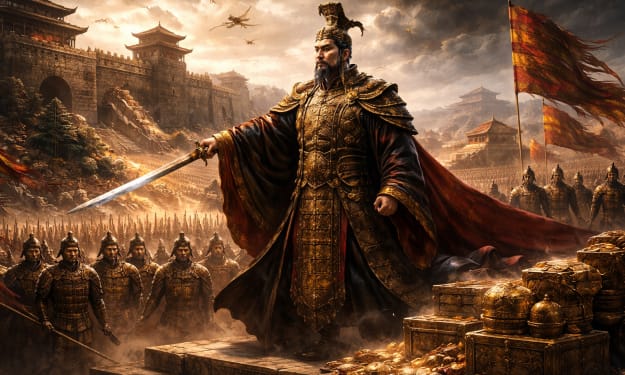
The Qin Empire: The Power That United the Chinese Nation
China Before Unification For centuries, China was divided into competing kingdoms, particularly during the Spring and Autumn Period and the Warring States Period. Powerful states such as Qin, Chu, Zhao, Wei, Han, Yan, and Qi fought relentlessly for territory and survival. Warfare was brutal, alliances were unstable, and millions suffered.
By Say the truth about 14 hours ago in History
Chandragupta Maurya vs the Greek Empire: The Clash That Reshaped Ancient India
Background: Alexander’s Invasion and Its Aftermath The roots of the conflict trace back to Alexander the Great’s invasion of India in 326 BCE. Although Alexander defeated King Porus at the Battle of Hydaspes, his army refused to advance further east. Upon his return westward and his death in 323 BCE, Alexander’s vast empire fractured among his generals, known as the Diadochi.
By Say the truth a day ago in History


Comments
There are no comments for this story
Be the first to respond and start the conversation.