
First world war E02,the Eastern Front and Gallipoli
How Germany and the Ottoman Empire Defied the Odds

Introduction
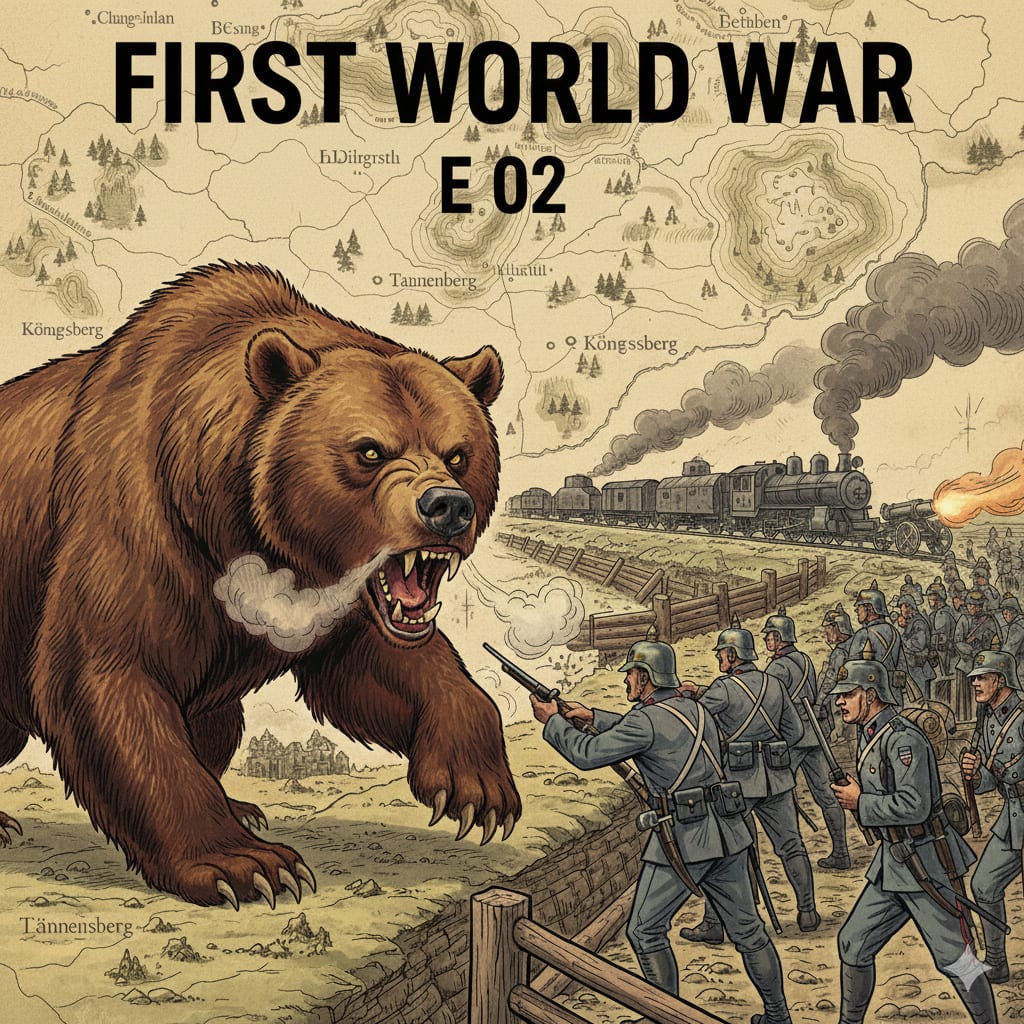
While World War I is often remembered for trench warfare on the Western Front, some of the most dramatic and decisive events unfolded far from Paris and the English Channel. On the Eastern Front and at Gallipoli, Germany and the Ottoman Empire faced overwhelming enemies but achieved astonishing victories. From the crushing defeat of Russia at the Battle of Tannenberg to the Ottoman resistance against Britain and France at Gallipoli, these campaigns reshaped the balance of power in the First World War.
Germany Under Threat on the Eastern Front
At the start of World War I, Germany’s main focus was the Western Front, where its forces invaded Belgium and France under the Schlieffen Plan. Paris was the ultimate target. However, events on the Eastern Front quickly turned into a nightmare.
Contrary to German expectations, the Russian Empire mobilized far faster than predicted. Instead of taking six weeks, Russian forces attacked East Prussia within just two weeks. Against 166,000 German troops, Russia deployed nearly 460,000 soldiers, creating panic among German commanders who feared the destruction of their homeland.
Russia’s Two-Army Strategy
Russia devised an ambitious plan by dividing its invading force into two armies:
First Army, commanded by General Paul von Rennenkampf, advanced from the east.
Second Army, under General Alexander Samsonov, attacked from the south.
The strategy aimed to trap German forces between these two armies and capture Königsberg, the capital of East Prussia. On paper, the plan was brilliant—but in practice, it suffered from serious flaws.
Russian Weaknesses and German Intelligence
Several factors undermined the Russian offensive:
Poor training and logistics
Lack of familiarity with East Prussian terrain
Natural obstacles, including the Masurian Lakes, which separated the two armies
Personal rivalry between Rennenkampf and Samsonov
Unencrypted radio communications, allowing Germans to intercept Russian plans
Despite their numerical advantage, Russian coordination was dangerously weak.
The Battle of Tannenberg: A German Masterstroke
After early defeats, Germany replaced its eastern commander with Paul von Hindenburg and Erich Ludendorff, supported by Colonel Max Hoffmann, who devised a decisive plan. Using East Prussia’s efficient railway network, German troops rapidly redeployed to strike Samsonov’s Second Army from multiple directions.
By late August 1914, German forces successfully encircled the Russian Second Army. Between August 27 and 31, the Russians suffered a catastrophic defeat:
48,000 killed
92,000 captured
Only 10,000 escaped
General Samsonov, devastated by the loss, committed suicide. German casualties were fewer than 14,000. This victory became known as the Battle of Tannenberg, one of Germany’s greatest triumphs in World War I.
Austria’s Struggles and Russia’s Temporary Success
While Germany celebrated at Tannenberg, its ally Austria-Hungary faced disaster against Russia. At the Battle of Lemberg (August–September 1914), Russian forces crushed the Austrians, killing or capturing hundreds of thousands. The Russians advanced deep into Galicia and laid siege to Przemyśl, which fell after 133 days.
By early 1915, Russia appeared unstoppable. However, German intervention soon reversed the situation. In mid-1915, Russian forces began the Great Retreat, losing vast territories to German and Austrian armies.
The Ottoman Empire Enters World War I
The Ottoman Empire joined the war in November 1914 after Britain seized two fully paid Turkish battleships. This decision angered the Turkish public and pushed the Ottomans closer to Germany, which transferred warships to Turkish control.
Soon after, Ottoman Caliph Mehmed V declared jihad against Britain, France, and Russia, opening new fronts in the war.
Gallipoli Campaign: Churchill’s Gamble
To knock the Ottomans out of the war, Britain and France launched the Gallipoli Campaign in 1915. The plan, largely backed by Winston Churchill, aimed to seize the Dardanelles, capture Constantinople, and open a supply route to Russia.
On paper, the plan was flawless. In reality, it became a disaster.
Turkish Resistance and Mustafa Kemal’s Leadership
German General Otto Liman von Sanders and Ottoman officers prepared strong defenses. Among them was Mustafa Kemal, commander of the 19th Division, who accurately predicted Allied landing points.
Turkish naval mines laid by the ship Nusrat sank or crippled several British and French battleships in March 1915. When ground invasions began on April 25, Allied forces—including ANZAC troops—faced fierce resistance.
Mustafa Kemal’s leadership proved decisive. At critical moments, he personally rallied retreating soldiers and blocked Allied advances on high ground.
Heroism at Gallipoli
The campaign produced legendary acts of bravery, such as Seyit Ali Çabuk, a Turkish gunner who carried 375-kg artillery shells on his back when mechanical equipment failed. His actions became a symbol of Ottoman resilience.
Despite deploying nearly 489,000 Allied troops against 315,000 Ottoman soldiers, the Allies failed to break through.
Allied Withdrawal and Ottoman Victory
After months of stalemate and heavy losses, the Allies quietly evacuated Gallipoli by January 1916 using dummy soldiers and fake artillery. The retreat was so well executed that Ottoman forces realized it only after the enemy had gone.
Casualties were immense:
Allied losses: ~348,000
Ottoman losses: ~160,000+
Despite the cost, Gallipoli was a strategic victory for the Ottoman Empire and a humiliating defeat for Britain. Churchill was forced to resign as First Lord of the Admiralty.
Conclusion
From Tannenberg to Gallipoli, World War I proved that numbers alone could not guarantee victory. Superior planning, intelligence, leadership, and morale allowed Germany and the Ottoman Empire to defeat stronger enemies. These battles reshaped the Eastern Front, elevated leaders like Hindenburg and Mustafa Kemal, and changed the course of modern history.
About the Creator
Muhammad waqas
Turning Dreams into Reality – One Story at a Time
I'm passionate about telling real success stories that inspire and empower. From ordinary beginnings to extraordinary achievements, I share journeys of resilience, hope, and transformation.
Keep reading
More stories from Muhammad waqas and writers in History and other communities.
First World War E01 Why Did WWI Start?
In July 1914, Europe stood at the edge of what its rulers believed would be a short and routine conflict. The German and Russian Empires prepared for war with optimism, assuming victory would come within weeks. German Emperor Kaiser Wilhelm II famously told his soldiers they would return home before the leaves fell from the trees. Russian commanders shared similar confidence.
By Muhammad waqas2 months ago in History
The Christmas Day Massacre
Imagine it’s Christmas Eve, 1926. New York City is glowing under a light dusting of snow, the air is thick with the sound of upbeat jazz, and behind a few nondescript basement doors, the party of the century is in full swing. This was the height of Prohibition, a time when being a "dry" nation only seemed to make everyone thirstier. But while the flapper girls were dancing and the champagne was flowing, something dark was creeping into the glasses of unsuspecting revelers.
By KWAO LEARNER WINFRED7 days ago in History



Comments
There are no comments for this story
Be the first to respond and start the conversation.