
Fatima al-Fihri: The Woman Who Built the World’s Oldest University and Empowered Muslim Education
In a time when women’s voices were often silenced, she built a beacon of knowledge that still shines bright after over 1,200 years.

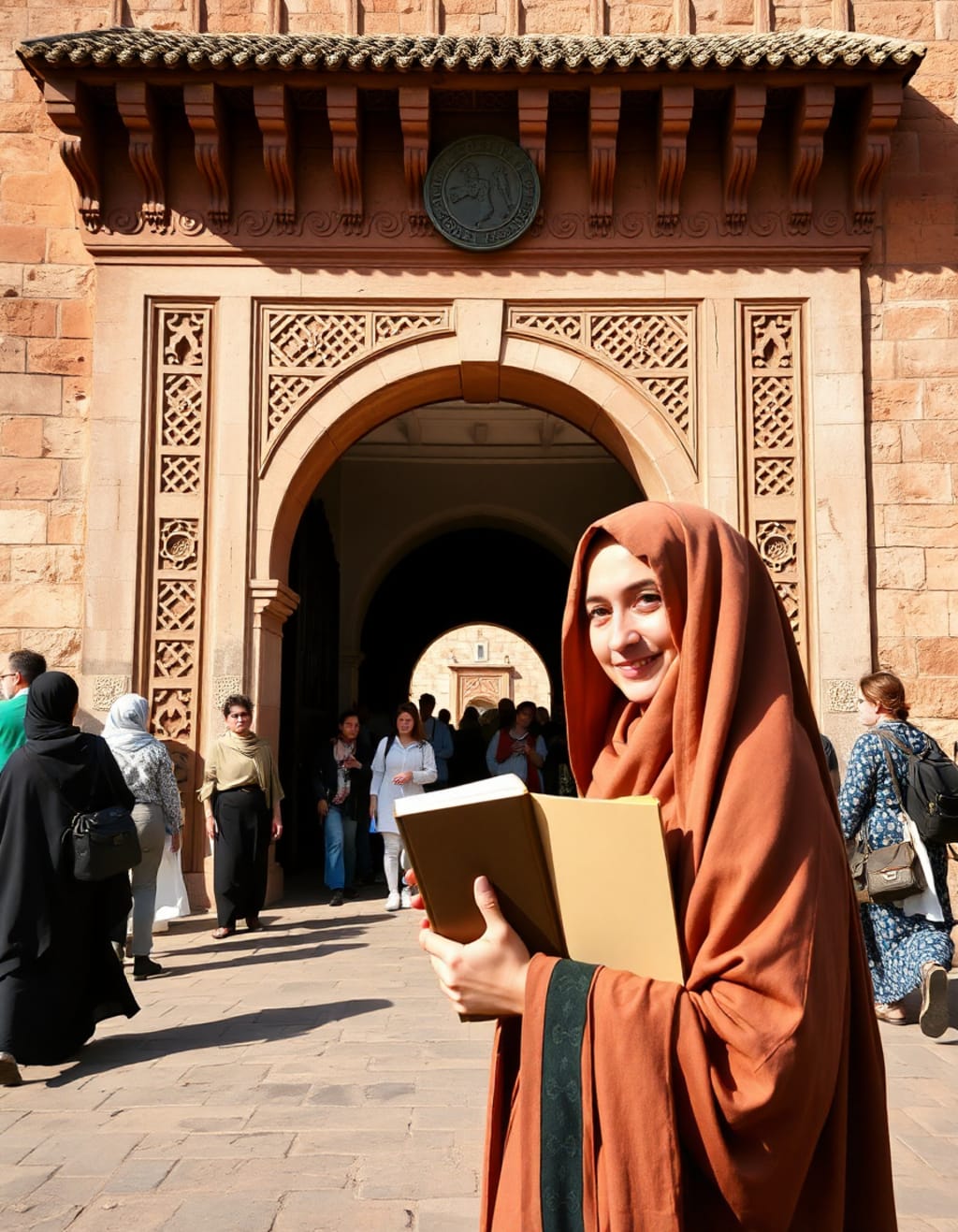
In the dusty alleys of 9th-century Fez, Morocco, a city alive with trade, culture, and diversity, a young Muslim woman dared to dream beyond the boundaries of her era. Her name was **Fatima al-Fihri**, and she was about to change the world of education forever.
### Chapter One: Roots of a Vision
Born in 800 CE in Kairouan, a city in modern-day Tunisia, Fatima was the daughter of **Mohammed al-Fihri**, a successful merchant. Her family belonged to the **Qarawiyyin tribe**, a community known for its devotion to religion and scholarship. Mohammed had moved his family to Fez, then a blossoming city of the Maghreb, to seek greater opportunities.
Fatima, along with her sister Mariam, was raised in a household that deeply valued education, piety, and charity. Despite the societal norms that limited women's roles to domestic spaces, Fatima's father ensured his daughters were well-educated and nurtured their intellectual abilities.
When their father passed away, Fatima and Mariam inherited a substantial fortune. Unlike many who would have chosen luxury, they chose legacy. Mariam financed the construction of the **Al-Andalus Mosque**, and Fatima, determined to go even further, envisioned a center for both worship and learning.
### Chapter Two: The Birth of Al-Qarawiyyin
In 859 CE, Fatima laid the foundation of what would become the **University of Al-Qarawiyyin**. Built in the heart of Fez, this wasn’t just another mosque. It was a multifunctional institution that combined spiritual devotion with the pursuit of knowledge.
Fatima personally oversaw the construction, fasting throughout the entire period as a form of spiritual dedication. She specified architectural details, selected scholars, and ensured the building was inclusive and open to diverse seekers of knowledge.
Al-Qarawiyyin started as a mosque and madrasa but evolved into a full-fledged university. It welcomed scholars from all over the Islamic world and even Europe, becoming a center for interfaith learning and intellectual exchange.
### Chapter Three: A Golden Age of Learning
During the Islamic Golden Age, Al-Qarawiyyin rose to prominence. It housed vast libraries, hosted philosophical debates, and produced some of the most influential thinkers of the time. The curriculum included:
* Islamic jurisprudence (Fiqh)
* Grammar and linguistics
* Logic and rhetoric
* Astronomy and mathematics
* Medicine and music
Fatima’s institution nurtured scholars like **Ibn Khaldun**, **Ibn al-Arabi**, and **Leo Africanus**. It also influenced later European institutions, contributing indirectly to the European Renaissance through translated texts and shared knowledge.
Al-Qarawiyyin set a precedent for structured higher education. It introduced degrees, peer review, and formal instruction — features that would later become hallmarks of Western universities.
### Chapter Four: A Feminine Legacy in a Patriarchal World
Fatima’s achievement was radical not only for its time but even by modern standards. In an age when women were mostly confined to domestic life, she was:
* A **visionary philanthropist**
* A **community leader**
* A **pioneer of education**
* A **female founder of a university**
She showed that education was not limited by gender or class. Her work opened doors for women in the Muslim world to engage in scholarly pursuits. Though her name was almost forgotten in many historical texts, modern scholarship is reviving her memory.
### Chapter Five: Al-Qarawiyyin in the Modern Era
Over 1,200 years later, the **University of Al-Qarawiyyin** still operates in Fez. It remains a respected center for Islamic theology and jurisprudence, as well as Arabic grammar and linguistics. In 1963, it was officially integrated into the modern Moroccan university system.
In 1985, UNESCO and the Guinness World Records recognized Al-Qarawiyyin as the **oldest existing and continually operating educational institution in the world**.
Today, the university balances tradition and modernity. Students still gather in the arched halls of the mosque for lectures, just as they did centuries ago. Fatima’s legacy continues to thrive, reminding the world of the enduring power of knowledge.
### Chapter Six: Remembering Fatima
Why was Fatima al-Fihri forgotten for so long? Like many women in history, her contributions were often overshadowed by male counterparts. But recent interest in Islamic history and women’s roles is bringing her story back into the light.
She stands as a symbol of:
* **Female empowerment through education**
* **The Islamic legacy of knowledge and tolerance**
* **Cross-cultural academic heritage**
In an age where women's rights and access to education are still global issues, Fatima’s life is not just historical; it is deeply relevant.
### Conclusion: A Light That Still Shines
Fatima al-Fihri died in Fez, but her vision outlived her. Her university shaped minds, bridged civilizations, and ignited a legacy of scholarship that still echoes in lecture halls across the globe.
She proved that one woman, armed with faith, vision, and compassion, could change the course of history — not with a sword or throne, but with a mosque, a school, and a dream.
She did not seek recognition. She sought knowledge.
And in doing so, she earned immortality.
About the Creator
rayyan
🌟 Love stories that stir the soul? ✨
Subscribe now for exclusive tales, early access, and hidden gems delivered straight to your inbox! 💌
Join the journey—one click, endless imagination. 🚀📚 #SubscribeNow
3 Historical Events That Were Ruined by One Incredibly Small Detail
History is shaped by big ideas, brave leaders, and sweeping movements—but sometimes, the tiniest, most overlooked detail changes everything. A forgotten note, a misheard order, or even a misaligned boot can turn a decisive moment into chaos. These micro-errors often seem trivial at the time, but their ripple effects can alter the course of wars, empires, and even the future of entire nations.
By Enoch Sagini6 days ago in History
Pablo Escobar: The Man Who Declared War on Colombia
Pablo Emilio Escobar Gaviria was born on December 1, 1949, in Rionegro, Colombia, and raised in the nearby city of Medellín. He grew up in a modest household, the son of a farmer and a schoolteacher. From an early age, Escobar showed ambition and defiance. He dreamed of power, wealth, and influence—dreams far larger than his surroundings. In a country struggling with inequality and limited opportunity, Escobar believed the rules were written to keep people like him down. Instead of trying to change the system, he chose to dominate it.
By The best writer 3 days ago in History




Comments (1)
Fatima al-Fihri's story is truly inspiring. It's amazing how she defied the norms of her time to create a place for education. I can't help but wonder what challenges she faced during the construction of Al-Qarawiyyin. How did she convince people to support her vision? And what were the key factors that made it grow into a renowned university? It makes me think about the power of determination and the impact one person can have.