

Ethereum ETFs See Significant Outflows in March, Reflecting Broader Risk-Off Sentiment
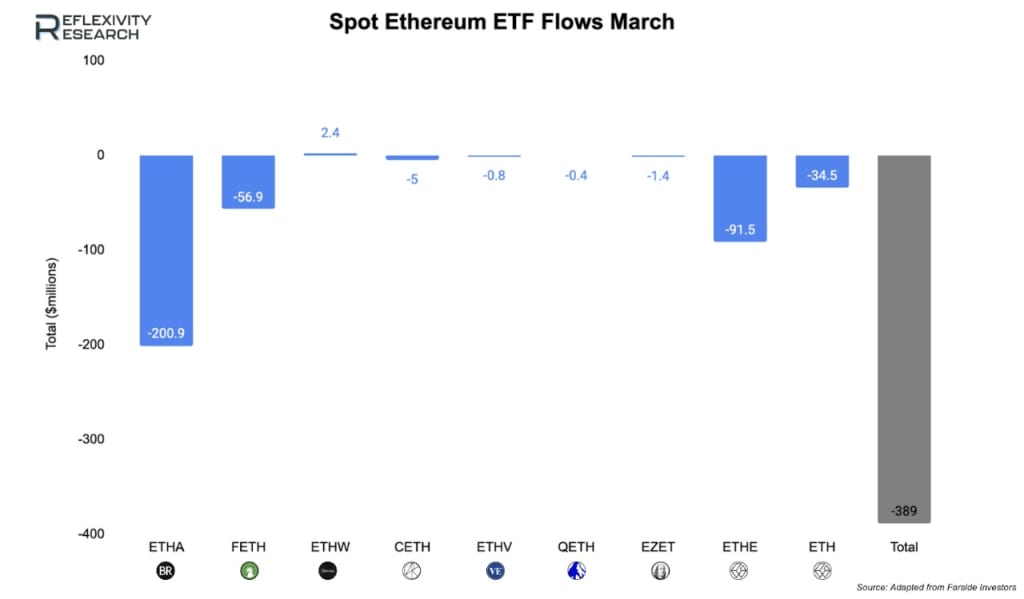
Ethereum ETFs experienced substantial outflows in March, mirroring the trends observed in Bitcoin (BTC) ETFs. Ethereum-based exchange-traded funds (ETFs) closed the month with a staggering $389 million in net outflows, marking a period of significant selling pressure in the broader cryptocurrency market. This decline mirrors the broader risk-off sentiment that prevailed in the financial markets during the month, where both institutional and large-scale players reduced their exposure to cryptocurrencies.
Ethereum, like Bitcoin, has been subjected to the ebb and flow of investor sentiment, with fluctuations largely influenced by broader macroeconomic factors, such as inflation concerns, regulatory developments, and expectations around the upcoming Bitcoin halving event. This article will delve deeper into the March outflows, explore the possible drivers behind this trend, and analyze how Ethereum ETFs compare to their Bitcoin counterparts.
March Outflows: A Deep Dive Into the Numbers
Ethereum ETFs saw a series of significant redemptions throughout March. The top redemptions were:
ETHA: –$200.9M
ETHE: –$91.5M
FETH: –$56.9M
ETHH: –$34.5M
These large withdrawals reflect a general trend of risk-off sentiment across the market, where investors, particularly institutional ones, became more cautious about holding crypto assets in the face of potential market instability or a broader financial downturn.
Despite these large withdrawals, there were also some minor inflows into Ethereum ETFs:
ETHW: +$2.4M
QETH: +$1.1M
However, these inflows had a negligible impact on the broader flow trends, underscoring the dominance of the sell-off during the month. While minor inflows were seen in some funds, they were simply too small to offset the more significant withdrawals happening across the market.
Key Periods of Outflows: Mid to Late March
The most aggressive drawdowns in Ethereum ETFs occurred during the period between March 7–11, which coincided with a similar selloff in Bitcoin ETFs. This suggests that the outflows in both BTC and ETH ETFs were part of a broader market sentiment rather than being specific to either cryptocurrency.
The mid-March period saw both Bitcoin and Ethereum ETFs experience sharp declines as large institutional investors liquidated their positions, likely driven by a combination of risk-aversion and shifting investment strategies in response to broader economic concerns. Whether driven by regulatory uncertainty, the uncertain global macroeconomic environment, or upcoming market events, it appears that investors were seeking to reduce exposure to riskier assets in anticipation of possible economic headwinds.
In the latter half of March, signs of stabilization and rotation began to emerge. However, this was not enough to reverse the broader trend of net outflows for Ethereum ETFs. The stabilization likely reflects a balancing act as some institutional players began to hedge their positions or shift their portfolios, but it wasn’t sufficient to make up for the aggressive outflows earlier in the month.
Drivers Behind Ethereum ETF Outflows
The massive outflows from Ethereum ETFs in March can likely be attributed to several key factors, both specific to the crypto market and tied to the broader financial ecosystem. Let’s break down these influences:
1. Macro-Economic Environment and De-Risking
The global financial landscape in March was marked by ongoing concerns over inflation, interest rates, and the potential for a recession. These macroeconomic factors tend to influence the behavior of large institutional investors, many of whom reduce their exposure to volatile assets like cryptocurrencies during periods of economic uncertainty. Ethereum, like Bitcoin, is considered a high-risk, high-reward asset, and during times of financial strain, investors may pull back from such investments to minimize exposure.
2. Bitcoin Halving and the Preemptive Shift in Strategy
Another potential driver of the outflows could be the anticipation of the Bitcoin halving event, which is expected to occur in 2024. In the months leading up to such an event, there’s often a trend of rebalancing portfolios, with investors either increasing their Bitcoin holdings in anticipation of price gains or reducing their exposure to riskier assets in preparation for volatility. This could explain why both Bitcoin and Ethereum ETFs experienced similar outflows in March, as institutional investors may have been reallocating capital in preparation for the upcoming Bitcoin halving.
3. Ethereum-Specific Factors
While the broader market sentiment played a significant role, there were also Ethereum-specific factors at play. Ethereum has been undergoing significant changes, such as the transition from Proof of Work (PoW) to Proof of Stake (PoS) and ongoing upgrades related to scalability and network efficiency. These changes have caused some uncertainty in the market, particularly as the network faces competition from other blockchain platforms that offer faster transaction speeds and lower fees. As a result, some investors may have been wary of holding Ethereum-based ETFs, fearing that the network's performance could face challenges in the short-to-medium term.
Additionally, regulatory concerns surrounding Ethereum, including potential scrutiny from global regulators, may have made institutional investors more hesitant to maintain their positions in Ethereum ETFs. Given the uncertain regulatory landscape, some may have seen it as safer to liquidate their positions in favor of more established assets.
The Broader Implications: A Cautionary Tale for Crypto ETFs
The significant outflows from Ethereum ETFs in March reflect the broader challenges facing the cryptocurrency ETF market. While the underlying assets (Bitcoin and Ethereum) continue to see widespread interest, institutional investors seem to be increasingly cautious, particularly during periods of economic uncertainty. The fact that both Bitcoin and Ethereum ETFs experienced similar outflows suggests a broader risk-off sentiment and the difficulty of maintaining exposure to volatile assets during uncertain times.
Conclusion: De-Risking and the Future of Crypto ETFs
March’s outflows from Ethereum ETFs illustrate a period of de-risking and caution in the cryptocurrency space, as large-scale players sought to reduce exposure amidst macroeconomic uncertainty and potential market volatility. While minor inflows into certain Ethereum ETFs were observed, they were insufficient to offset the significant withdrawals that took place across the market.
As the crypto landscape continues to evolve, and with significant events like the Bitcoin halving on the horizon, it will be interesting to monitor how institutional investors approach crypto ETFs. Whether driven by regulatory changes, technological advancements, or broader market sentiment, Ethereum and Bitcoin ETFs will likely remain a focal point for investors navigating the uncertain waters of the crypto market.
About the Creator
Abrar Hossen
EXPERT IN CRYPTO MARKET ANALYSIS
Keep reading
More stories from Abrar Hossen and writers in History and other communities.
⚡ INSIGHT: Bitcoin Exchange Reserves Hit All-Time Low – What This Means for the Market
⚡ INSIGHT: Bitcoin Exchange Reserves Hit All-Time Low – What This Means for the Market Bitcoin continues to make headlines in 2025 as its exchange reserves hit a new all-time low, marking a significant shift in market dynamics. This development underscores a growing trend: more BTC is flowing out of centralized exchanges, a strong signal of long-term accumulation by whales, institutional investors, and even governments.
By Abrar Hossen8 months ago in Trader
A Story of the World
The history of the world is the longest story ever told—a vast journey that began long before written words, long before cities, and even before humans themselves. It is a story shaped by nature, driven by curiosity, and transformed by ideas, power, faith, and struggle. The Dawn of Life and Early Humanity Billions of years ago, the Earth was a violent and restless place. Volcanoes erupted, oceans formed, and the first simple life appeared in the seas. Over immense stretches of time, life evolved from single-celled organisms into complex plants and animals. Eventually, a branch of primates learned to walk upright, use tools, and think beyond survival. These were the early humans. For tens of thousands of years, humans lived as hunters and gatherers. They followed animals, gathered plants, and learned to cooperate in small groups. Fire changed everything—it provided warmth, protection, and a way to cook food. Language allowed ideas to pass from one generation to the next. Slowly, humans spread across continents, adapting to deserts, forests, mountains, and ice. The Agricultural Revolution and the First Civilizations Around 10,000 years ago, a turning point arrived: agriculture. Humans learned to grow crops and domesticate animals. This allowed them to settle in one place, build villages, and increase their population. Farming began independently in regions such as Mesopotamia, the Indus Valley, China, Egypt, and Mesoamerica. With settled life came civilization. Cities rose near rivers that provided water and fertile soil. Governments formed to organize labor and protect land. Writing was invented to record trade, laws, and stories. The first legal codes appeared, such as the Code of Hammurabi, which tried to define justice. Religion became organized, explaining the mysteries of life and death and giving meaning to human existence. Empires, Power, and Belief As civilizations grew, so did conflict. Powerful kingdoms expanded into empires through conquest and control. The Egyptian, Persian, Greek, Roman, Mauryan, and Han empires shaped large parts of the ancient world. Roads, armies, taxes, and laws connected millions of people under a single rule. Ideas traveled along with armies and traders. Greek thinkers explored philosophy, science, and democracy. In India and China, deep philosophies like Hinduism, Buddhism, Confucianism, and Taoism offered guidance on morality and harmony. In the Middle East, monotheistic faiths emerged, teaching belief in one God and emphasizing justice and compassion. The Roman Empire became a bridge between ancient and modern worlds. It spread law, engineering, and language across Europe and the Mediterranean. Yet no empire lasts forever. Over time, internal weakness, economic strain, and outside pressures caused great empires to fall. The Middle Ages and the Flow of Knowledge After the fall of Rome in the West, Europe entered a period often called the Middle Ages. Power was divided among kings, nobles, and the Church. Life was difficult for many, but this era was not without progress. Universities formed, architecture flourished, and faith shaped daily life. Meanwhile, the Islamic world experienced a golden age. Scholars preserved and expanded knowledge in mathematics, medicine, astronomy, and philosophy. Cities like Baghdad and Cordoba became centers of learning, where ideas from Greece, India, and Persia were studied and improved. Trade routes connected Asia, Africa, and Europe, allowing goods and cultures to mix. In Asia, powerful dynasties ruled China, advancing technology such as paper, printing, gunpowder, and the compass. These inventions would later transform the world. The Renaissance and the Age of Exploration Around the 14th century, a rebirth of learning began in Europe: the Renaissance. Artists, scientists, and thinkers looked back to classical knowledge while pushing forward with new ideas. Figures like Leonardo da Vinci and Galileo challenged old beliefs and celebrated human potential. At the same time, explorers set sail across unknown oceans. The Age of Exploration connected the world as never before. Europeans reached the Americas, Africa, and Asia, creating global trade networks. This brought wealth and knowledge—but also suffering. Indigenous civilizations were destroyed, millions were enslaved, and colonial empires rose through exploitation. Revolutions and the Modern World The 18th and 19th centuries were ages of revolution. Political revolutions in America and France challenged absolute monarchy and promoted ideas of liberty, equality, and rights. The Industrial Revolution transformed economies, as machines replaced manual labor and cities grew rapidly. Life improved for some, but workers often faced harsh conditions. New ideologies emerged—capitalism, socialism, nationalism—each offering different visions of society. Nations formed and competed, leading to global conflicts. The 20th century witnessed two devastating world wars that reshaped borders and shattered illusions of progress. Yet from the ruins came international cooperation, technological leaps, and movements for independence and civil rights. The World Today and Beyond In recent decades, technology has accelerated history. Computers, the internet, and artificial intelligence have changed how humans communicate, learn, and work. Globalization has connected economies and cultures, while also creating new challenges. Climate change, inequality, and conflict remind humanity that progress is fragile. The history of the world is not just a record of kings and wars—it is the story of ordinary people: farmers, thinkers, builders, dreamers. It is a story of mistakes and lessons, destruction and hope. Each generation inherits this long journey and adds its own chapter. The future remains unwritten. Like those who came before, humanity stands at a crossroads—guided by the past, tested in the present, and responsible for what comes next.
By The best writer 6 days ago in History




Comments (1)
GREAT ARTICAL