
English Cut glass beads - a short history.
What’s in a name

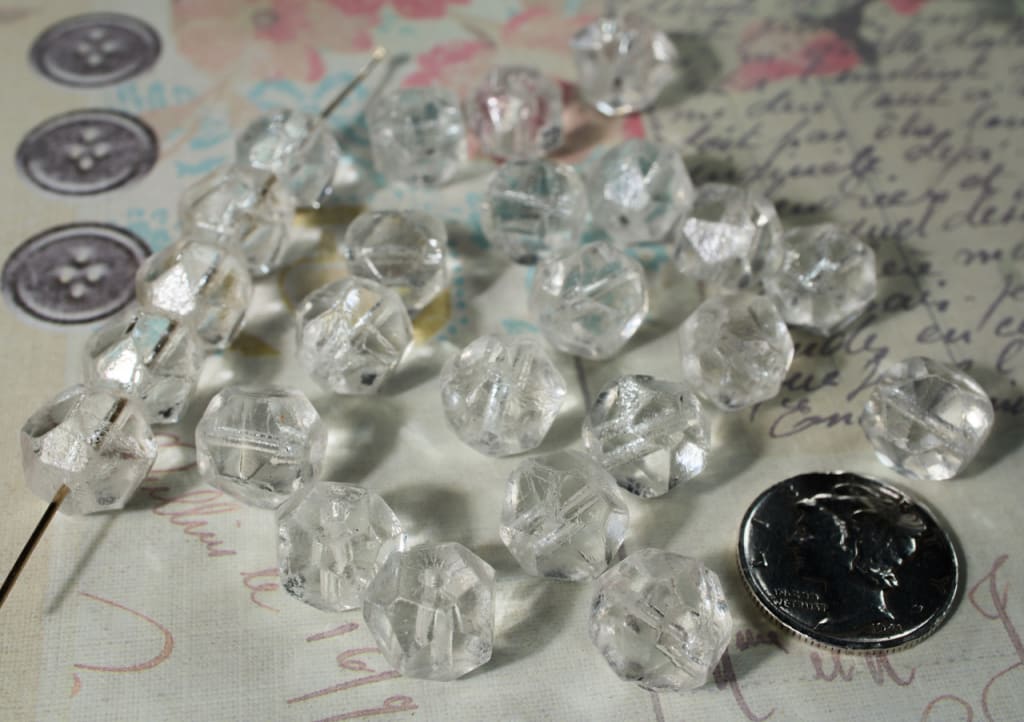
English cut glass beads, popular from the 17th to 19th centuries, were primarily drawn glass tubes cut and faceted to mimic expensive gems, used extensively in the fur trade with Native Americans and the transatlantic slave trade as currency and status symbols, with techniques evolving from Venetian methods and later becoming central to Bohemian and English glass industries, culminating in diverse styles like 'rodel and faceted beads that documented global trade.
English cut glass beads, while part of the broader history of European glassmaking (which had ancient roots in Egypt and the East), gained prominence through global trade, especially with African and Native American cultures from the 16th-20th centuries, where they served as valuable trade items, though often overshadowed by Venetian and Bohemian beads, with English innovations focused more on engraved glass, enameling (like Beilby family), and specific types like Hebron beads (though originating in Palestine) traded by English merchants.
Early English Glass & Beads
Anglo-Saxon Era: Glass bead-making existed in England, with finds from this period showing native production and influences from incoming groups.
Technological Shifts (16th Century): Immigrants from the continent brought new techniques, improving English glass quality and potentially introducing new bead styles, including early forms of decorative glass.
The Rise of Trade & "Cut" Techniques
Trade Beads: Glass beads became crucial for trade, used by Europeans to exchange for goods and slaves in Africa and the Americas, with beads like Hebron (Palestinian) and Venetian types dominating.
Cut Glass: While Venetian glass was known for intricate millefiori (flower patterns) and lampwork, "cut glass" refers to a technique of decorating glass by cutting facets, a method used on larger items but also adapted for beads to add sparkle, similar to gemstones.
English Adaptation: English glassmakers, influenced by European innovations and the massive demand for colorful, decorative beads (like the "Margarita" or "Conterie" beads from Venice), began producing their own versions, sometimes cutting or grinding edges for specific effects, as seen with Hebron beads adapted in Africa.
Key Developments
Competitors: Venice dominated early bead production, but crises in the 19th century led to mass-produced beads (like conterie) that saved their industry.
Global Trade: English-made glass, including beads, fed into this global market, with specific styles gaining names from where they were traded (e.g., "Kano Beads").
In essence, English cut glass beads evolved from early traditions, adopted and adapted continental innovations (like millefiori and cutting), and played a significant role in the complex world of 18th- and 19th-century global trade for decorative items and currency.
Cut glass or cut-glass is a technique and a style of decorating glass. For some time the style has often been produced by other techniques such as the use of moulding, but the original technique of cutting glass on an abrasive wheel is still used in luxury products. On glassware vessels, the style typically consists of furrowed faces at angles to each other in complicated patterns, while for lighting fixtures, the style consists of flat or curved facets on small hanging pieces, often all over. Historically, cut glass was shaped using "coldwork" techniques of grinding or drilling, applied as a secondary stage to a piece of glass made by conventional processes such as glassblowing.
Today, the glass is often mostly or entirely shaped in the initial process by using a mould (pressed glass), or imitated in clear plastic. Traditional hand-cutting continues, but gives a much more expensive product. Lead glass has long been misleadingly called "crystal" by the industry, evoking the glamour and expense of rock crystal, or carved transparent quartz, and most manufacturers now describe their product as cut crystal glass.
There are two main types of object made using cut glass: firstly drinking glasses and their accompanying decanters and jugs, and secondly chandeliers and other light fittings. Both began to be made using the cut glass style in England around 1730, following the development there of a reliable process for making very clear lead glass with a high refractive index.Cut glass requires relatively thick glass, as the cutting removes much of the depth, and earlier clear glass would mostly have appeared rather cloudy if made thick enough to cut. For both types of object, some pieces are still made in traditional styles, broadly similar to those of the 18th century, but other glassmakers have applied modern design styles.
the first century AD, Pliny the Elder described how patterns may be cut on glass vessels by pressing them against a rotating wheel of hard stone.The process of cutting has stayed the same in modern times apart from changes in details since that description in the middle of the first century AD. It has always used a small rotating wheel of, or coated with, some abrasive substance, and usually with a liquid lubricant such as water, perhaps mixed with sand, falling onto the area being worked and then being collected below. The wheels were originally powered by treadles, but by the mid-19th century workshops had several stations linked to steam power. Today electric power is used. For cutting flat facets a turntable device called a "lap", already used in gem-cutting, was adopted.
Typically the design is marked with paint on the glass before cutting – in England red is usually used. One advantage of cut glass for the manufacturer is that it can very often be arranged for the small flaws such as bubbles that are inevitable in a proportion of glass pieces, and would lead to a clear piece being rejected, to be placed in the areas to be cut away. Conversely, if imitation cut glass using moulds is made, the complexity of the mould shapes greatly increases the number of faults and rejects.
A second operation polishes the cut glass, traditionally using a wooden or cork wheel "fed with putty powder and water". In the late 19th century, an alternative method using fluoric acid was introduced; this made the process of polishing faster and cheaper. However, it "gives a dull finish and tends to round off the edges of the cuts".
Labour was the main cost in making cut glass. Arguing against the reduction of tariffs in 1888, a leading figure in the American industry claimed that "We take a piece of glass .... costing 20 cents and .... in many cases put $36 of labor on it".
Technically, the decorative "cutting" of glass is very ancient, although the term "cut glass" generally refers to pieces from the 18th century onwards. The Bronze Age Indus Valley civilization made glass beads that were engraved with simple shapes. Ancient Roman glass used a variety of techniques, but mostly large amounts of drilling, often followed by polishing, to produce the deeply under-cut cage cups, objects of extreme luxury, cameo glass in two colours.
Islamic art, especially that of the Fatimid court in Egypt, valued bowls and other objects in "carved", that is, cut rock crystal (quartz, a clear mineral), and this style was also produced in glass, which was cheaper and easier to work. Cameo glass was also produced. Similar relief effects were also achieved even more cheaply in mould-blown glass.
Very shallowly scratched or cut engraved glass was revived by at least the Renaissance, but there was very little use of deeper cutting which, however, continued to be used in rock crystal and other forms of hardstone cutting. In Germany in the late 17th and early 18th centuries there was a revival, for "two generations", of cut relief decoration, water-powered and imitating rock crystal. Typical pieces were cups and goblets with coats of arms surrounded by rich Baroque ornament, with the background cut away to leave the reliefs raised. This is called the Hochschnitt ("high cut") style.
In the later 17th century George Ravenscroft developed a cheap and reliable lead "crystal" glass with a high refractive index in England, which various other glassmakers adopted. After some time, the potential of cut glass using this basic material began to be realized; a high lead content also made the glass easier to cut.
This is the background history of faceting and cutting of glass which culminated into “English cut” fire Polish beads that we all know. Of course, the talented Bead makers of Austrian era Gablonz and Czechoslovakia era Gablonz, made these beads cheaper and in larger quantities than the original English bead makers, and put the name “English cut” on the shape. They pressed the shape using metal molds in the newly invented method which was first shown in Prague at the world fair in the early 1800s, along with nail head beads. These early examples of pressed glass beads led to an explosion of mass manufacturing of glass beads and world wide recognition of Bohemian beads and costume jewelry. Of course, Gablonz was changed to Jablonec, Austrian empire vanished into history and the region became Czechoslovakia, and then Czech Republic, and after world war 2 the German bead makers went to NeuGablonz in Barvaria and continued to make English Cut beads.
So now you know the history of English cut fire Polish beads, and how their name came to be.
About the Creator
Guy lynn
born and raised in Southern Rhodesia, a British colony in Southern CentralAfrica.I lived in South Africa during the 1970’s, on the south coast,Natal .Emigrated to the U.S.A. In 1980, specifically The San Francisco Bay Area, California.


Comments
There are no comments for this story
Be the first to respond and start the conversation.