
Elucidation of a Historical Falsehood
The Old True Original Historical Reports On “Jean Baptiste Point De Sable”

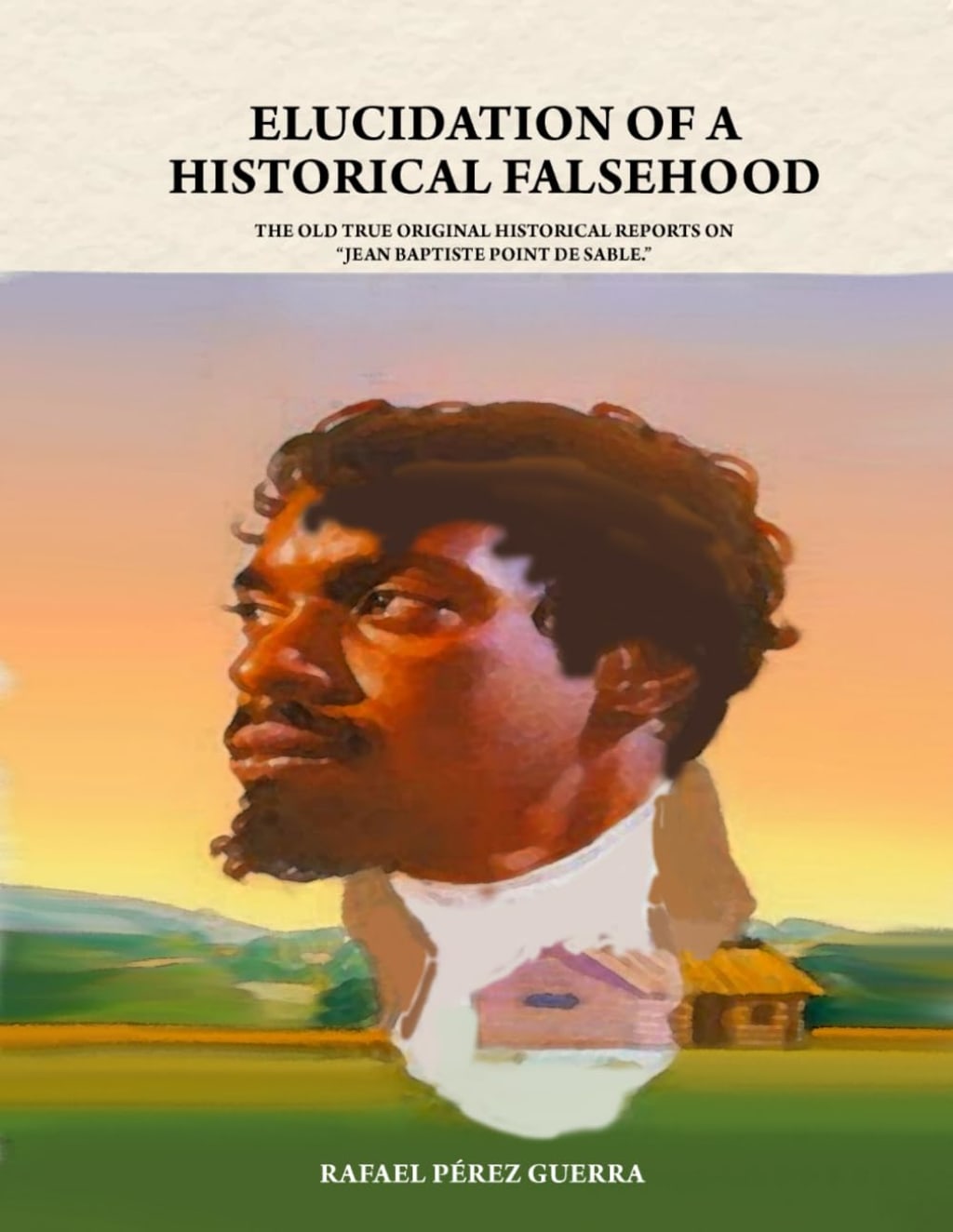
In "Elucidation of a Historical Falsehood," author and retired surgeon Rafael Pérez Guerra presents a meticulously researched account that challenges the widely accepted narrative surrounding Jean Baptiste Point de Sable, a pivotal figure in the history of Chicago. Point de Sable is often heralded as the first non-Indigenous settler of Chicago and is commonly depicted as a man of Haitian descent. However, Guerra's work dives deep into historical records and primary sources to debunk several myths and present a nuanced understanding of this enigmatic figure's true origins and contributions.
A New Perspective on a Historical Figure
Guerra's investigation begins with a critical examination of the existing literature and popular narratives that have surrounded Jean Baptiste Point de Sable. Traditionally, Point de Sable has been characterized as a pioneering settler of African descent, with his Haitian roots frequently highlighted. This narrative, while widespread, is built on a scant foundation of verifiable historical evidence. Guerra's work challenges these assumptions, advocating for a reevaluation of Point de Sable's background and heritage.
Through a rigorous analysis of archival materials, including colonial records, letters, and legal documents, Guerra reconstructs a more accurate portrayal of Point de Sable's life. He questions the oversimplified depictions of Point de Sable's origins, suggesting that his background is more complex and possibly different from the conventional Haitian ancestry often ascribed to him. This reexamination is not merely an academic exercise; it seeks to correct the historical record and offer a more truthful account of Point de Sable's identity.
The Complex Identity of Jean Baptiste Point de Sable
A key aspect of Guerra's work is the exploration of Point de Sable's complex identity. Point de Sable was a man of mixed heritage, which included African and possibly European ancestry. This mixed-race background positioned him uniquely within the social and racial hierarchies of his time. Guerra delves into the social dynamics of the late 18th and early 19th centuries, illustrating how Point de Sable navigated the racially stratified society of colonial North America.
Guerra's research highlights how Point de Sable's status as a mixed-race individual influenced his interactions with both Indigenous peoples and European settlers. His role as a trader and community leader was crucial in the establishment and development of Chicago. He built a trading post at the mouth of the Chicago River, which became a central hub for commerce and interaction between different cultural groups. Point de Sable's ability to bridge cultural divides was instrumental in the early economic and social fabric of the region.
Debunking the Myth of Haitian Heritage
One of the most significant contributions of Guerra's work is his challenge to the long-standing belief that Point de Sable was of Haitian descent. This notion, Guerra argues, lacks concrete historical evidence and is likely a later addition to the narrative, possibly influenced by the desire to find a distinct and noble origin for an important figure in African American history. Guerra scrutinizes the sources that have perpetuated this claim, revealing a lack of substantiation and encouraging a more critical approach to historical scholarship.
By questioning the Haitian origin story, Guerra opens the door to a broader inquiry into the diverse backgrounds of early settlers in North America. He posits that Point de Sable's life should be understood within the context of the broader Atlantic world, where movements of people and cultures were complex and often undocumented. This perspective not only challenges the accepted narrative but also enriches our understanding of the multicultural foundations of American society.
Reconstructing Chicago's Founding Narrative
Guerra's work is not just a biography of Jean Baptiste Point de Sable; it is also a call to reconsider the broader narrative of Chicago's founding. The traditional story of Chicago's origin often overlooks the contributions of diverse groups, including Indigenous peoples and people of mixed heritage like Point de Sable. By providing a more accurate account of Point de Sable's life, Guerra argues for a more inclusive historical narrative that recognizes the diverse contributions to the city's early development.
The author's meticulous research into the social, economic, and political contexts of Point de Sable's time reveals the complexities of early Chicago. Point de Sable was not merely a passive participant in history; he was an active agent who shaped the early community through his interactions and economic activities. His story, therefore, is integral to understanding the multiethnic and multicultural roots of Chicago.
A Call for Historical Accuracy and Rigor
"Elucidation of a Historical Falsehood" serves as a broader critique of historical scholarship. Guerra emphasizes the need for accuracy and rigor in historical research, urging historians and readers alike to critically examine established narratives. He points out that many widely accepted historical accounts are based on limited or biased sources, and he advocates for a more nuanced and comprehensive approach to understanding history.
Guerra's work is a reminder of the importance of questioning historical "truths" and being open to new interpretations. It challenges the tendency to simplify complex histories and encourages a deeper exploration of the past. By doing so, Guerra hopes to foster a more informed and critical understanding of history, one that acknowledges the full range of human experiences and contributions.
Conclusion: Rethinking History
"Elucidation of a Historical Falsehood" by Rafael Pérez Guerra is a crucial work for those interested in American history, African American studies, and the history of Chicago. It challenges long-held assumptions and offers a compelling case for reexamining the life and legacy of Jean Baptiste Point de Sable. Guerra's detailed research and thoughtful analysis provide a richer and more accurate account of this important historical figure.
This book is not just a correction of the historical record; it is an invitation to rethink how we understand and interpret the past. By uncovering the complexities of Point de Sable's identity and contributions, Guerra encourages a more inclusive and accurate recognition of the diverse individuals who have shaped American history. "Elucidation of a Historical Falsehood" is an essential read for anyone interested in uncovering the true stories behind the myths of history.
About the Creator
Lilly Zayla
Hey, I'm Lilly Zayla—a book aficionado and storyteller. Explore diverse book genres with me as I share insightful discussions and captivating tales. Join the literary adventure! 📚✨
#BookLover #Storyteller #LillyZaylaReads
Keep reading
More stories from Lilly Zayla and writers in History and other communities.
14 Stories in the Bronx: Stickball, Skelly, and Spaldeens - Profiles from the Projects
The Bronx, a place teeming with life and history, stands as a testament to the resilience and spirit of its inhabitants. Carlo Frank Calo's "14 Stories in the Bronx: Stickball, Skelly, and Spaldeens" captures this essence, weaving together personal experiences and historical events that shaped his life. Set against the backdrop of the Bronx's largest housing projects, this collection offers a vivid portrait of boys coming of age in the Bronx during the 1950s and 1960s. In this blog, we delve into the stories that define this journey, exploring themes of identity, camaraderie, and resilience.
By Lilly Zayla2 years ago in History



Comments
There are no comments for this story
Be the first to respond and start the conversation.