

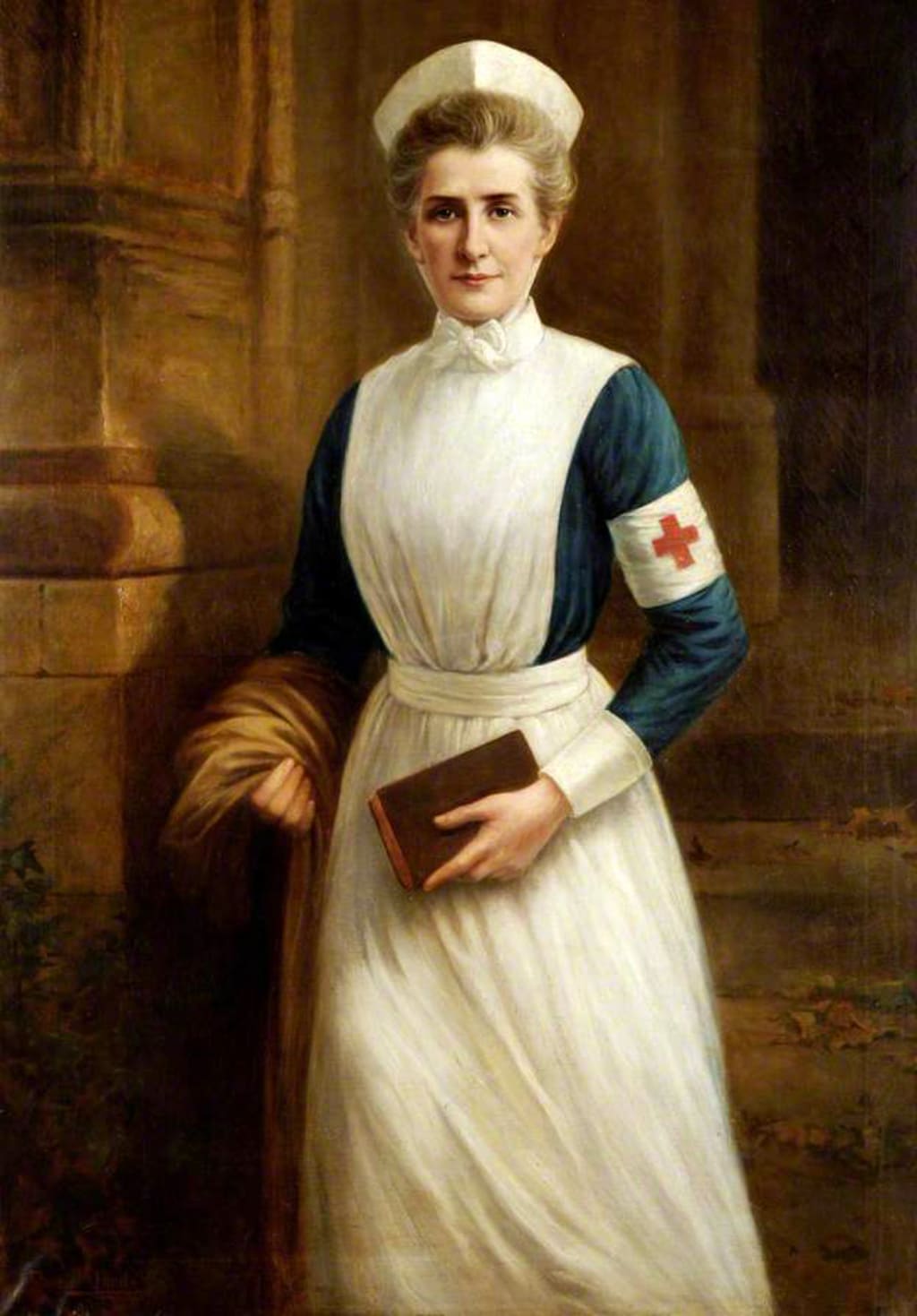
She was a British nurse who worked in German-occupied Belgium during World War One. Helping hundreds of British, French and Belgium soldiers escape, she was arrested and executed, by firing squad in 1915, when she was 49 years of age.
She was Edith Cavell.
When I read about this woman, I see someone who had incredible courage, an amazing feeling for others, and a real love for doing what is right. Edith’s ‘story’ gives me real Inspiration.
Edith was born in Norfolk, in the village of Swardeston, on 4th December, 1865. Her father was Reverend Frederick Cavell and her mother was Louisa Sophia. Edith’s siblings were Florence Mary, Mary Lilian and John Frederick Scott. She was educated at Norwich High School for Girls, and then she was sent to boarding schools in Clevedon, Somerset and Peterborough (Laurel Court).
Edith’s upbringing was one of service and compliance, of putting other people’s needs ahead of her own. This made her conscientious, kind and reliable and Edith had also acquired some teaching skills from her time in Laurel Court. With all of these qualities behind her, Edith became a governess to several families until her father became seriously ill, and she returned home to help nurse him. This led Edith into nursing, especially when her father made a full recovery.
Training to become a nurse in London, Edith gained experience in nursing by working in several hospitals. When she became a matron, Edith worked in the Manchester and Salford Sick and Poor and Private Nursing Institution in 1906 for nine months. After gaining more experience here, Edith accepted a position as matron in Belgium’s first training hospital and school for nurses. At that time, there was no established nursing profession in Belgium, and because of Edith’s pioneering work within the nursing field, she is considered the founder of modern nursing in that country.
The First World War broke out in 1914. Edith was visiting her widowed mother at the time and as soon as she had heard the news, Edith returned straight away to Brussels. The clinic and nursing school where Edith was matron had been taken over by the Red Cross.
After the German occupation of Brussels in November, 1914, Edith began to use her position and skills to shelter British soldiers and smuggled them out of Belgium into the Netherlands, which was a neutral country. Wounded British and French soldiers, as well as Belgian and French civilians (of military age) were hidden, provided with false papers and smuggled into ‘safe houses’, where they were given money and then led to the Dutch frontier, to safety.
Over 11 months, Edith Cavell helped roughly 200 British, French and Belgian soldiers. She, of course, was not alone and the whole ‘operation’ was set up with over 30 brave people willing to risk their lives to help these soldiers.
Edith was in violation of the German military laws at the time, the local authorities became suspicious and our brave nurse was arrested on 3rd August, 1915. She was put into solitary confinement in St.Gilles Prison in Brussels. Edith was charged with harbouring Allied soldiers. Someone had betrayed our nurse! Edith courageously admitted helping the soldiers, admitting her ‘guilt’ when she signed a statement the day before the trial. The court martial was on 7th October, 1915, and Edith, along with 34 others, were found guilty.
According to German military law during that war, the penalty was death. Edith had been arrested for “war treason”, even though she was not a German national but British born. Despite appeals for clemency and the international outcry, Edith was found guilty and sentenced to death by firing squad.
On 12th October, 1915, Edith Cavell was shot to death by firing squad.
Our brave nurse became a 'symbol' of the Allied cause, and her memory was evoked in recruitment posters and messages in Britain, as well as around the world. Edith was seen by many as a martyr for the cause of peace and humanity.
“I can face death with a clear conscience. I have done my duty as a nurse, as I have been trained to do. Patriotism is not enough. I must have no hatred or bitterness towards anyone” — Edith Cavell.
About the Creator
Ruth Elizabeth Stiff
I love all things Earthy and Self-Help
History is one of my favourite subjects and I love to write short fiction
Research is so interesting for me too
Keep reading
More stories from Ruth Elizabeth Stiff and writers in History and other communities.
Life Inside The Victorian Prisons
“It is not the prisoners who need reformation, it is the prisons “ — Oscar Wilde The Victorian Era reminds us of the “Class System”, when the wealthy lived in elegant surroundings and had plenty to eat and beautiful clothes to wear. The “Poor” class had virtually nothing to eat, nothing to wear and very often nowhere to live. When ‘prison’ was a better alternative to living ‘at home’, it does make us wonder (in 2025), just what was life like in Victorian prisons (in the 1800s)?
By Ruth Elizabeth Stiff10 months ago in History
3 Harmless Habits That Once Caused Absolute Chaos
Most habits are comfortingly dull. You chew gum. You clap at events. You check your phone. You assume—reasonably—that these actions will not destabilize governments, bankrupt industries, or end lives. Society depends on this assumption. If every small habit carried catastrophic potential, we would never leave the house.
By Enoch Sagini4 days ago in History
Brosley Punch — The Strike That Shook Fate
Brosley was never taught how to throw a punch. He learned it the hard way—through hunger, through survival, through a childhood spent on a world that showed no mercy. Long before the universe would whisper his name in fear, Brosley was just a boy standing on cracked red stone, staring at a sky that never answered his questions.
By The best writer 2 days ago in History



Comments
There are no comments for this story
Be the first to respond and start the conversation.