
"Draped in Empire: The Legendary Dress of Alexander the Great and Its Priceless Legacy"
Alexander the Great wasn’t just a military genius—he was a master of symbolism. This article explores the rich history and political meaning behind his royal dress, a unique blend of Greek and Persian elements. More than fabric and jewels, Alexander’s attire symbolized divine power, imperial unity, and cultural fusion. Estimated today to be worth over $300 million, his legendary garments reflect an empire’s ambition and the vision of one of history’s most iconic rulers.

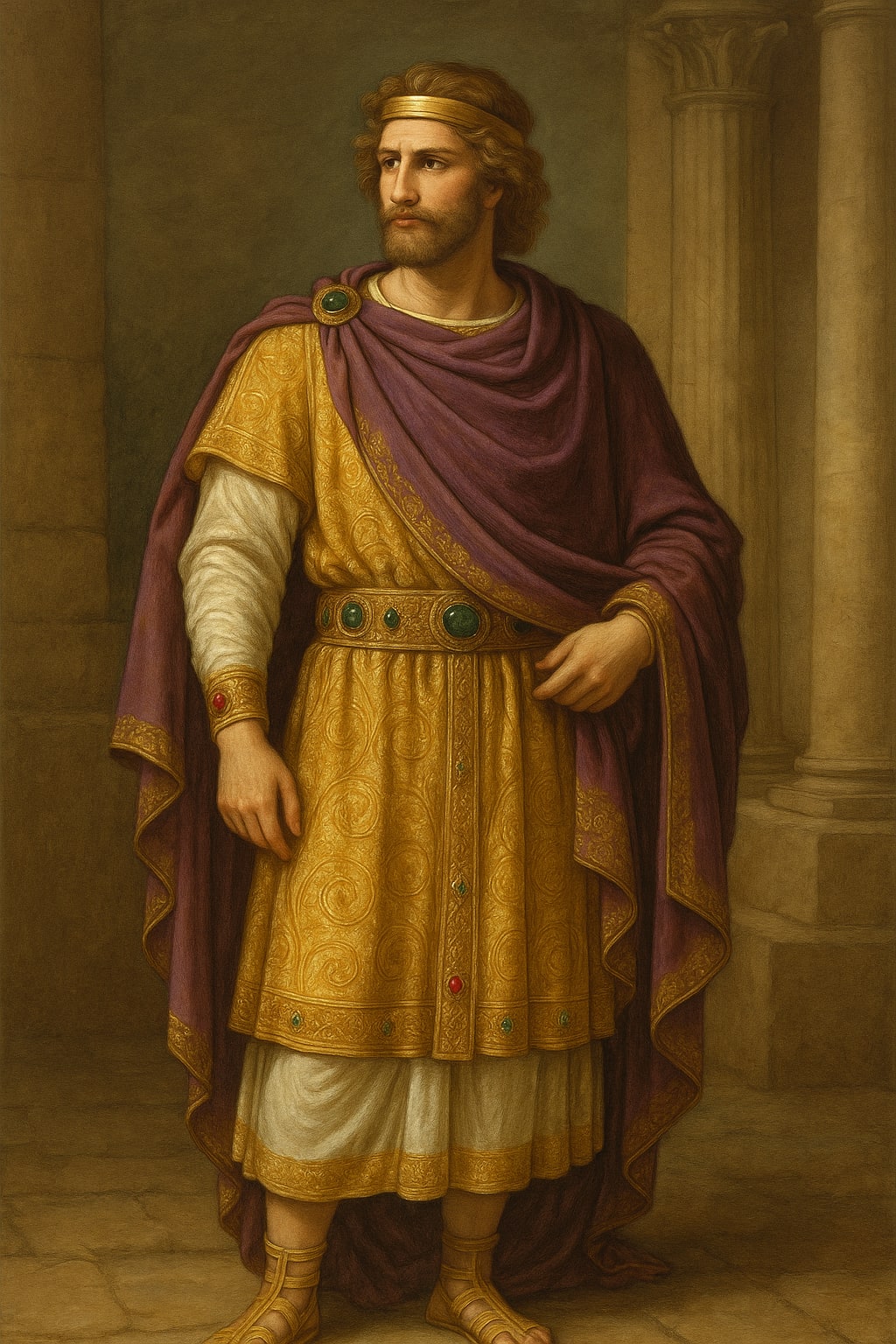
Draped in Power: The History and Worth of Alexander the Great's Regal Dress
:
This article explores the historical background and significance of Alexander the Great's iconic royal attire. More than just clothing, his dress symbolized divine power, imperial ambition, and the merging of Eastern and Western traditions. Estimated today to be worth hundreds of millions of dollars if it still existed, Alexander’s royal dress remains a powerful symbol of leadership and legacy.
:
Throughout history, few figures have captured the world’s imagination like Alexander the Great. From his conquests that stretched from Macedonia to the Indus Valley, to his legendary charisma, Alexander’s image has endured for over two millennia. One of the most powerful visual emblems of his rule was his royal dress—not merely a piece of clothing, but a carefully crafted statement of power, unity, and divine right.
The Historical Setting
Born in 356 BCE to King Philip II of Macedon and Queen Olympias, Alexander was groomed for greatness from a young age. He was taught by none other than Aristotle, and by the age of 20, he inherited a powerful kingdom. His military campaigns would eventually create one of the largest empires in ancient history. But Alexander’s genius extended beyond the battlefield. He understood the value of symbolism and image, especially in foreign lands.
As he began adopting Persian customs following the conquest of the Achaemenid Empire, Alexander's dress evolved into a blend of Macedonian, Greek, and Persian elements, reflecting his ambition to unite East and West. It became both a political tool and a spiritual garment, linking him with gods and emperors.
Description of the Dress
There are no surviving examples of Alexander’s original garments, but ancient texts and artistic depictions give us clues. His iconic dress included several elements:
The White Tunic: Made from fine linen or silk, it was a symbol of purity and divinity, often dyed subtly with purples and blues to signify royalty.
The Persian Robe (Kandys): A long flowing cloak, richly embroidered with gold threads and precious stones. This marked his adoption of Eastern traditions.
The Diadem: A white band worn around the head, symbolizing kingship. After defeating Darius III, Alexander adopted the Persian version of the diadem.
Jewelled Accessories: Gold armlets, belts, and brooches embedded with emeralds and rubies.
Lion Motif Sandals or Boots: These sometimes bore motifs of strength and power, such as lions or eagles, linking him to Hercules and Zeus.
Alexander used clothing as a way to communicate legitimacy to his newly conquered subjects, who were accustomed to grand displays of wealth and divine kingship.
Cultural and Political Impact
In Macedonia and among his Greek peers, Alexander’s adoption of Persian royal attire was controversial. Many of his generals viewed it as a betrayal of Greek traditions. However, Alexander saw himself as a universal ruler. He wore his elaborate dress to court, ceremonies, and religious rituals, and even encouraged his commanders to do the same.
By dressing like a Persian king, he sent a powerful message to his subjects: Alexander was more than just a Greek conqueror—he was a world ruler. He effectively used fashion as a diplomatic tool to bridge cultures, easing tensions and gaining loyalty from the Persian nobility.
The Worth of Alexander's Dress
If Alexander’s original royal ensemble were somehow preserved and discovered today, its estimated worth would likely exceed $300 million. This valuation comes not only from the potential historical and archaeological value but also the craftsmanship and materials involved:
Gold and gemstone embroidery: If his robe was indeed lined with real gold thread and precious gems, even the fabric itself would be worth millions.
Historical provenance: Artifacts directly linked to Alexander would command astronomical prices at auctions.
Symbolic value: As a symbol of one of the most famous empires in history, the dress would attract institutions, museums, and collectors from around the globe.
Such an item would likely never be sold outright—it would be placed in the world’s top museums under tight security and studied extensively.
The Legacy
Alexander’s dress did more than symbolize power—it influenced generations of leaders. The Roman Emperors adopted similar regalia. Napoleon styled himself in Alexandrian fashion. Even modern ceremonial military attire draws from ancient traditions like those initiated by Alexander.
In myth and legend, Alexander is sometimes portrayed as a semi-divine figure, and his attire contributes to this larger-than-life image. His clothing became the visual proof of his ambition: to not just rule the known world, but to shape its culture forever.
Conclusion
Alexander the Great’s royal dress was not just clothing—it was a masterpiece of political propaganda, cultural fusion, and divine symbolism. Blending the traditions of Greece and Persia, it reflected his unprecedented ambition and his attempt to unite the known world under one rule. Today, it stands as a historical mystery and a powerful symbol of leadership, empire, and vision. If found, its value—both material and symbolic—would be immeasurable.
Would you like a Ghibli-style or traditional-style illustration of Alexander wearing this dress?
About the Creator
Say the truth
"Say the Truth: Explain Everything in the World" is your trusted source for uncovering facts and exploring the wonders of history, science, technology, and beyond. We simplify complex ideas and reveal truths to inspire curiosity .
Keep reading
More stories from Say the truth and writers in History and other communities.
“The Golden Mirage: Unveiling the Legend of El Dorado’s Hidden Palace”
The Golden Mirage: Chronicle of the Golden Palace in El Dorado For centuries, the myth of El Dorado, the legendary city of gold concealed deep within South America, has sparked the imagination of explorers, historians, and adventurers. Central to this legend is the Golden Palace, a radiant fortress purportedly decorated entirely with goldits walls, floors, thrones, and even sacred altars. Although no concrete evidence of its existence has ever been discovered, the legacy of the palace continues to cast a golden hue throughout the annals of history.
By Say the truth 9 months ago in History
Firoun: The Tyrant Who Defied God
Firoun, known to history as Pharaoh, was not just a king—he was a symbol of absolute power. He ruled over ancient Egypt at a time when the Nile flowed generously, the granaries were full, and massive stone monuments rose toward the sky. To his people, Firoun appeared invincible. To himself, he was more than human.
By The best writer 3 days ago in History
Ludacris and Nelly draw backlash over bookings at MAGA-coded music festival
Ludacris and Nelly headlining a mostly right-wing event is good for them. It’s also great for the genre of hip hop. The two rap veterans have showcased their talents on other stages. Why can’t they perform for mostly MAGA folks and grab that bag?
By Skyler Saunders5 days ago in Beat


Comments (1)
I find it ridiculous to write Macedonian, Greek like it was 2 different Nations..ridiculous at the lowest point of hypocrisy and half if not less knowledge to the point of propaganda. MACEDONIANS WERE GREEK (HELLENES) PEOPLE, SPEAKING GREEK, THINKING GREEK, WITH SAME TRADITIONS AND CUSTOMS LIKE THE REST OF THE GREEK PEOPLE!!! AMD THE GOAL OF ALEXANDER LIKE HIS FATHER BEFORE WAS TO UNITE ALL GREEKS AGAINST THEIR ANCIENT ENEMIES THE PERSIANS.. ALL THE REST IS CRAP..