
Donald Trump's Middle East Tour: Strategic Deal,Diplomatic Shifts, and Controversies
Trump's
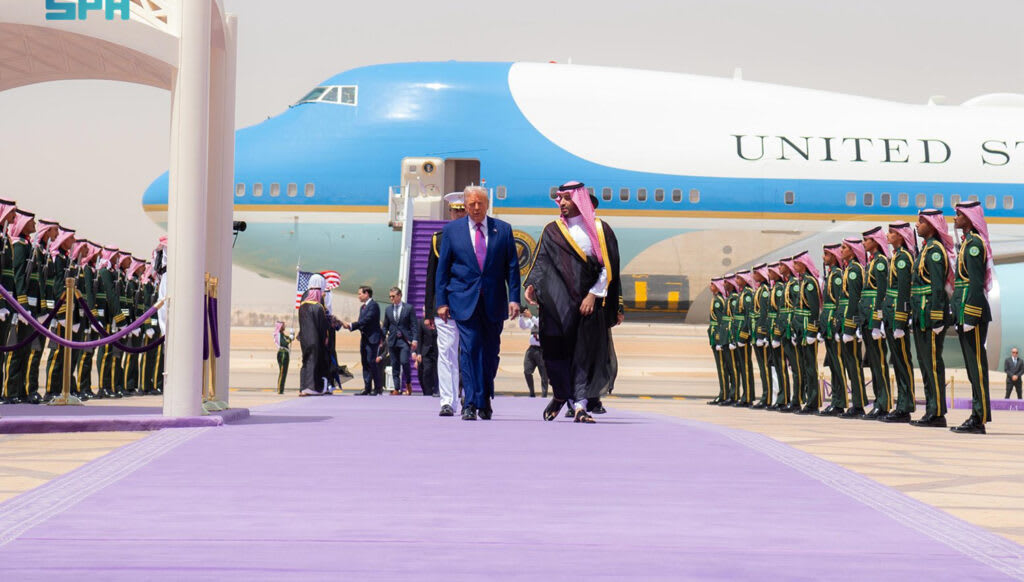
President Donald Trump's recent Middle East tour, encompassing visits to Saudi Arabia, Qatar, and the United Arab Emirates (UAE), has been marked by significant diplomatic engagements, substantial economic agreements, and notable policy shifts. This trip, his first major overseas venture during his second term, underscores a renewed U.S. focus on the Gulf region's strategic importance.
Saudi Arabia: Economic Partnerships and Regional Diplomacy
In Riyadh, Trump secured a historic $600 billion investment commitment from Saudi Arabia, aimed at bolstering U.S. infrastructure, energy, and defense sectors. This agreement signifies a deepening of economic ties between the two nations.
Additionally, Trump met with Syrian President Ahmed al-Sharaa, announcing the lifting of longstanding U.S. sanctions on Syria. This move aims to encourage Syria's normalization of relations with Israel and the expulsion of foreign terrorist elements.
Qatar: Military Engagements and Diplomatic Initiatives
In Doha, Trump addressed U.S. troops at Al Udeid Air Base, emphasizing America's military commitment to the region. He also oversaw the signing of a deal for Qatar to purchase Boeing aircraft, reflecting strengthened defense cooperation.
During discussions with Qatar's Emir Sheikh Tamim bin Hamad Al Thani, Trump expressed optimism about nearing a diplomatic resolution with Iran, stating, "We're not going to be making any nuclear dust in Iran." This statement suggests a shift towards diplomatic engagement over military confrontation.
United Arab Emirates: Technological Collaboration and AI Initiatives
In Abu Dhabi, Trump met with UAE President Sheikh Mohammed bin Zayed Al Nahyan, focusing on enhancing bilateral relations and technological cooperation. Discussions included advancing artificial intelligence initiatives, with the UAE expressing hopes to become a leader in AI development.
Controversies and Regional Reactions
Trump's proposal to transform Gaza into a "freedom zone" has drawn criticism, with some viewing it as an oversimplification of the complex Israeli-Palestinian conflict. Additionally, his decision to lift sanctions on Syria without preconditions has raised concerns among U.S. officials and Israeli leaders, who fear it may embolden adversarial regimes.
Notably, Trump's itinerary did not include a visit to Israel, leading to speculation about the current state of U.S.-Israel relations.
Conclusion
President Trump's Middle East tour has been characterized by significant economic agreements, strategic diplomatic engagements, and controversial policy decisions. While the trip has strengthened ties with key Gulf allies, it has also sparked debates over the implications of certain policy shifts, particularly concerning Syria and the Israeli-Palestinian conflict. As the region continues to navigate complex geopolitical dynamics, the long-term effects of these developments remain to be seen.
Detailed Conclusion: A Bold Gamble with High Stakes
Donald Trump’s return to the Middle East stage during his second term was anything but routine. Spanning key Gulf nations—Saudi Arabia, Qatar, and the UAE—the visit showcased a series of bold policy moves that reflect both strategic calculation and Trump’s characteristic flair for disruption.
Economically, Trump achieved one of the most headline-grabbing outcomes of the trip: a $600 billion investment commitment from Saudi Arabia, largely focused on American infrastructure, energy, and defense. This agreement strengthens economic ties and aligns with Trump’s domestic agenda of job creation and infrastructure rebuilding, even as it raises questions about long-term dependency on Gulf capital.
Diplomatically, the decision to lift U.S. sanctions on Syria represents a seismic shift in American Middle East policy. By engaging directly with Syrian President Ahmed al-Sharaa, Trump has chosen to gamble on normalization rather than containment. While this opens potential for regional reconciliation—particularly if Syria distances itself from Iranian influence—it also risks empowering a regime previously isolated for human rights violations and civil war atrocities.
Trump's outreach to Qatar emphasized America’s ongoing military commitment and hinted at a softening stance on Iran. His remark, “We're not going to be making any nuclear dust in Iran,” suggests a pivot toward diplomacy, possibly influenced by backchannel talks. Whether this rhetoric translates into a concrete deal remains to be seen, but it is a notable shift from the previous posture of maximum pressure.
The UAE leg of the tour focused on future-oriented collaboration, especially in the field of artificial intelligence and technology partnerships. By aligning with the UAE’s vision to become a global AI hub, Trump has opened new avenues for economic cooperation beyond traditional sectors like oil and defense.
Yet, the trip was not without controversy. Trump’s proposal to convert Gaza into a "freedom zone"—vaguely defined and largely unsupported by Palestinian voices—has drawn sharp criticism for oversimplifying a deeply entrenched conflict. His omission of Israel from the itinerary also raised eyebrows, suggesting either a cooling of relations or a calculated shift in focus to Arab Gulf states.
Critics argue that some moves, such as the sudden thaw with Syria, may lack a clear exit strategy and risk alienating traditional allies. Supporters, however, hail the visit as a pragmatic re-engagement with the region—prioritizing deals and results over ideology.
What Comes Next
The trip has set several balls in motion: potential Syrian-Israeli rapprochement, fresh Iran diplomacy, massive Gulf investment inflows, and new tech partnerships. But the sustainability of these developments depends on how they’re followed up in Washington—and whether Trump’s diplomatic overtures are matched with stable, institutionalized policies.
Ultimately, Trump's Middle East tour was a signature performance: disruptive, deal-driven, and polarizing. It has reshaped conversations in key capitals from Riyadh to Tehran, but its success or failure will only be measured by what happens in the months to come.
About the Creator
The Blue Ridge Stalker
Tom had left the Ford down the way, its spark plugs finally exhausted and no mechanics for a dozen miles back through the foothills to Strossburg. No matter, he had worn his boots—almost as if he planned for this to happen. The puzzle he sought to solve emanated from the woods clinging to the slopes above; the valley behind held no mysteries.
By Stephen A. Roddewig5 days ago in Fiction



Comments
There are no comments for this story
Be the first to respond and start the conversation.