

Date: May 15, 2025
Byline: International Desk
The fragile peace between South Asia's two nuclear-armed neighbors, India and Pakistan, is once again under strain following heightened border clashes and a war of words over nuclear responsibility. This escalation comes in the wake of an April 22 terrorist attack in Kashmir that killed 26 civilians, for which India has blamed Pakistan-based militants.
Operation Sindoor and Renewed Clashes
India responded to the Pahalgam attack with "Operation Sindoor," a series of missile strikes on alleged militant hideouts across the Line of Control (LoC) in Pakistan-administered territory. The Indian government claimed these were “precision attacks” targeting infrastructure linked to Jaish-e-Mohammed and Lashkar-e-Taiba, two Pakistan-based militant groups.
In retaliation, Pakistan launched mortar and drone strikes targeting Indian border posts and the town of Poonch, resulting in civilian casualties and the destruction of infrastructure. The Pakistani military claims to have downed multiple Indian reconnaissance drones during the skirmishes.
Casualty reports vary, but Indian authorities have confirmed 26 civilian deaths and 5 military casualties. Pakistan has reported over 50 fatalities, including 40 civilians. Both nations have since agreed to a temporary ceasefire, though tensions remain high along the LoC.
India Questions Pakistan’s Nuclear Safety
Further exacerbating the crisis, India’s Defence Minister Rajnath Singh made a provocative statement during a military address in Srinagar, calling Pakistan a “rogue nation” and demanding international oversight of its nuclear weapons.
“We cannot trust a country that sponsors terrorism to manage nuclear weapons responsibly. The IAEA must take charge,” Singh declared.
Pakistan’s Ministry of Foreign Affairs swiftly rebuked the comments, stating they were a reflection of India’s “frustration and fear” over Pakistan’s defense posture. Islamabad insisted that its nuclear program remains under strict command and control structures.
Global Alarm and Diplomatic Reactions
The war of words between India and Pakistan has caused alarm across the international community, with several countries urging restraint.
The United Nations expressed “deep concern” and called for “immediate de-escalation and dialogue.” China, a strategic ally of Pakistan, cautioned India against “further provocation,” while the United States has offered to mediate backchannel talks between the two countries.
The International Atomic Energy Agency (IAEA) issued a statement saying it respects state sovereignty over nuclear arsenals but would be willing to inspect safety protocols if both countries consent. India is not demanding oversight of its own arsenal, which some analysts view as hypocritical.
Domestic Response and Political Ramifications
In India, Rajnath Singh’s statements have received mixed reactions. The ruling Bharatiya Janata Party (BJP) has rallied behind the Defence Minister, praising his “bold stand against terror.” However, opposition parties have criticized the government for escalating tensions without considering diplomatic alternatives.
In Pakistan, Prime Minister Shehbaz Sharif has convened an emergency meeting with the military high command, with the government warning of “serious consequences” should any further attacks occur. Pakistani state media have also aired reports highlighting civilian suffering due to Indian shelling.
A History of Volatility
India and Pakistan have fought three full-scale wars since their independence in 1947, and several smaller conflicts. The most recent comparable crisis occurred in 2019, when both sides conducted airstrikes following a terror attack in Pulwama.
Both nations maintain large standing armies and possess a combined over 300 nuclear warheads, according to the Stockholm International Peace Research Institute (SIPRI). Despite signing a ceasefire in 2021, violations have remained frequent.
Outlook: A Call for Dialogue
Despite the temporary ceasefire, the region remains on edge. Experts warn that even a minor miscalculation could lead to an unthinkable nuclear confrontation.
“Both sides must remember the stakes,” said former Indian National Security Advisor Shivshankar Menon. “It’s time for backchannel diplomacy and not bravado.”
As of now, all eyes remain on whether the ceasefire will hold — and whether the two nations will choose escalation or engagement.
https://en.wikipedia.org/wiki/2025_India%E2%80%93Pakistan_border_skirmishes
About the Creator
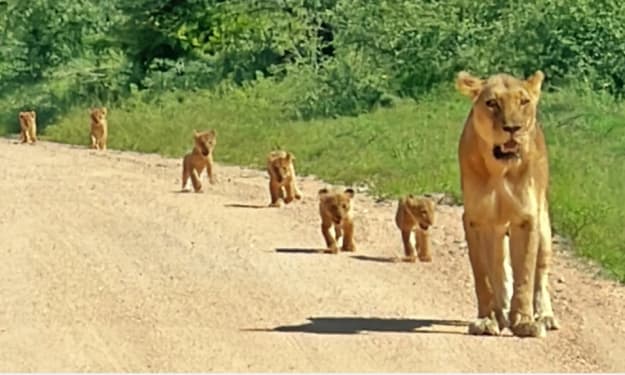
Tiny Lion Cubs Struggle To Keep Up With Mom
In the heart of the African savannah, life is a constant lesson for young animals. Few scenes are as endearing — or as heartwarming — as tiny lion cubs trying to keep pace with their mother. These little bundles of fur face a world full of challenges, from learning to hunt to avoiding dangers, all while depending on the guidance and protection of their experienced mom. Watching cubs wobble and tumble as they attempt to keep up with their mother reminds us that growing up, even in the wild, is a journey full of struggle, determination, and adorable missteps. The Early Days of Lion Cubs Lion cubs are born blind and helpless, usually in litters of two to six. For the first few weeks, they rely entirely on their mother for warmth, food, and safety. Even after opening their eyes and beginning to explore, the cubs are far from independent. The first months are crucial. Cubs learn social cues, hunting basics, and survival skills simply by watching their mother and the pride. But as anyone who has observed them knows, there’s often a huge gap between observation and action. Tiny cubs often struggle to match their mother’s pace, especially when she moves through long stretches of savannah or leads the family on patrols. A Mother’s Role in the Wild For a lioness, raising cubs is a full-time commitment. She hunts, defends her territory, and teaches her young, all while staying alert to predators such as hyenas, leopards, and even rival lions. The cubs, meanwhile, attempt to mimic her every move — often with clumsy yet charming results. A mother lion’s patience is remarkable; she frequently slows down, nudges them along, or stops to ensure no cub is left behind. These moments, while stressful for the tiny cubs, are vital learning opportunities. Struggling to Keep Up: Why It’s So Hard There are several reasons why tiny lion cubs have trouble keeping pace with their mother: Short Legs, Big Steps: Lion cubs’ legs are tiny and their coordination is limited, making it difficult to cover the same distance as an adult lioness. Curiosity: Cubs are naturally curious. A single butterfly or rustling bush can distract them, leaving mom to pause repeatedly. Energy Levels: Young lions tire quickly. Even with frequent naps, the cubs’ stamina is far lower than their mother’s. Learning Through Play: Play is not just fun; it teaches hunting, balance, and social skills. Running off to pounce on a sibling or chase an insect is all part of their education. Despite these challenges, the cubs’ determination to keep up demonstrates their resilience and growing understanding of the wild world. Lessons in Teamwork and Survival Every cub struggling to keep up is also learning crucial survival skills. The journey across the savannah is more than a test of speed — it’s a lesson in: Coordination: Cubs learn how to move efficiently across different terrains. Patience: They begin to understand the rhythms of adult life and the pace required for survival. Social Skills: Staying with the group teaches cubs how to interact with siblings and the pride, which is essential for their future roles. Observation: By following their mother, cubs study hunting techniques, territorial behavior, and predator awareness. Even the moments when cubs stumble or lag behind are essential for their development. These experiences prepare them for independence, which comes sooner than many might expect. The Cutest Moments in the Wild Anyone who has watched tiny lion cubs knows that their struggles are often irresistibly cute. Video clips from wildlife reserves frequently show cubs toddling along, tumbling over each other, or getting distracted mid-step. Observers often comment that these little stumbles reveal personality, determination, and playfulness, making them one of nature’s most heartwarming spectacles. While their mother is serious and focused, the cubs inject a sense of humor and lightness into life on the savannah. Why This Matters The struggles of lion cubs aren’t just adorable — they’re vital for understanding wildlife behavior. Conservationists and animal behaviorists use these moments to study growth patterns, social structures, and survival strategies in lion populations. These observations also highlight the importance of preserving natural habitats. Cubs must learn in a safe environment to survive; habitat loss, poaching, and climate change make these early struggles even more dangerous. Protecting the African savannah ensures that future generations of lions can experience the same lessons and playful tumbles. The Road to Independence Within a year, these tiny cubs will be more agile, faster, and more confident. By the time they reach two to three years old, males may begin to leave the pride, while females often stay and become caretakers themselves. Every misstep, tumble, and lagging moment is part of the journey toward strength, coordination, and independence. Watching them now gives us a glimpse of the challenges they will overcome, and the survival skills they will carry for life. A Celebration of Motherhood Ultimately, these scenes remind us of the incredible bond between mother and cubs. Her patience, vigilance, and teaching are the foundations of their future. The cubs’ struggles highlight the trials of growing up, while their determination showcases the resilience and beauty of wildlife. For those observing, it’s a powerful lesson in care, guidance, and perseverance, not just in lions but in the natural world as a whole. Final Thoughts Watching tiny lion cubs try to keep up with their mother is both entertaining and enlightening. It’s a story of growth, struggle, and resilience — a reminder that even the fiercest creatures start small, learning step by step. These little lions capture hearts while teaching life lessons: patience, determination, teamwork, and the importance of guidance. As they tumble and waddle across the savannah, they show us that growth is a process, one adorable misstep at a time. For wildlife enthusiasts, animal lovers, and anyone enchanted by nature, these tiny cubs are proof that even in the wild, love, care, and persistence are universal truths.
By Aarif Lashari7 days ago in Earth
Greenland’s Strategic Position in Seven Maps: Why Trump Wants the Island
In 2019, former U.S. President Donald Trump made waves by suggesting the United States should buy Greenland from Denmark. While his offer was quickly dismissed by the Danish government, the incident sparked a wider discussion about the geopolitical and strategic significance of the island. Why, out of all the territories in the world, would a major world power be so keen to acquire this cold, remote landmass?
By Muhammad Hassan4 days ago in Earth
📢 Raise Your Voice Thread: 01/22/2026
Our “Raise Your Voice Threads” are hosted most alternating Thursdays at 12PM ET to offer creators more avenues to uncover exceptional stories on Vocal. As we are continuously searching for fresh creators and inspiring stories, this thread provides an opportunity to exchange and discuss the stories that have moved and motivated us on Vocal.
By Raise Your Voice by Vocal4 days ago in Resources


Comments
There are no comments for this story
Be the first to respond and start the conversation.