
Did the Ancient Egyptians Reach the Americas and Australia?
historians have credited Christopher Columbus with "discovering" the Americas in 1492


For centuries, historians have credited Christopher Columbus with "discovering" the Americas in 1492. But what if long before Columbus set sail, ancient Egyptians had already crossed the vast oceans and made contact with the lands now known as the United States, Mexico, and even Australia? Some researchers and controversial findings suggest that ancient Egyptian explorers may have traveled farther than we ever imagined, leaving behind tantalizing clues that challenge conventional history. Could it be possible? Let's explore the evidence, theories, and ongoing debates.
Strange Egyptian Artifacts in the Americas and Australia
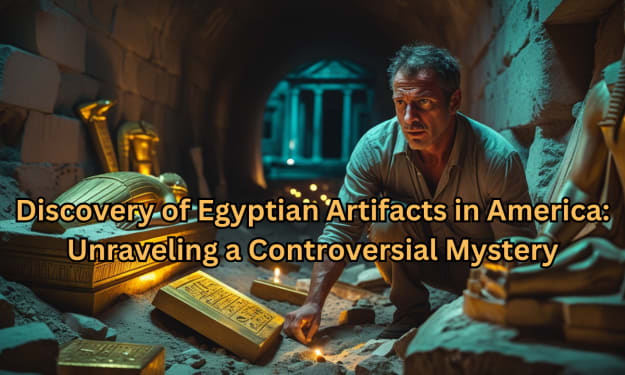
One of the most compelling arguments for an ancient Egyptian presence in the Americas comes from artifacts and inscriptions that some researchers claim to have discovered in North and South America. A particularly fascinating case emerged in the Grand Canyon, where a 1909 article in The Arizona Gazette described an alleged discovery of Egyptian-style artifacts in a hidden cave system. The report suggested that these objects, including statues, hieroglyphic carvings, and even mummies, could indicate that Egyptians had reached the Americas thousands of years ago. However, the Smithsonian Institution, which was supposedly involved, has since denied any such discovery.
Similarly, in Australia, researchers have uncovered mysterious carvings known as the "Gosford Glyphs" in New South Wales. These rock inscriptions resemble Egyptian hieroglyphs and have led some to believe that ancient Egyptians may have made contact with the indigenous people of Australia. While mainstream archaeologists dismiss these claims, calling them modern forgeries, proponents argue that the precision of the carvings and their linguistic structure suggest otherwise.
How Could Ancient Egyptians Have Traveled So Far?
Skeptics argue that ancient Egyptians lacked the technology to undertake transoceanic voyages. However, evidence suggests that they were more advanced sailors than many give them credit for.
Shipbuilding Skills: The Egyptians built sophisticated boats, as seen in the Khufu ship, a 4,600-year-old vessel buried near the Great Pyramid of Giza. If Egyptians could construct sturdy ships for river and coastal travel, could they have adapted them for oceanic voyages?
Papyrus Boats and Thor Heyerdahl's Ra Expeditions: In 1970, Norwegian explorer Thor Heyerdahl built and sailed a papyrus boat named Ra II from North Africa to the Caribbean, proving that such a journey was possible using ancient technology. If a modern researcher could achieve this, why not the ancient Egyptians?
Ancient Trade Routes: The Egyptians engaged in long-distance trade with civilizations such as the Phoenicians, who were expert navigators. If the Egyptians learned from or collaborated with Phoenician sailors, it’s not unthinkable that they could have ventured farther than previously assumed.
The Cocaine and Tobacco Mystery
One of the most controversial pieces of evidence comes from a study conducted in the 1990s on ancient Egyptian mummies. Researchers found traces of nicotine and cocaine in the hair of some mummies. These substances were native to the Americas and were unknown in the Old World at the time. How, then, did they end up in the bodies of Egyptian rulers?
Some scholars argue that the findings suggest transatlantic contact, with Egyptian traders obtaining these plants from South America. Others propose contamination or misinterpretation of results. Despite ongoing debates, the presence of these substances in mummies remains one of the most perplexing clues in this mystery.
The Cultural Parallels Between Egypt and the Americas
Beyond artifacts and potential travel routes, some theorists point to cultural similarities between ancient Egypt and pre-Columbian civilizations in the Americas.
Pyramids: The Egyptians and the Maya both built pyramids as monumental structures. While mainstream scholars attribute this to independent cultural development, some suggest that knowledge of pyramid construction could have been shared.
Solar Worship: Both societies revered the sun, with Egyptian deities like Ra paralleling Mesoamerican gods such as Tonatiuh of the Aztecs.
Mummification Practices: Some indigenous groups in South America practiced forms of mummification, leading to speculation that Egyptian influences may have reached the region.
Skepticism and Mainstream Views
Most historians and archaeologists remain unconvinced that ancient Egyptians made it to the Americas or Australia. They argue that the evidence is circumstantial, the artifacts questionable, and the theories speculative at best.
Critics also note that no confirmed Egyptian DNA has been found in pre-Columbian remains, and there is no clear archaeological proof of sustained contact between the civilizations. The Grand Canyon story, for instance, is widely considered a hoax or a misinterpretation of natural formations.
Yet, for every skeptical argument, there are unexplained anomalies that continue to fuel debate. Could mainstream history be missing a crucial chapter? Could a lost Egyptian voyage have reached distant shores, only to be forgotten in the sands of time?
What If the Theories Are True?
If the ancient Egyptians did reach the Americas and Australia, it would completely rewrite history as we know it. It would mean that global travel and cultural exchange existed thousands of years before previously believed, challenging Eurocentric narratives of exploration and discovery.
For now, the mystery remains unsolved, but one thing is certain—history is never as simple as we think. What other secrets are waiting to be uncovered beneath the sands of time?
Would you like to explore more of these fascinating mysteries?
Subscribe to PharaohX and uncover the untold stories of ancient Egypt!
About the Creator
PharaohX
Unraveling the mysteries of the pharaohs and ancient Egyptian civilization. Dive into captivating stories, hidden secrets, and forgotten legends. Follow my journey through history’s most fascinating era!
Can Global Peace Exist Without a Global Authority?
Can Global Peace Exist Without a Global Authority? The idea of global peace without a global authority sounds appealing to some people. In theory, nations could manage their own affairs, respect each other’s borders, and resolve disputes peacefully without an overarching institution telling them what to do. Supporters of this view argue that global bodies are slow, biased, and often ineffective. But history and current events raise a difficult question: can lasting global peace truly exist without a central authority to guide it?
By Wings of Time a day ago in History


Comments
There are no comments for this story
Be the first to respond and start the conversation.