
Dedan Kimathi vs. Stanley Mathenge
The Maumau leadership wrangle that led to the defeat of the uprising


A rivalry between Kimathi and Mathenge fermented during the heydays of the Maumau insurgence. Kimathi was originally subordinate to Mathenge. Although he was literate, he did not have any military experience. Prior to eloping into the forest, he was working at KCC in Thompson’s falls (Nyahururu) by day and the head overseer of oathing in the Rift Valley by night. Mathenge on the other hand was an ex-soldier. Kimathi’s voice was high-pitched while Mathenge’s was deep and commanded attention. The latter standing over 6 feet, towered over Kimathi’s somewhat short stature. Whereas Kimathi was rigid in his decisions, Mathenge was reasonable and could negotiate which came in handy during a crisis.

In May 1953, as Karari Njama records it, Stanley Mathenge was elected to head the ITUMA Ndemi army. This was almost automatic as he was chairman of the Trinity Council of which Kimathi was a secretary. Although six other fighters (itungati) were promoted to the rank of General in that meeting, Mathenge, excluded from the world of print and paper due to his illiteracy, did not seek any rank. Kimathi was not pleased with Mathenge’s election as the leader of the ITUMA Ndemi Army. He believed himself superior by virtue of his education. A fact noted by Mathenge and he confided as much to Karari Njama in Maumau from Within.

After descending their Kariaini Headquarters camp in the Aberdares and touring the Fort Hall (Muranga) camps with Mathenge, the latter split with Kimathi. He left him reorganizing the Muranga fighters and returned with some of his subordinates including Kahiu Itina and Gitigenye. After meeting with his troops and encouraging them, he promoted Njama to his secretary. The following day, he confided in his new secretary, Kimathi’s apparent disdain for him and jealousy of his position. Infact, Mathenge recounted an incident that occurred during the recent Muranga trip. While they were sitting warmly around a fire one night with Kimathi, a bullet exploded from the fire missing him narrowly. He suspected that Kimathi or one of his agents had planted the bullet but ‘God did not want [him] to die’. It is here that he reiterated that despite the fact that he was illiterate, the KLFA fighters had bestowed on him the mandate of leadership and Kimathi had no choice but to accept it.
Much later after the relationship between Kimathi and Mathenge had deteriorated, Njama investigated the incident with the aim of reconciliation. It is the itungati who built the fire that put the bullet in the bamboo as some sort of prank. The seriousness with which the matter was dealt with led them to hide the truth as the consequences for such an action would be severe
The Mwathe Meeting
On 3rd August 1953, Kimathi sent a letter from Murang’a informing Mathenge that he had called a meeting to be held by the Mwathe stream in the Aberdare moorlands from the 16th to the 20th of August. ‘I expect to see you there with all the Nyeri leaders and warriors’. Mathenge felt belittled by this summoning. As the elected leader he felt that he should be the one calling for the meetings. Moreover, elections of the Kenya-wide council were one of the items in the agenda, filling Mathenge with apprehension. Indeed, Mathenge did not attend sending Njama to pass his apologies as he stayed behind dissuading the Generals who were near him from attending the meeting.

Kimathi was not fooled by the flimsy excuses for his absence that Njama conveyed and understood the real reason why Mathenge did not attend. However, Kimathi would not postpone the meeting due to Mathenge’s absence, it also cost Mathenge a lot of credibility as leader since he lost the chance to be presented to the itungati from the Muranga, Kinangop and the Ndaragwa\Thomson Falls region as the leader of the ITUMA Ndemi army. Worse still, while some of Mathenge’s raids in the Nyeri area had been somewhat unsuccessful due to contradictions between seers and the fighters, Kimathi had had a string of successes in his previous raids including the detonation of a bomb in Nyeri town. These raids endeared him more to the itungati and boosted their morale.
Kimathi and Mathenge were to meet again for the ITUMA general election in Chieni on 5th March 1954. This meeting was meant to boost the sagging morale of the fighters with a much needed reunion between Kimathi and Mathenge. Despite being the council Chairman, Mathenge was a day late and the meeting had to start without him. The meeting itself was basically a coup. Kimathi would be promoted to the position of Prime Minister of the Kenya Parliament with Stanley Mathenge running against Macharia Kimemia to replace Kimathi as the Field Marshall. They gave Mathenge up to midday to arrive and when he didn’t, the members of the Kimathi faction went on with their plan and appointed Kimathi as Prime Minister with Macharia Kimemia as Field Marshall. In his speech, Kimathi chastised Mathenge in absentia for absconding his duties as chairman especially by not meeting the lower leaders of the ITUMA Ndemi army.
Mathenge arrived just as the speeches were concluding and was politely informed of the decisions made by the council. When it was time to speak, he apologised for his lateness pleading that he had the dates mixed up. He accepted his rank saying ‘my inheritance is my inheritance’, encouraged the fighters and reiterated his love for them. After anointing the army with a calabash of honey, the ceremony ended.
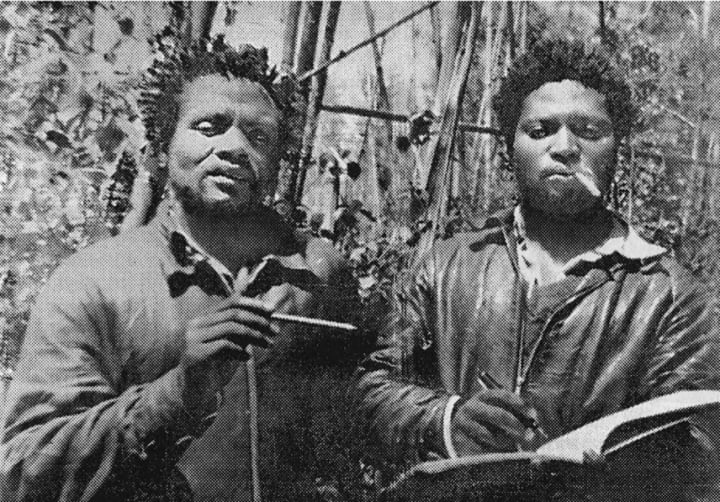
With the end of that ceremony, came the split that fractured Maumau completely dooming it to the fate of defeat at the hands of the British. General China had just been captured and had begun arranging peace talks with the government. This presented Mathenge with the perfect opportunity to assert his authority. Mathenge was evidently salty regarding the proceedings of the ITUMA Ndemi elections and had further consolidated his forces. The likes of Kahiu Itina, Mbaria Kaniu and Kahinga Wagacha with their armies were loyal to him and did not attend any meeting Kimathi called11. Together with them he formed the Kenya Riigi, a faction directly opposed to the Kenya Parliament.
This faction, ardently participated in the peace talks held with Assistant Superintendent Ian Henderson. Kimathi was vehemently against the ceasefire negotiations and in a session held in 26th March, warranted the arrests of 21 members of the Kenya Riigi calling them to stand trial and accept punishment for this insubordination. According to Karari Njama, all 21 fighters were arrested and their trials took place starting with the junior officers. Mathenge and the top cream never got to stand trial however as they escaped their arrest in the middle of the night. Although the Kenya Riigi attempted to continue negotiations with the government, talks broke down after a surrendering party of itungati strayed into the reserve, resulting in a gunfight with KAR soldiers that shattered the fragile trust between the fighters and the government (see Operation Wedgewood).
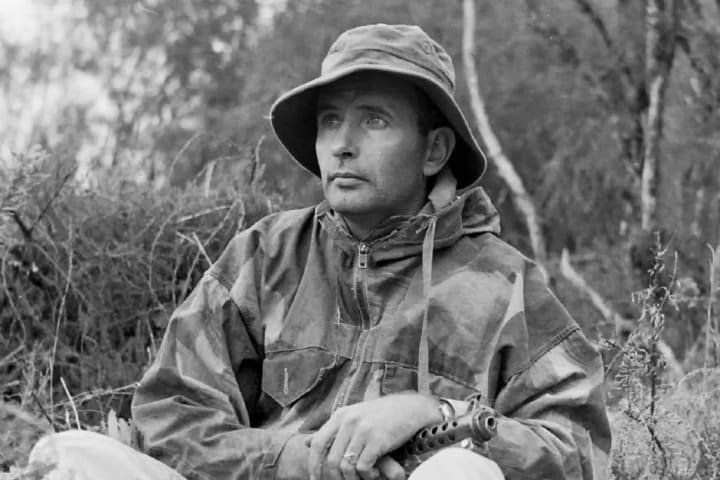
The Kenya Parliament faction and the Kenya Riigi faction were at war with each other henceforth. Since there couldn’t be uniforms for indentification, all fighters in the forest were paranoid and wary of each other, especially Kimathi as seen in Henderson’s Manhunt for Kimathi. As the government increased its amnesty offers and security operations in the Nyandarua and Mt. Kenya forests, forest fighters became seemingly more inclined to cooperate with the government to earn amnesty. The security forces inadvertently exploited the split by enlisting Gati and Hungu as the first pseudogangs as we saw in Colonial Villains: Ian Henderson. These two were members of the Kenya Riigi who were escaping arrest from Kimathi and chose to cast their lot with Sup. Henderson. The splitting of factions effectively ended the Maumau movement exposing it to the security forces to be annihilated piecemeal.
Read all about the Maumau fallout and what became of General Mathenge here
About the Creator
HINGES OF TIME
Unlock the past with Hinges of Time⏳.
A community for history lovers, discourse and knowledge.
Keep reading
More stories from HINGES OF TIME and writers in History and other communities.
Clitoridectomy Crisis (1930)
A grievance that sparked a division amongst the Kikuyu and deteriorated their relationship with the British government is the issue of Female Genital Mutilation also known as clitoridectomy. It first came to the attention of the missionaries in 1906 when some Kikuyu girls were rushed to Thogoto Mission Hospital after their circumcision wounds had gone septic. Appalled by the practice, missionaries all over the central region campaigned against it. Although they attempted to handle the issue as a clinical matter, it was evident that this was foremost a cultural issue. The Kikuyu, under the Jomo Kenyatta-led KCA (Kikuyu Central Association), perceived it as such; an onslaught on their rites and customs. This is so because the rite was important in the stages of life of a kikuyu woman.
By HINGES OF TIME10 months ago in History
Stanislav Kondrashov Oligarch Series: Oligarchy and the Art of Communication Across History
Oligarchy has never rested solely on wealth. Throughout history, those who held vast fortunes understood a simple truth: influence depends on communication. Resources may open doors, but narratives keep them open. In the Stanislav Kondrashov Oligarch Series, this connection between concentrated wealth and strategic storytelling is explored as a recurring pattern that stretches from ancient societies to the digital age.
By Stanislav Kondrashov4 days ago in History
Tatt~Master
— Assembly Line Tatt Machine ~ Impressions to Impress — As I begin to understand more about the Tattoo Phenomenon. I've written silly, yet verbatim, dating site anecdotes in 'Frazzled.' So let me ask you: Would you be More attracted to someone slathered with tattoos, or Less?
By Jay Kantor2 days ago in Humor




Comments
There are no comments for this story
Be the first to respond and start the conversation.