
Day 10: The Fall of Bhishma – A Turning Point in the War
Day 10: The Fall of Bhishma – A Turning Point in the War
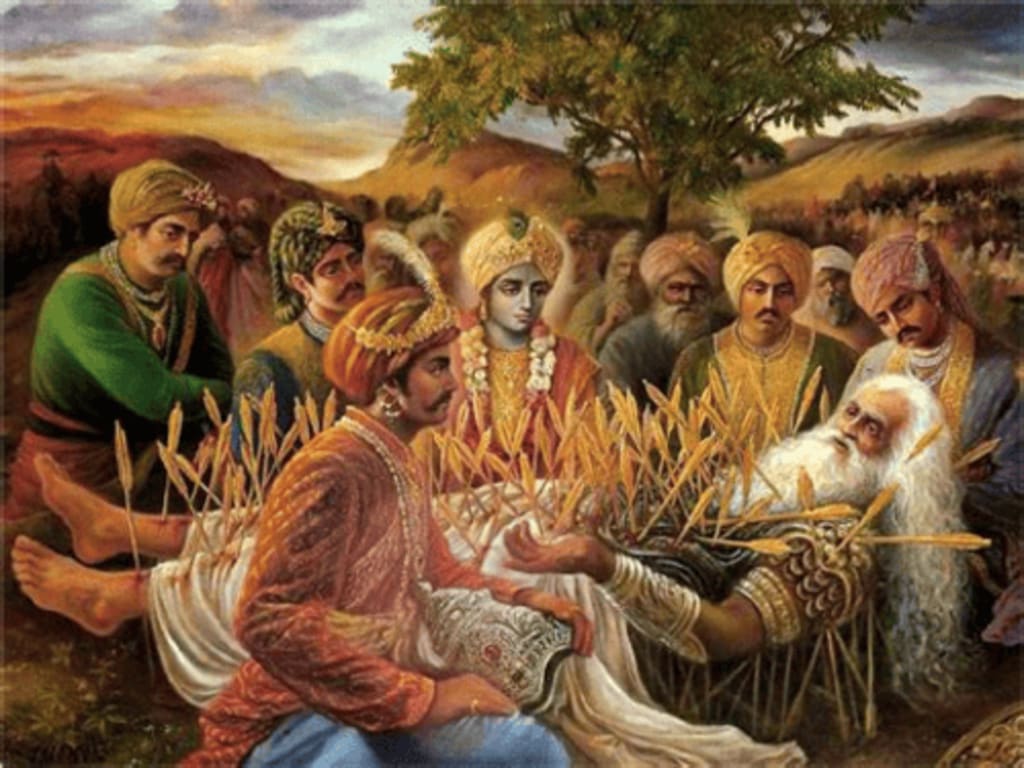
The tenth day of the Kurukshetra War marked a monumental moment in the epic conflict as the invincible Bhishma, the grandsire of the Kuru dynasty and the commander of the Kaurava forces, was brought down. This day saw the culmination of the Pandavas’ efforts to neutralize Bhishma, whose dominance had caused immense losses to their army. The events of the tenth day underscored the moral complexities and sacrifices inherent in the battle for dharma.
Preparations for the Tenth Day 23BF89
After nine days of relentless devastation caused by Bhishma, the Pandavas realized that they could no longer afford to hold back. Despite their reverence for Bhishma, it became clear that his removal from the battlefield was essential for their survival. Krishna, sensing their hesitation, reminded them of Shikhandi, the key to Bhishma’s downfall.
Krishna’s Strategy
Krishna devised a strategy to use Shikhandi, who was the reincarnation of Amba, a woman who had sworn vengeance against Bhishma. Bhishma had vowed never to fight a woman or someone who was perceived as one, making Shikhandi the ideal choice to confront him.
Kaurava Formation: Sarvatobhadra Vyuha (Omni-Protective Formation)
Bhishma arranged the Kaurava forces in the Sarvatobhadra Vyuha, emphasizing defense to protect Duryodhana and key warriors.
Bhishma, as usual, led the charge from the forefront, supported by Drona, Ashwatthama, and Kripa.
Pandava Formation: Krauncha Vyuha (Heron Formation)
The Pandavas countered with the Krauncha Vyuha, a heron-shaped formation designed for piercing enemy defenses.
Shikhandi was placed at the forefront of the formation, shielded by Arjuna and Bhima.
Yudhishthira remained at the center, guarded by Nakula, Sahadeva, and Dhrishtadyumna.
The Battle Begins
The day began with a fierce clash between the Pandava and Kaurava armies, with both sides displaying unmatched valor. Bhishma’s presence continued to dominate, as his arrows caused devastation across the battlefield.
Bhishma’s Relentless Assault
Bhishma, unyielding in his duty, led the Kaurava forces with the same brilliance and intensity as in previous days. His celestial weapons created havoc among the Pandava ranks, forcing them into defensive positions.
Shikhandi Steps Forward
As per Krishna’s plan, Shikhandi moved to confront Bhishma. Positioned at the forefront of the Krauncha Vyuha, Shikhandi unleashed a barrage of arrows at Bhishma. True to his vow, Bhishma refused to retaliate, recognizing Shikhandi as the reincarnation of Amba.
Key Battles of the Day
Bhishma vs. Shikhandi:
Shikhandi, driven by Amba’s vengeance, relentlessly attacked Bhishma, but his efforts were insufficient to bring him down. Bhishma’s refusal to counterattack allowed Shikhandi to maintain pressure.
Arjuna’s Role:
Arjuna, stationed behind Shikhandi, used the opportunity to target Bhishma. Under Krishna’s guidance, Arjuna unleashed a rain of arrows, piercing Bhishma’s armor and body.
Bhishma, seeing Arjuna’s involvement, acknowledged that his end was near. He praised Arjuna’s valor, recognizing him as the only one capable of bringing him down.
Drona vs. Dhrishtadyumna:
Drona, realizing the Pandavas’ strategy, attempted to protect Bhishma by engaging Dhrishtadyumna and other key Pandava warriors. Their duel was intense, but Dhrishtadyumna managed to hold his ground.
Bhima vs. Duryodhana’s Brothers:
Bhima continued his relentless assault, targeting Duryodhana’s brothers and the Kaurava infantry. His rampage created significant openings in the Kaurava formation.
Ashwatthama vs. Satyaki:
Ashwatthama and Satyaki clashed in a heated duel, with both displaying exceptional skill and courage. Their fight ended inconclusively as both were called to assist their respective formations.
The Fall of Bhishma
As the battle raged, Arjuna’s arrows, combined with Shikhandi’s relentless assault, gradually wore down Bhishma. Despite his invincibility, Bhishma chose to lay down his arms, allowing himself to be struck by Arjuna’s celestial arrows.0958E8
Bhishma’s body was pierced by countless arrows, creating a bed upon which he fell. Even in his defeat, his grace and composure remained intact.
As he lay on the battlefield, Bhishma declared his intent to wait for the auspicious time of Uttarayana (the northern solstice) to leave his mortal body. He praised Arjuna for fulfilling his duty as a warrior and offered blessings to the Pandavas.
The Aftermath of the Day
The fall of Bhishma marked a turning point in the war. The Kauravas, who had relied heavily on his leadership, were left demoralized, while the Pandavas gained renewed hope. Bhishma’s removal from the battlefield symbolized the inevitability of dharma’s triumph, though at great cost.
Casualties:
The Pandavas suffered moderate losses, as Bhishma’s attacks had weakened their forces earlier in the day.
The Kauravas faced heavy losses, both in terms of morale and manpower, following Bhishma’s fall.
Legacy of the Tenth Day
The tenth day of the Kurukshetra War is remembered as one of the most significant days in the epic. Bhishma’s fall highlighted the moral dilemmas and sacrifices inherent in the battle for righteousness. His decision to lay down his arms underscored his devotion to dharma and his acceptance of fate.
With Bhishma no longer leading the Kauravas, the dynamics of the war shifted dramatically. The Pandavas, inspired by their success, prepared to face the challenges ahead, while the Kauravas regrouped under Drona, who would take command on the eleventh day.
The tenth day remains a testament to the complexity of the Mahabharata, blending themes of duty, sacrifice, and the inevitability of divine will.
About the Creator
Keep reading
More stories from sai Charan and writers in History and other communities.
Day 9: The Unstoppable Bhishma – The Pandavas’ Breaking Point
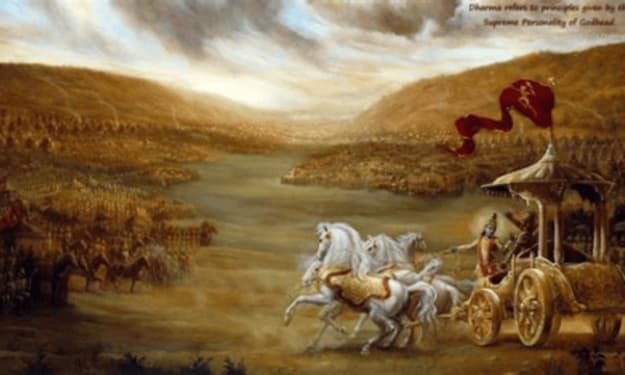
The ninth day of the Kurukshetra War was marked by unrelenting destruction as Bhishma, the Kaurava commander, unleashed the full extent of his might. His celestial weapons devastated the Pandava forces, leaving them desperate and on the verge of despair. The Pandavas, despite their efforts, struggled to counter Bhishma’s dominance. This day also saw growing tension between Krishna and Arjuna, as Krishna’s frustration with Arjuna’s hesitation reached a boiling point.310DDC
By sai Charanabout a year ago in History
The Eternal Triangle: The Story of the Egyptian Pyramids
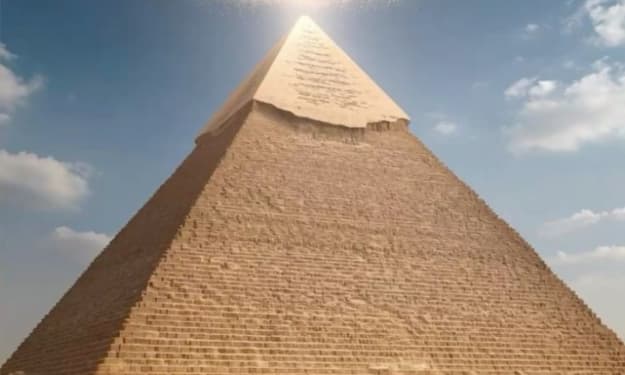
In the golden heat of the Egyptian desert, where the Nile River flows like a ribbon of life through endless sand, stand the greatest monuments of ancient human ambition—the pyramids. For over four thousand years, these towering structures have watched the rise and fall of empires, the march of armies, and the endless turning of time. They are not merely piles of stone; they are symbols of power, faith, and mystery. The story of the pyramids begins in the Old Kingdom of Egypt, around 2600 BCE, during a time when pharaohs ruled as living gods. The Egyptians believed that their king was not just a ruler but a divine being, chosen by the gods to maintain order in the world. When a pharaoh died, it was not seen as an end but as a journey into the afterlife. To ensure that their king would live forever among the gods, the Egyptians built massive tombs—structures that would protect the body and provide everything needed for eternal life. Before pyramids, royal tombs were simple rectangular structures called mastabas, made of mudbrick. But everything changed with Pharaoh Djoser. His architect, a brilliant man named Imhotep, had a daring idea. Instead of building a flat mastaba, he stacked smaller mastabas on top of one another, creating a stepped pyramid. Around 2630 BCE, the Step Pyramid of Saqqara rose toward the sky—the first large stone structure in history. It was a revolutionary achievement, marking the beginning of pyramid construction. As time passed, Egyptian builders sought perfection. They experimented with smoother sides and greater heights. Pharaoh Sneferu, father of the famous Khufu, was determined to create the perfect pyramid. His first attempt, the Meidum Pyramid, partially collapsed. His second attempt, the Bent Pyramid at Dahshur, changed angle midway because of structural concerns, giving it a strange shape. Finally, Sneferu succeeded with the Red Pyramid—the first true smooth-sided pyramid. Through trial and error, Egyptian engineers mastered the art of building monuments that could stand for eternity. Then came the age of greatness—the construction of the Great Pyramid of Giza. Around 2580 BCE, Pharaoh Khufu ordered the building of a pyramid that would surpass all others. On the west bank of the Nile, near modern Cairo, thousands of workers gathered. Contrary to old myths, these were not slaves chained in misery but skilled laborers, farmers who worked during the Nile’s flooding season when their fields were underwater. Stone blocks, some weighing up to 2.5 tons, were quarried and transported across the desert. Historians still debate exactly how they were lifted into place. Some believe ramps were built; others suggest clever systems of levers and sledges. Whatever the method, the achievement remains astonishing. Over 2.3 million blocks were arranged with incredible precision, forming a pyramid originally 146 meters tall. Its sides aligned almost perfectly with the four cardinal directions—north, south, east, and west—showing a deep understanding of astronomy. Inside the Great Pyramid were hidden chambers. The King’s Chamber held a granite sarcophagus, meant to house Khufu’s mummified body. Narrow shafts pointed toward specific stars, perhaps guiding the king’s spirit to the heavens. The pyramid was once covered in smooth white limestone that reflected the sunlight, making it shine brilliantly like a beacon. Near Khufu’s pyramid stood two others—built for his son Khafre and his grandson Menkaure. Together, they formed the famous Pyramids of Giza. Guarding them was the Great Sphinx, a colossal statue with the body of a lion and the face of a pharaoh, likely Khafre. The Sphinx symbolized strength and wisdom, silently protecting the royal tombs. But why did the Egyptians build such enormous structures? The answer lies in their beliefs. The afterlife was central to Egyptian religion. They believed that the soul had different parts—the ka, the ba, and the akh—that needed the body to survive. This is why mummification was so important. Organs were carefully removed, the body dried with natron salt, and wrapped in linen. Treasures, food, statues, and inscriptions were placed inside the tomb to serve the king in the next world. However, pyramid-building did not last forever. After the Old Kingdom, Egypt faced economic troubles and political instability. Later pharaohs built smaller pyramids or chose hidden tombs in the Valley of the Kings, like that of Tutankhamun. The era of giant pyramids faded, but their legacy remained. For centuries, the pyramids stood largely undisturbed. Ancient travelers marveled at them. Greek historian Herodotus visited in the 5th century BCE and wrote stories—some accurate, others exaggerated—about their construction. Over time, sand covered parts of the structures. Treasure hunters and grave robbers broke into tombs, stealing valuables. In modern times, archaeologists have studied the pyramids with scientific methods. Excavations revealed workers’ villages, tools, and even bakeries that fed thousands of laborers. These discoveries changed our understanding, proving that pyramid builders were respected members of society, not enslaved masses. The pyramids have also inspired countless myths. Some claim aliens helped build them, unable to believe that ancient humans could achieve such precision. But evidence shows the Egyptians possessed remarkable engineering knowledge. They understood mathematics, geometry, and organization. The pyramids are a testament to human capability—not extraterrestrial intervention. Today, the Great Pyramid is the only surviving wonder of the Seven Wonders of the Ancient World. Earthquakes have shaken it, stones have been removed, and its shining limestone casing is mostly gone, yet it still stands proudly against the desert sky. Tourists from around the world visit Giza, walking in the footsteps of ancient kings. As the sun sets over the Sahara, the pyramids glow in shades of gold and red. They remind us of a civilization that believed in eternity. Though the pharaohs are long gone, their monuments endure, whispering stories of ambition, faith, and the desire to conquer death itself. The Egyptian pyramids are more than tombs. They are bridges between earth and sky, between life and afterlife. They show what humans can achieve when driven by belief and unity. Thousands of years later, they still challenge our imagination and inspire awe. And perhaps that is their greatest mystery—not how they were built, but why they continue to captivate us. In their silent strength, the pyramids tell a simple truth: time may pass, empires may fall, but the dreams carved in stone can last forever.
By The best writer about 6 hours ago in History


Comments
There are no comments for this story
Be the first to respond and start the conversation.